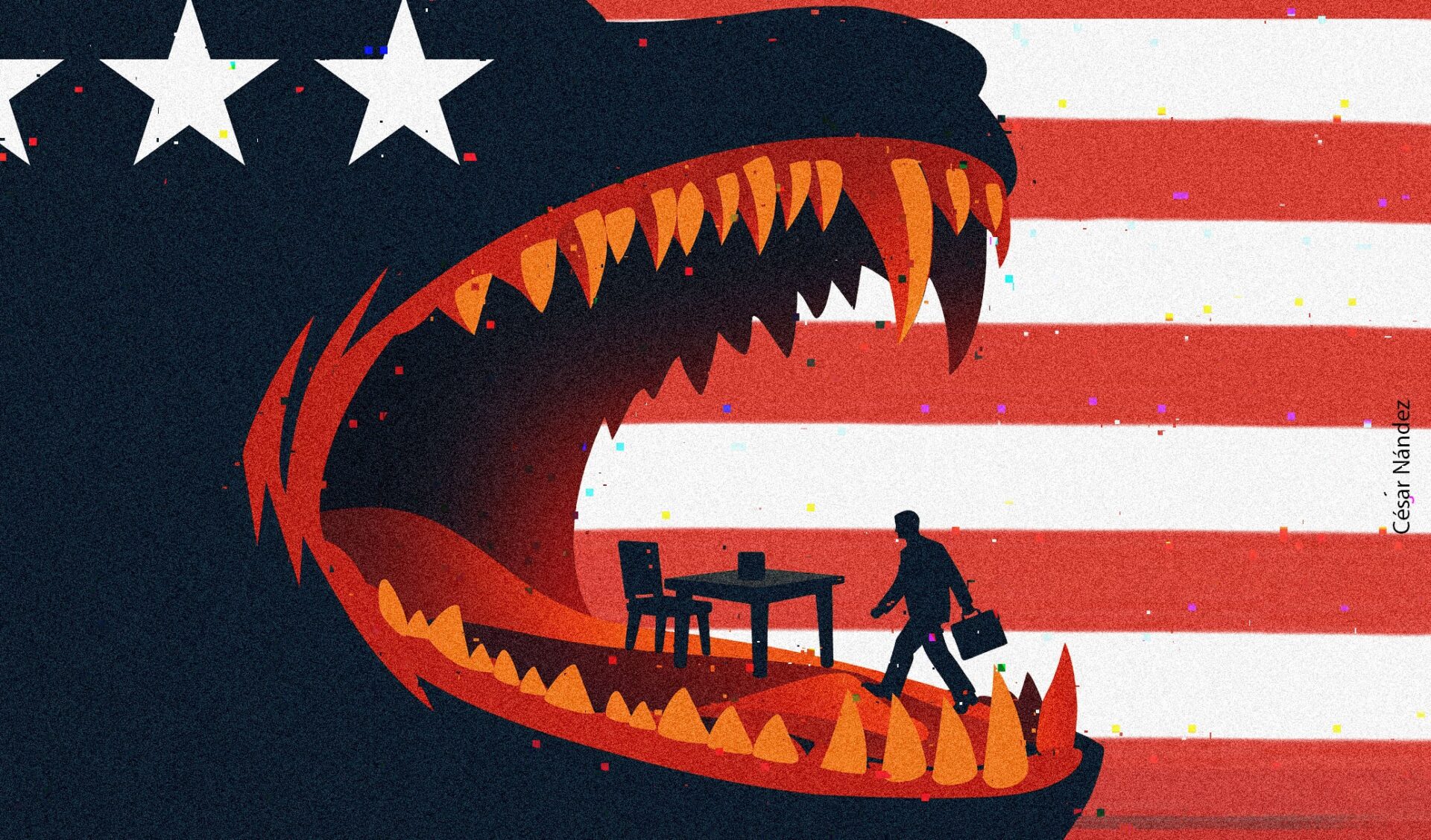
Who controls the weapons? Who controls the money? Who can accept losing an election without breaking democracy?
Political theory distinguishes two major types of transitions to democracy from authoritarian regimes, which in reality rarely occur in a pure form. On the one hand, there are negotiated transitions, based on agreements between sectors of the authoritarian regime and sectors of the opposition, usually involving moderate factions on both sides. These processes tend to produce institutional continuities, guarantees for outgoing elites, and amnesties, with gradual and controlled change. Chile and Spain are classic examples. Philippe Schmitter and Guillermo O’Donnell emphasized that this type of negotiation occurs mainly because no side has sufficient strength to impose itself decisively. The other major path to democracy is transition through regime collapse, whether due to economic crisis, military defeat, or civil mobilization. Argentina after the Malvinas War, as well as Greece and Portugal (1974), illustrate this trajectory.
A subsequent question emerged decades later: what kind of democracy remains after a transition, and with what real capacities? Several theories address this issue. Juan Linz and Alfred Stepan focus on the idea that leaving authoritarianism is not enough; democracy must be accepted by all actors as the only possible game in town. O’Donnell, for his part, observed that many transitions produce electoral democracies but not republican ones, introducing the concept of “low-intensity citizenship.” Adam Przeworski, from an institutional perspective, argued that democracy works when losers accept the outcome with the expectation that they can win future elections.

Venezuela is, for now, a laboratory for transition theory. With incomplete information and until the forces with electoral and veto power organize themselves, this is an extraordinary and still politically indeterminate event. That said, one intuition seems clear: Maduro’s arrest does not resolve the transition; it merely marks the beginning of the riskiest period, when it will be defined whether the process leads to rupture, a negotiated transition, or a hybrid experience.
Three possible trajectories
The first scenario is rupture. This would occur if Maduro’s arrest results in a collapse of command, combined with a loss of the regime’s coordination capacity. Cracks could open within the Armed Forces themselves, as well as the intelligence services, the police, militias, and local governments. The fragmentation of the coercive apparatus would open a window of opportunity for rapid reforms such as the release of political prisoners, electoral opening, or the dismantling of parallel structures. The main risk is falling into anomie and violence: reprisals, arbitrary detentions, communication censorship, and struggles by figures such as Diosdado Cabello, Padrino López, or local commanders to retain or expand their power—or the reconstruction of order by a new armed actor cast as a savior.
A second scenario would follow the logic of negotiated transitions. A return to institutional normalcy and the calling of elections would occur in exchange for guarantees such as exile, partial amnesties, and the preservation of quotas of economic or military power. The agreement would involve moderate sectors of chavismo, the opposition, and external guarantors. It would be a pact under a certain degree of coercion, in which key actors have not only the capacity to negotiate but also to enforce what is agreed, even if many of them are not democratic themselves. The risks are typical of democracies born of negotiated transitions: weak justice systems, a state that can be colonized by vested interests, corruption recycled into a new regime, and institutional concessions designed to ensure stability and pacification.
The third scenario is a tutelary transition. The opposition may gain power and achieve a change in the governing elite, but here regime change does not arise primarily from internal dynamics, but from intervention or supervision by external actors. Bosnia and Herzegovina (1995) or Iraq (2003) are extreme examples. The central risk is a severe legitimacy deficit, as democracy may appear to have been installed from the outside, with limited capacity to generate internal obedience. Added to this is the persistence of a chavismo without Maduro, surviving as a political identity anchored in territorial, economic, corruption, and drug-trafficking networks, reinforced by a narrative of foreign aggression.
Impunity or uncertainty
If a pact prevails, the transition to an electoral democracy may be faster, but players inherited from the previous regime—military officers, judges, intelligence services, or future legislators—retain power and privileges. This often translates into negotiations over impunity, slow institutional reforms, and areas of the state that remain under the influence of prior administrations.
If rupture prevails, democracy may be born with greater reformist ambition, but also with higher levels of economic uncertainty and lower initial trust in new actors, institutions, and elites.
The type of regime built in Venezuela will depend on the relative weight of actors—democratic or not—with the capacity to construct or veto agreements. Ultimately, success boils down to three questions: who controls the weapons, who controls the money, and who can credibly ensure that, if they lose elections—and with them privileges and impunity—they will continue to bet on democracy. In Venezuela, democracy may begin with winning an election, but it will only thrive when someone accepts losing one.
*Machine translation, proofread by Ricardo Aceves.
Autor

BA in Political Science from the University of Buenos Aires (UBA), specialization in International Relations, diploma from the INCAP School of Government. Analyst at the Institute for International Security and Strategic Affairs (ISIAE/CARI).