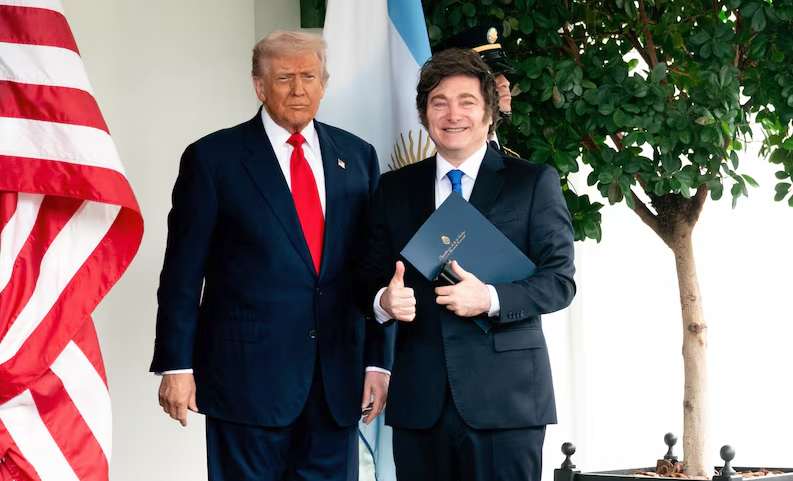
Argentina has just reached a new milestone in its renewed alignment with Washington. A few weeks ago, officials from both countries sealed the so-called Framework Agreement for Reciprocal Trade and Investment (ARTI). In Buenos Aires, the signing was celebrated as a triumph of economic openness and as a decisive step in the country’s reintegration into the world. However, ARTI is much more than a simple tariff pact. In its scope and demands, it is a perfect illustration of what the United States currently seeks in “its hemisphere” and what it is willing to offer.
Since Donald Trump’s return to power, U.S. foreign policy has shaken the global stage, and Latin America has once again become a primary focus for the White House. In just over a year, unprecedented episodes such as the capture of Nicolás Maduro and clashes with other regional leaders have raised alarm bells. But Washington does not operate solely through confrontation and the use of force. Quiet negotiations and diplomatic agreements like ARTI are the other side of that same strategy, and they are key to understanding the new order being designed for the southern part of the continent.

The agreement under scrutiny
Although official information about the treaty is limited and parliamentary approvals are still pending for its entry into force, the guidelines released by both governments make it possible to identify the nature of what has been signed. The document published by the Office of the United States Trade Representative (USTR) places particular emphasis on the trade chapter, detailing the conditions for Argentine products to enter the U.S. market. While, in general terms, the negotiation does not introduce major changes to the current flow between the two countries, a considerable benefit stands out for South Americans in the trade of beef.
The agreement increases the annual quota from the current 20,000 tons to a maximum of 100,000. This figure, which would quintuple current export capacity, ensures an additional inflow of foreign currency that is critical for Argentina as it seeks to meet its obligations to external creditors and stabilize its financial front.
Beyond strictly tariff-related matters, Argentina gains access through this agreement to the status of “Major Non-NATO Ally.” Beyond the title, this category would provide the country with key protection against the so-called Section 232 of the U.S. Trade Expansion Act. This regulation is the legal mechanism through which President Trump claims the right to impose discretionary tariffs on his current rivals, citing national security concerns.
For the Casa Rosada, the central value of what has been signed is the establishment of a framework of certainty in bilateral trade. The objective is to shield Argentine exports and prevent them from being subject to unforeseen tariffs, even if they are not entirely exempt from the fluctuations between the Oval Office and the Judiciary. In this way, ARTI seeks to guarantee a stability that transcends the political volatility of the moment.
Beyond trade, the agreement also includes Washington’s commitment to support investment projects through financial institutions such as the Development Finance Corporation and the EXIM Bank. It is important to clarify that these are not direct disbursements, but rather a political commitment to back projects in strategic resources. Within this framework, the lithium industry emerges as the main target, a sector viewed in Washington with particular attention.
The agreement establishes that this support will materialize as long as the projects involve U.S. companies. For Buenos Aires, this condition represents an opportunity that ensures its mining production enters directly into the U.S. supply chain, guaranteeing a major buyer and stability for its exports. But, on the other hand, it begins to set the limits of what Argentina will be able to negotiate with other actors interested in its resources.
Restrictions: the price of alignment
It is precisely at this point that ARTI reveals its most political dimension: the restrictions and conditions imposed on Argentina. These constraints are aligned with the White House’s central objective in the region, which is none other than to displace China’s influence from the hemisphere. The document mentions a series of vetoes and commitments that regional partners must accept in exchange for preferential access to the U.S. market.
Among the most notable points, Argentina commits to using only suppliers from “trusted nations” in critical sectors. The treaty explicitly mentions the nuclear technology and telecommunications sectors; a clause that, in practice, blocks the possibility of acquiring Chinese-designed nuclear reactors or using its 5G technology. At the same time, the agreement introduces a “mirror clause” regarding sanctions: Buenos Aires must apply restrictive measures similar to those enacted by the Oval Office and, moreover, make its best efforts to ensure that companies based in the country cannot circumvent Washington’s regulations to access the U.S. market.
Finally, control also extends to the entry of foreign capital. The country “self-commits” to informing the United States about incoming investments so that it can assess their national security risks. In addition, the Casa Rosada must combat the practices of state-owned enterprises controlled by third countries, in a clear reference to Chinese firms seeking to exploit local resources. Argentina secures U.S. technology and credit in exchange for closing the door to investments from the Asian giant in sectors that Washington considers vital to its security.
The pincer strategy and the end of ambiguity
This network of incentives and restrictions embodied in ARTI is not an isolated event, but rather the cornerstone of Washington’s new National Security Strategy (NSS). The document is unequivocal: the Western Hemisphere is the priority, and the incursion of extra-regional powers is no longer accepted. Under this logic, the White House operates through a pincer strategy over the continent. On the one hand, the arm of trade diplomacy—represented by ARTI—which rewards alignment with access to markets and financing. On the other, the arm of force and extreme pressure applied to hotspots that Washington considers a direct threat to its security.
Recent events in the region are the material execution of this strategy. The total energy blockade on Cuba or the capture of Nicolás Maduro are demonstrations that, for the Trump administration, U.S. strategic interests are above any diplomatic formalities. Washington will not allow countries in the region to seek the benefits of its security umbrella while maintaining China as their main commercial ally.
Far from the doctrines of free trade, U.S. trade policy today acts as an instrument of its national security: benefits for allies and isolation for the rest. Argentina has willingly entered this network, but the price has been to give up its freedom to partner with other global actors. ARTI shows that Buenos Aires’s alignment is no longer merely rhetorical, but a pact that exchanges cooperation in security for trade preferences.
The United States has taken note of China’s advance in “its hemisphere” and is pressuring local governments through a pincer strategy: conditional economic power or the use of military force. The countries of the south have been warned. Their future will depend on their ability to anticipate their relationship with the northern neighbor before the pincer finally closes around them.
Autor

Bachelor's degree in Economics (UNR) with postgraduate studies in Geopolitics (UNS). Currently pursuing a specialization in Argentine Economic Structure (UNDAV).