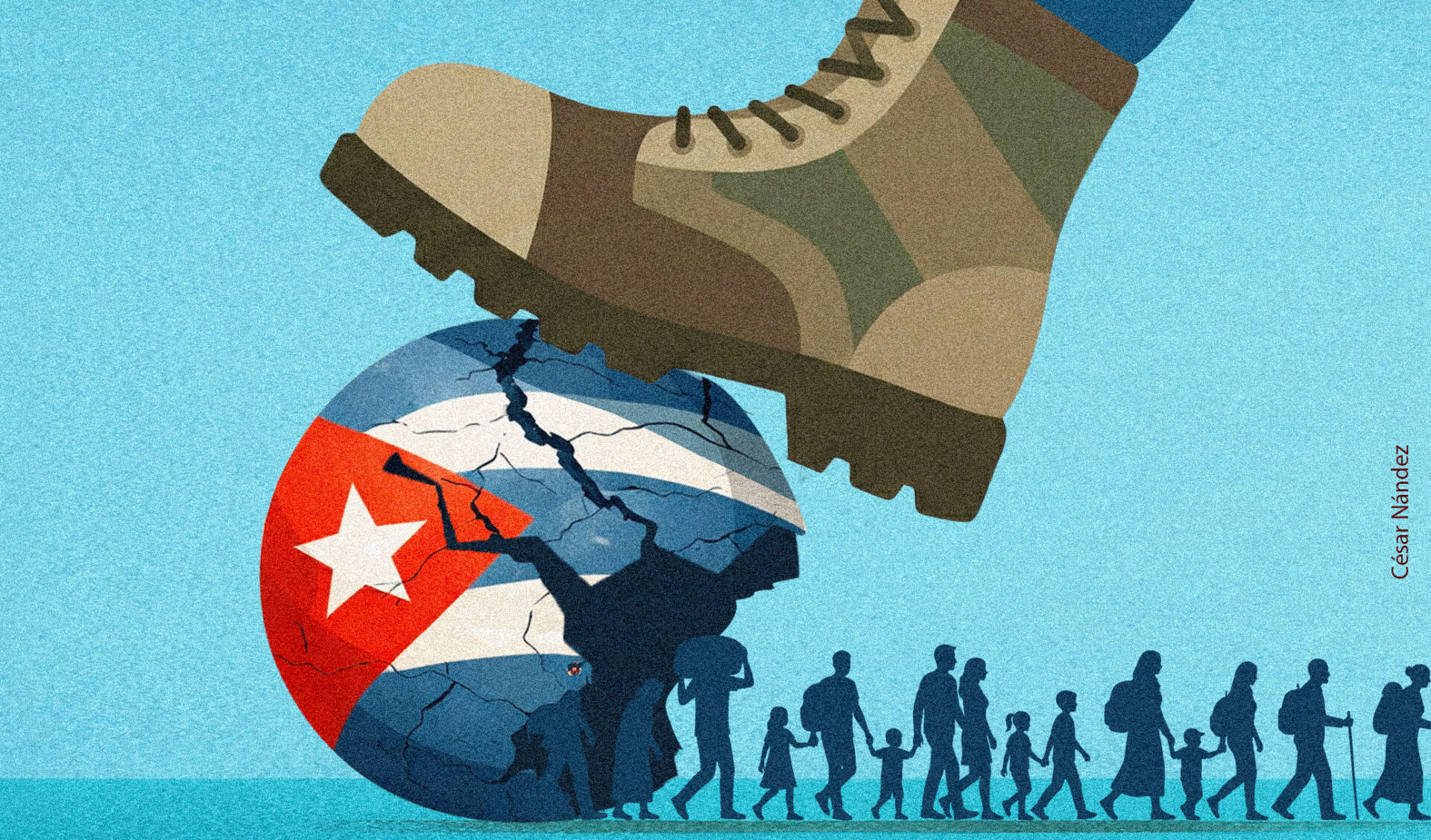
John Maynard Keynes once warned that “practical men, who believe themselves to be quite exempt from any intellectual influence, are usually the slaves of some defunct economist.” His thesis was not simply that bad ideas endure, but that when ideas are detached from the intellectual and institutional contexts that produced them, they acquire a dangerous autonomy. They migrate into power, are simplified, and begin to operate as moral imperatives rather than as arguments. The current convergence of Trumpism, Cuban American exile conservatism, select strands of migration economics, humanitarian language, and migratory flows illustrates this process with unsettling clarity, transforming Cuba from a real and complex society into a symbolic problem that demands historical closure.
Since the 1959 Revolution, Cuba has occupied a singular place in the U.S. political imagination. The overthrow of the U.S.-backed Batista dictatorship and the island’s rapid alignment with the Soviet Union constituted not only the emergence of an adversarial state, but a permanent affront to U.S. hemispheric authority ninety miles from Florida.

The Bay of Pigs invasion, the Missile Crisis, and decades of embargo, covert action, and diplomatic isolation fixed Cuba as a Cold War problem whose symbolic weight far outlived its strategic significance. Even after the collapse of the Soviet Union, Cuba’s survival remained, for many in Washington, an unresolved historical anomaly.
The brief normalization process under Barack Obama mattered precisely because it broke with this logic by treating Cuba as a normal state. Its reversal under Donald Trump, and now under Secretary of State Marco Rubio in his second term, has restored a Cuba policy organized around memory rather than management.
That politics of memory has long been mediated by the Cuban American exile community, particularly in Miami, where anticommunism hardened into a disciplined ideological regime. Rubio’s political trajectory exemplifies this structure. His rhetoric is not empirical but eschatological: socialism is always imminent, Cuba is always on the brink, and history perpetually demands a narrative of redemption.
Trump’s second term has supplied the governing temperament for this worldview, marked by indifference to norms, a preference for spectacle, and impatience with constraints—expressed most dramatically in the abduction of Nicolás Maduro and the effective seizure of Venezuela’s oil assets.
Within this political ecosystem, the work of George J. Borjas—a Cuba-born economist, raised in the United States and trained at Harvard—acquired relevance far beyond its original academic scope. Borjas’s central argument, developed in the early 2000s and later consolidated in his work on the economics of immigration, holds that increases in low-skilled immigration can exert downward pressure on the wages of certain native workers. His 2017 reanalysis of the iconic Mariel boatlift episode went further, arguing that it depressed the wages of low-skilled non-Hispanic workers in Miami.
These conclusions remain deeply contested by multiple studies. Even Borjas himself has acknowledged the sensitivity of his results to underlying assumptions. Yet once translated into political discourse, the nuances disappeared. Migration restriction ceased to appear as a policy option with trade-offs and instead became an apparent necessity. In Keynes’s sense, Borjas became the archetypal “defunct economist”: alive and cited, yet abstracted, with his work functioning as moral authorization rather than empirical argument.
What binds the memory of Miami exile, Borjas’s econometrics, and Cuba’s present crisis is a single political circuit. Rubio’s anticommunism supplies the moral script, Trump-era migration economics supplies the technocratic alibi, and executive power supplies the coercive capacity.
As economic collapse drives Cuban migration, the movement is reimported into U.S. politics as proof rather than consequence: evidence that socialism expels and borders must harden. Borjas’s wage effects, stripped of contestation, become the bridge between grievance and policy. Pressure produces migration, migration legitimizes restriction, and restriction authorizes more pressure. Cuba’s ruin thus becomes not a failure but a mandate.
Cuba’s history is far more ambivalent than exile narratives allow. Since 1959, the Revolution delivered genuine social achievements: near-universal literacy, life expectancy comparable to that of developed countries, a widely admired primary health care system, and a rich cultural life despite material scarcity.
At the same time, it consolidated a single-party state, repressed political pluralism, misallocated resources, and failed to sustain productive growth. The U.S. embargo, while insufficient on its own to explain economic failure, exacerbated inefficiencies and constrained adaptation. After the Soviet collapse, Cuba survived through improvisation, tourism, remittances, and partial reforms—neither prospering nor collapsing.
That fragile equilibrium has now broken. Cuba is experiencing its deepest economic crisis in decades, marked by sustained inflation above 20 percent, successive years of GDP contraction, and chronic shortages of food, fuel, and medicines. Tourism—the island’s primary source of foreign exchange—has collapsed under the combined weight of the pandemic, deteriorating infrastructure, and prolonged uncertainty. For years, Venezuela subsidized Cuba’s energy system, allowing the island to sustain its balance of payments through a fragile external energy arbitrage.
With the decapitation of the Maduro regime and the effective blockade of Venezuelan oil flows, this lifeline has been abruptly cut. Limited supplies from Mexico are insufficient. The result has been cascading blackouts that now structure daily life, paralyzing transport, manufacturing, and food distribution. Analysts note that Cuba’s remaining energy channels are narrow and easily disrupted, making further isolation relatively low-cost for Washington but economically devastating for the island.
Yet economic collapse has not produced rebellion. Fear of chaos, violence, and post-collapse retribution has reinforced elite cohesion and social passivity. Pressure hardens the state rather than fracturing it. What it does produce is migration. Cubans leave instead of rising up, and this movement crosses a crucial interpretive threshold. Economic suffering becomes political urgency abroad. At the U.S. border, causality disappears: sanctions and structural collapse are replaced by a moral narrative of people “fleeing communism.” Migration becomes proof, and proof becomes mandate.
Here humanitarian language functions as the final hinge. Sanctions sound punitive, embargoes aggressive, and invasion imperial, but “humanitarian intervention,” corridors, and stabilization sound reluctant and moral. Historically, this is how coercion crosses its final rhetorical threshold. Migration supplies urgency, humanitarianism supplies legitimacy, and force enters unnamed.
There are two iconic Cuban songs—Veinte años atrás, a habanera by María Teresa Vera, whose verses insist that a love that has already passed “should not be remembered,” yet nonetheless demands recognition; and Quizás, quizás, quizás, by Osvaldo Farrés—that map the emotional grammar of a Cuba suspended between a social contract that once promised care, love, and belonging and a future that offers neither clarity nor answer.
Keynes warned that ideas escape those who create them. Here we see something even more unsettling: mourning escaping its time and migrating into politics. Economics becomes moral, migration a mandate, and humanitarianism coercion—not out of singular cruelty, but because too many actors are trying to force history to resolve an unresolved nostalgia. And history, as Cuban popular music has long understood, does not respond to command or plea, but to the indefinite postponement of a reply that never quite arrives: perhaps, perhaps, perhaps…
Autor

Associate Research Fellow at ICAEPA, based in Sheffield, UK. Econometrician. Consultant in risk analysis, business intelligence, value chain analysis, and transfer pricing.