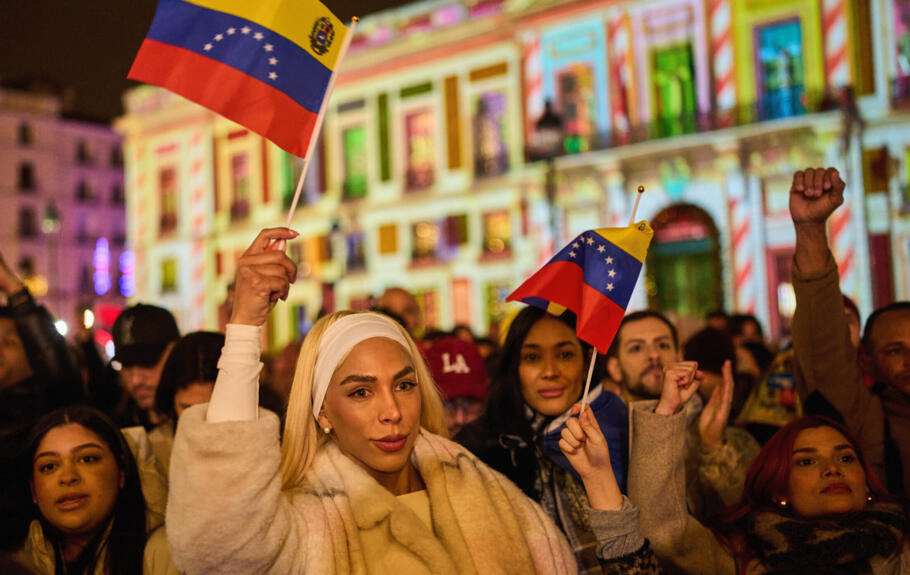
Two days after Maduro’s capture, before a thousand Venezuelans celebrating at the obelisk in the city of Buenos Aires, Patricia Bullrich—former minister of security and current pro-government senator—urged the crowd on: “Maduro is gone. (…) They took Maduro away.” To the audience’s ovation, she continued: “And now a path begins where all of you will return to your beloved Venezuela. Thank you very much. We’re going to miss you.” The crowd’s reaction shifted: few applause, some boos, much silence. The jarring contrast, which quickly went viral on social media, raises profound questions for Latin American governments: When will the 7.9 million Venezuelans be able to return to their country? Or, more pointedly, will they return?
Diasporas and return after conflicts
In situations of diaspora, as in the Venezuelan case, the premise of voluntary return to the country of origin faces complex questions: what happens when the conflict ends, but local integration has already taken place? After conflicts, return is usually limited and depends on multiple factors, among which security, institutional stability, economic prospects, and emotional and identity ties stand out. In general terms, diaspora populations tend to consider returning when they perceive that their country of origin offers minimum assurances of security and governability, along with reasonable economic opportunities.

In the absence of these elements, return is unlikely. Added to this is a complex emotional dimension, oscillating between identity attachment and commitment to national reconstruction on the one hand, and the new roots built after years of displacement on the other. These tensions explain why the bond with the country of origin—while it may translate into permanent repatriation—often takes alternative forms, such as remittances, investments, visits, or temporary returns.
Uncertain security and institutional stability
Following Maduro’s capture, the Venezuelan socialist state remains virtually intact. While the scope of President Trump’s words—“we are going to handle Venezuela”—is still unclear, what is clear is his administration’s backing of Delcy Rodríguez, Maduro’s vice president and loyal to the regime, as the new president. With her, the hard core of Chavismo, including Diosdado Cabello and Vladimir Padrino López, continues to govern. Political signals are contradictory. While Rodríguez’s government presents itself as cooperative with the U.S. administration, she herself declared, “We will never again be a colony of any empire.” And although the release of political prisoners has been announced—only some carried out—social organizations continue to report state violence and new detentions.
At the same time, Secretary of State Marco Rubio maintained that thinking about elections is premature, in line with the emphasis of Trump’s statements, focused on reaffirming the Monroe Doctrine and on the fate of Venezuelan oil resources, rather than on restoring democracy. The latter was not mentioned by Trump nor by any of the other speakers during the morning of January 3. Thus, the facts recorded in the first days suggest that a regime change leading to national reconstruction aimed at strengthening security and democratic institutional stability is extremely uncertain.
Economic uncertainty
Even if political conditions were to improve dramatically, economic prospects would remain bleak. First, it is not entirely clear what the Trump administration’s plan regarding oil is. What is certain is that Venezuela’s oil infrastructure lies in ruins after years of mismanagement and lack of investment. According to Bloomberg, a significant recovery of productive capacity would require an investment of around $100 billion—$10 billion annually for a decade. This challenge is compounded by a nearly 25% drop in oil prices over the past year, which seriously undermines the sector’s profitability. Thus, the possibility of a surge of investment into Venezuela does not appear likely.
Consequently, the economic incentive for Venezuelans to return and rebuild the country is uncertain. Moreover, many Venezuelan migrants have become economically established in their host countries. They have jobs, businesses, and professional networks. The opportunity cost of abandoning these hard-won achievements to return to an uncertain economic landscape is considerable.
The emotional and identity factor
Considering the emotional and identity dimensions of displacement is essential. After years of living elsewhere, love for the lost homeland becomes more complex. Consider adolescents born in the diaspora, children who are schooled, young people who fled to forge their future, and so many who have woven communities in their host countries. Their attachment to Venezuela is surely real and deep, but it coexists with an equally real attachment to the societies that received them and to which they have also contributed in multiple ways. Identity becomes transnational—a bridge connecting the homeland, the host country, and the global diaspora communities.
That complex love also coexists with the contradiction of a fractured national identity. Returning means returning to the place where what expelled them persists. This is not a matter of lack of patriotism or indifference. It is an identity process, characteristic of prolonged displacement, traversed by tensions and, in many cases, by the certainty of a definitive legal status in the host country, whether through residence permits or even naturalization.
Rethinking return
Return migration after a conflict rarely constitutes a linear process. In an optimal scenario, many Venezuelans will continue to maintain ties with their country of origin through remittances, investments, and periodic visits. Others will opt for forms of circular migration, alternating stays between both spaces. Likewise, many will continue to participate actively in promoting political change, while only some will return permanently with the aim of contributing to the country’s reconstruction. But expecting—or demanding—a massive repatriation ignores both the sociopolitical obstacles and the legitimate, complex lives that migrants have built. And it ignores that this has occurred not only with the express permission of host countries, but also alongside the political and electoral use of the Venezuelan conflict by those who govern Latin America.
The stark contrast of reactions at the Buenos Aires Obelisk should serve as a wake-up call. Host countries and the international community cannot expect an almost automatic return as a consequence of Maduro’s capture. Diasporas do not simply reverse with the end of conflicts, especially when the “supposed end” is marked by levels of uncertainty as high as those characterizing the Venezuelan situation. The silence at the Obelisk reframes the question: it is not about when Venezuelans will return or whether they will return, but whether Latin American societies are prepared to honor the complex reality of Venezuelan migrants and the legitimate decisions they make.
Autor

Sociologist from the National University of Cuyo and PhD in International Relations from Florida International University. Advisor at Pan-American Strategic Advisors. Postdoctoral researcher at the Steven J. Green School of International and Public Affairs at Florida International University.