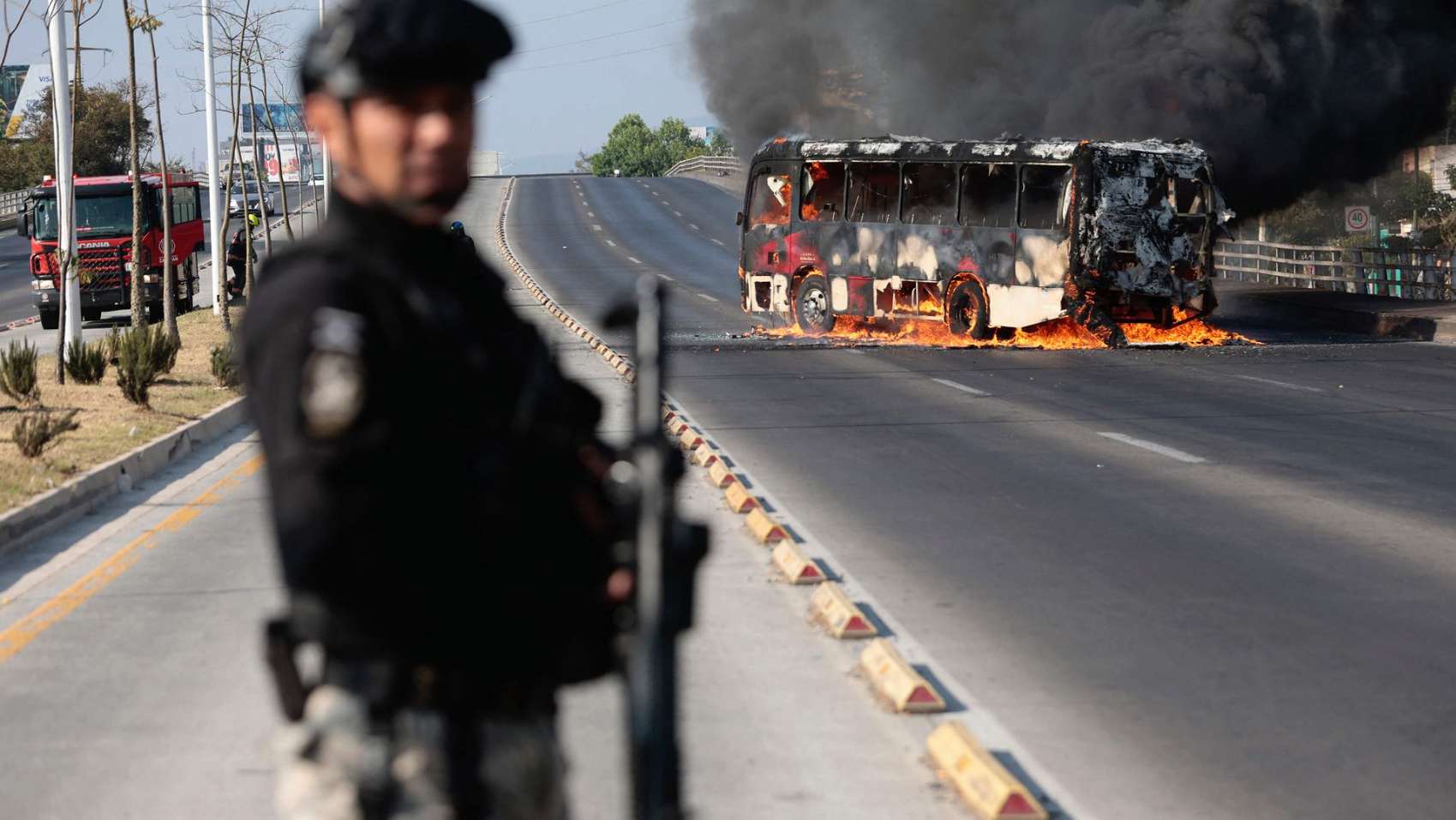
The images of burned vehicles, road blockades, and prison riots that followed the death of Nemesio Oseguera Cervantes in Jalisco cannot be read as isolated episodes or as mere emotional reactions from a wounded criminal organization. Nor are they an unexpected anomaly. They are part of a familiar sequence in contexts where the use of state force disrupts illicit equilibria without there being, at the same time, sufficient capacity to manage the consequences. The figure of at least 26 people killed, reported by La Jornada, is a stark reminder that organized violence rarely disappears with the removal of a single actor.
The New Generation Jalisco Cartel is neither an improvised structure nor one dependent exclusively on charismatic leadership. Reports from the Congressional Research Service and the Drug Enforcement Administration describe it as an organization with significant armed capacity, international expansion, and consolidated transnational networks. These characteristics explain why, following the fall of its historic leader, the response was not paralysis but a coordinated display of force: blockades, selective attacks, and the destabilization of everyday order.

The academic literature helps to make sense of this phenomenon. Research published in the Journal of Conflict Resolution shows that the effects of so-called criminal “decapitation” vary according to two key variables: the level of internal cohesion within the group and the state’s ability to rapidly occupy the power vacuums that remain. When these conditions are not met, violence tends to increase in the short term. In Mexico, this dynamic has been systematically documented by Guillermo Trejo and Sandra Ley, who have warned that organizational fragmentation, in the absence of effective state territorial control, produces internal disputes and the expansion of conflict.
The unrest following Oseguera Cervantes’s death also reveals another critical dimension: the operational resilience of illicit economies. The United Nations Office on Drugs and Crime has noted that criminal markets with robust financial infrastructure and diversified logistical control adapt quickly to leadership changes. In such cases, the problem is not the absence of a boss, but the persistence of economic incentives, routes, contacts, and corruption mechanisms that sustain illegal activity. Violence, then, becomes an instrument for redefining hierarchies and sending signals, both within the organization and to rivals and authorities.
This context explains why, alongside the violent incidents, speculation has emerged regarding possible implications for the 2026 World Cup. It is important to separate technical analysis from political noise. So far, there is no indication that FIFA has considered modifying the Mexican host venues. On the contrary, its president, Gianni Infantino, has publicly reiterated his confidence in Mexico as a host country. The relevant question is not whether the tournament is at immediate risk, but how security is managed in an environment where criminal reconfigurations may have deferred effects.
Major international events are not prepared based on certainties but on scenarios. Comparative experience indicates that succession processes within criminal organizations can extend for weeks or months, with intermittent peaks of violence. Ignoring this possibility would be irresponsible. At the same time, overstating it without empirical support would be counterproductive. The balance lies in strategic planning: constant monitoring, interagency coordination, and the preventive protection of critical infrastructure, especially in host cities.
Here, a structural problem emerges that goes beyond the CJNG. The Global Impunity Index indicates that Mexico continues to lag significantly in institutional effectiveness, criminal investigation, and penal enforcement. These weaknesses do not generate spectacular headlines, but they deeply condition the state’s capacity to transform tactical blows into sustainable results. Without solid institutions at the local level—professional police forces, effective prosecutors’ offices, and controlled penitentiary systems—each high-impact operation risks being merely an episode within a repetitive cycle of violence.
The penitentiary system deserves special mention. The Inter-American Development Bank has documented how Latin American prisons, far from neutralizing crime, frequently function as centers of operation and coordination. The incidents recorded in penitentiary centers following Oseguera Cervantes’s death reinforce this warning. Without prison governance, technological control, and external oversight, the deprivation of liberty loses its basic function as a public security tool.
The financial dimension is another decisive front. The United States Department of the Treasury has identified money-laundering networks linked to the CJNG that operate beyond Mexico’s borders. Targeting these structures does not produce spectacular images or generate immediate applause, but it directly reduces the regenerative capacity of organized crime. Financial traceability and the control of chemical precursors are, in this sense, security policies that are as important as—or more important than—high-profile arrests.
None of this implies downplaying the importance of eliminating criminal leadership. Rather, it means placing it in its proper dimension. Force without governance produces vacuums; vacuums produce disputes; and disputes translate into more violence for the population. International confidence, including that associated with events such as the World Cup, is not built by denying risks, but by demonstrating the capacity to anticipate and manage them.
Ultimately, security is not measured by the fall of a name but by the sustained reduction of violence and the strengthening of the rule of law. As long as strategy continues to privilege symbolic blows over institutional consolidation, each “victory” will carry a deferred cost. And that cost, as recent events show, is usually paid in lives.
Autor

PhD in Public Policy from IEXE University (Mexico). Master's degree in Public Security. Academic researcher. Organizational advisor to Mexican police forces and consultant in public and private security.