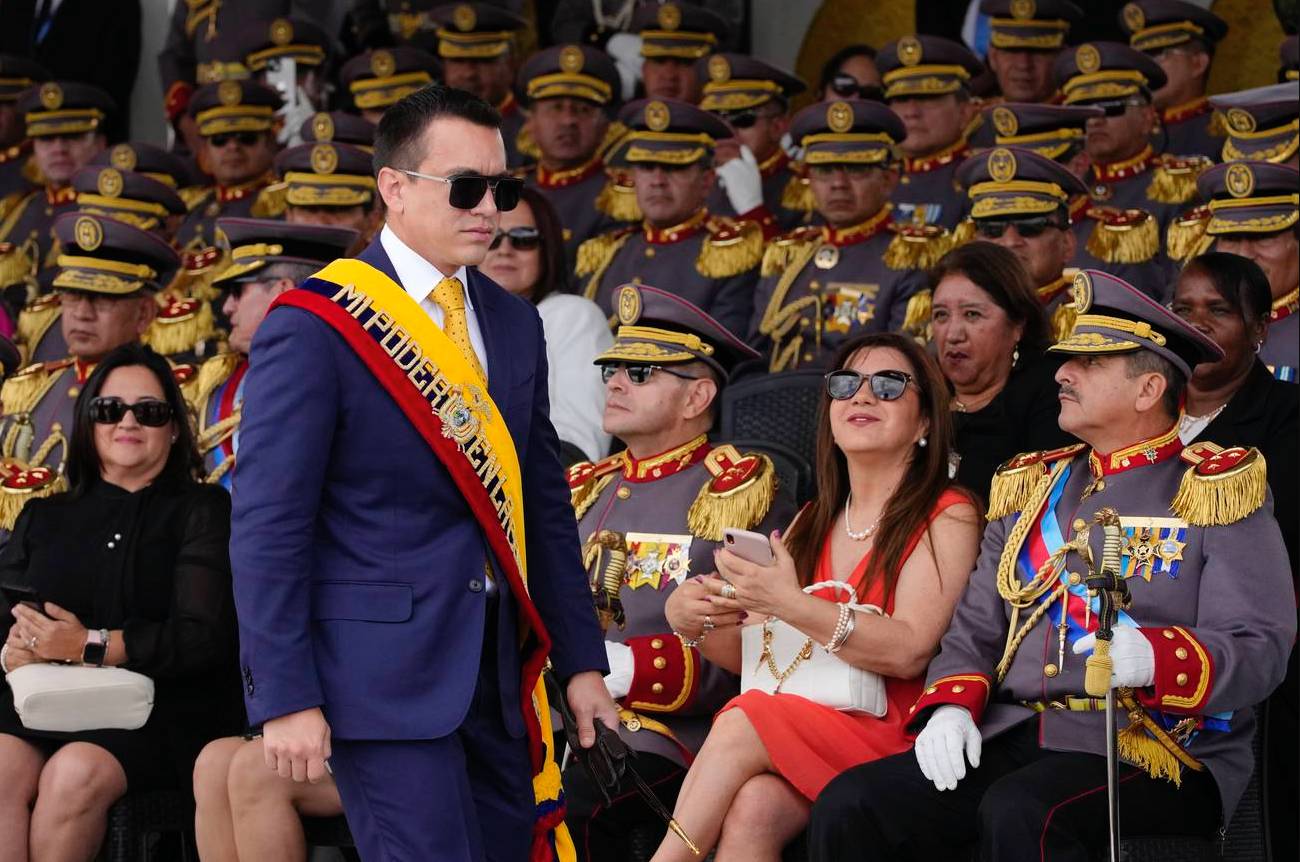
The government of Daniel Noboa, president of Ecuador, is showing increasingly consistent signs of an authoritarian drift. Gradually, the Executive is concentrating more and more power, checks and balances are weakening, and the rules of political competition are beginning to be reshaped from within the ruling camp itself.
Progressive concentration of institutional power
In the National Assembly, the ruling party has managed to build a functional majority by incorporating legislators from minor forces. This dynamic has not only facilitated the approval of government initiatives, but also weakens the role of the Legislature as an independent power and an effective counterweight.

This is compounded by influence over other key bodies. The Council for Citizen Participation and Social Control (CPCCS), responsible for appointing authorities, has shown behavior aligned with the logic of political power, while the Prosecutor’s Office and the Comptroller’s Office, in certain cases, project a selective performance that feeds perceptions of alignment.
At the same time, tensions with the Constitutional Court—including several episodes of public confrontation promoted by the Executive itself—reflect a dispute over the limits of institutional oversight.
Finally, some decisions by the National Electoral Council, such as bringing forward local elections, complete a scenario in which the rules of the political game cease to be a stable framework and become part of the contest itself.
Reconfiguration of the media ecosystem and pressure on the press
The relationship with the press has not been outside this process. A progressive reconfiguration of the information ecosystem can be observed, where traditional media operate under pressure, new digital actors aligned with the government emerge, and communication strategies are deployed to position the government’s narrative. The result is a reduction in informational pluralism.
Reports of pressure and interventions against critical media—such as the case of the Expreso newspaper of Guayaquil—illustrate this trend. Rather than a direct mechanism of censorship, what emerges is a more sophisticated scheme in which the combination of institutional harassment and economic incentives creates a less favorable environment for independent journalism. In this context, criticism begins to be treated as something to be managed.
Exceptionality as a tool of governance
Another relevant feature is the repeated use of states of emergency. What should in principle be an extraordinary instrument tends to become a habitual mechanism of governance, expanding the powers of the Executive and reducing effective political oversight of its decisions.
This trend is not neutral. The sustained application of restrictive measures in contexts of conflict has led to episodes that have generated public alarm, such as the case of the four children from Las Malvinas, in which the courts determined the responsibility of military personnel in a forced disappearance. More than an isolated incident, this case highlights the risks of prolonging logics designed for extreme situations. When the exceptional ceases to be temporary, the balance between security and rights begins to shift in a sustained way.
Tensions and redefinition of democratic rules
On a broader level, since the beginning of the government, decisions have been observed that strain basic norms of the democratic order. The police incursion into the Mexican embassy, for example, violated principles of diplomatic inviolability and set a precedent with significant impact on foreign policy and the country’s international perception.
Likewise, the decision not to hand over power to the vice president during the most recent electoral campaign raises questions about respect for the rules of competition and the institutional arrangements established for such scenarios.
These actions do not necessarily imply the formal annulment of norms, but they do alter their application. The interpretation of legality becomes increasingly flexible depending on political objectives.
Polarization as a tool of political structuring
The government seeks to organize the political system around defined antagonisms. The axis of confrontation is repeatedly framed in terms of the ruling camp versus correísmo, the current associated with former president Rafael Correa.
This cleavage simplifies the debate and frames competition within a binary logic that, in certain cases, facilitates the legitimization of controversial decisions. At the same time, it reduces the electoral space to two poles, limits the emergence of intermediate alternatives, and hinders the construction of consensus.
New actors, old methods
Contemporary democracies rarely collapse abruptly; rather, they tend to transform gradually through the accumulation of decisions. Ecuador has already undergone a similar process during the decade of Rafael Correa’s government, in which the concentration of power and pressure on the opposition consolidated progressively.
The current context is not identical, but it presents parallels in methods: centralization, reconfiguration of rules, and reduction of oversight spaces. When these processes become normalized—regardless of who governs—the risk is not only institutional erosion, but the redefinition of the boundaries of what is democratic.
Ecuador does not face a visible rupture of the democratic order, but rather a gradual transformation that, if not recognized, may ultimately redefine the rules of the political system in a lasting way.
Autor

Professor at the School of International Studies of the University of Azuay and former governor of Azuay during the government of Guillermo Lasso. Master's degree in Latin American studies, University of Salamanca, Spain.