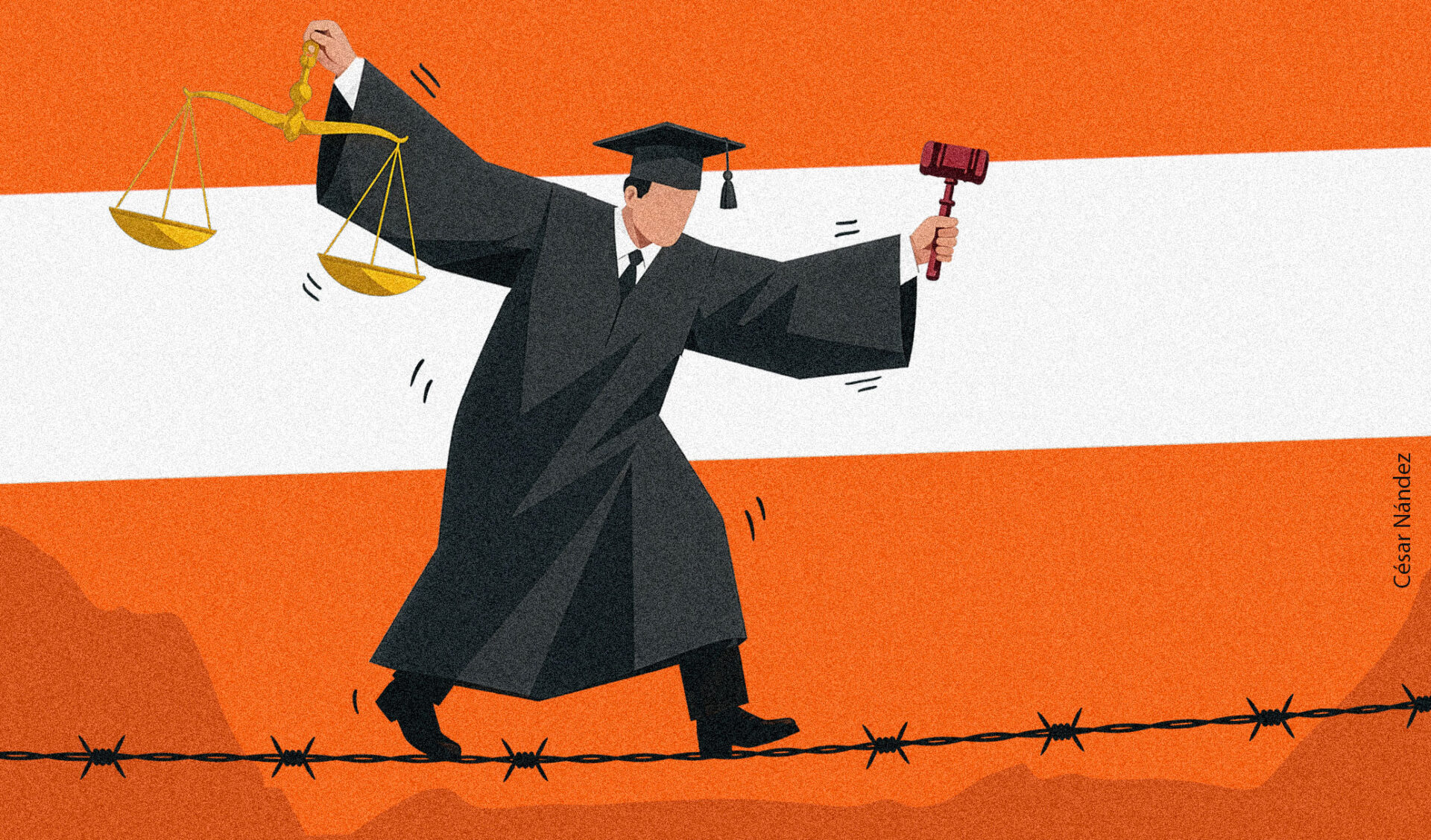
The winner of Hungary’s recent elections, Péter Magyar, described the defeated government of Viktor Orbán as a “criminal organization.” But beyond any crimes that might be proven, could the former president be convicted for attacking democracy and the rule of law? This is a key element in democratic transitions and the central issue for the future of Hungary’s democracy. History shows that when authoritarians have not been punished, often they have returned to power and attacked democracy again.
The history of how Latin America has addressed the legacy of dictators and would-be dictators—from the trials of Argentina’s military juntas in the 1980s to the recent trial of Jair Bolsonaro in Brazil—offers a historical lesson for Hungary. And perhaps also for the United States after the Trump era.

Democratic transitions, while they generate hope among much of the population, are also delicate, slow, and frustration-prone processes. Post-Orbán Hungary is and will be all of that. The crowds dancing in front of the Hungarian Parliament after Magyar’s victory recalled those who danced atop the Berlin Wall in 1989, and on Buenos Aires’ Avenida 9 de Julio in 1983. However, those were cases of political transitions from authoritarian regimes to democratic ones. Hungary’s situation is different, and we may be facing a new type of democratization process. It is not about the end of authoritarianism, but about the end of the “de-liberalization” of democracy.
What defined Orbán’s government as non-democratic was the enactment, since 2011, of sweeping constitutional reforms that entrenched conservative values, strengthened political control over the judiciary, altered electoral procedures, centralized power, and undermined human rights. The erosion of the rule of law, the dismantling of checks and balances, and the “colonization” of civic institutions, media, and independent state agencies by Fidesz transformed Orbán’s Hungary into a singular political regime.
Various scholars have described this regime as a mafia state, a hybrid democracy, a would-be fascist system, a form of legal authoritarianism, or an illiberal regime with autocratic features. Hungary was no longer a democracy, but neither was it a full-fledged authoritarian regime.
That said, Péter Magyar’s challenges will not be very different from those faced by Alfonsín in Argentina, Suárez in Spain, Wałęsa in Poland, or Frei in Chile—transitions to democracy that involved constitutional reforms, laws that established the supremacy of civilian authority, rehabilitated political parties, and expanded civil and political rights, without carrying out massive purges of the security apparatus, overhauling the entire judicial system, or prosecuting entire cadres of the previous regime.
In Argentina’s case, Raúl Alfonsín faced several military uprisings, and Adolfo Suárez had to contend with a coup attempt and far-right terrorism. Therefore, it is likely that the new government will face internal resistance and sabotage from Orbán loyalists, especially if it seeks to dismantle the obstacles imposed by the previous regime. This could generate instability and re-legitimize Orbán.
In this way, we may be witnessing a new type of democratization process, emerging from a regime that actively dismantled the rule of law and democratic institutions, but had not yet crossed the threshold into full authoritarianism—as evidenced by its electoral reversal.
Brazil and the United States followed a similar path recently, in 2022–23 and 2020–2021 respectively. Although in both cases we cannot speak of a “Trump regime” or a “Bolsonaro regime,” it is clear that both sought to subvert democracy, as shown by their respective coup attempts. By denying the results of the 2020 election and promoting lies about electoral fraud, Trump redefined populist politics, enabling and inspiring other leaders to deny the electoral legitimacy of their opponents. Trump’s attempted coup on January 6, 2021, encouraged others, such as Bolsonaro in Brazil.
One key difference is that Bolsonaro was tried for his crimes against Brazilian democracy, and on September 11, 2025, the Supreme Court sentenced him to 27 years in prison. Brazil thus set a precedent for democracies around the world. By contrast, in Trump’s case, justice was not done. He was allowed to launch a third presidential campaign and return to power.
If Péter Magyar is sincere in his desire to restore democracy, he will have to confront major challenges, especially in balancing justice, social and economic stability, and long-term viability. History teaches us that revenge alone leads to anti-democratic or technocratic outcomes. The challenge lies in how to integrate some of the authoritarian leader’s supporters into a more inclusive and egalitarian form of democracy.
Every time an anti-democratic regime falls, the key question arises: to what extent, and for how long, will justice be served?
Autor

University in Exile Research Professor and Professor of History en la New School for Social Research. Taught also at Brown University. PhD at Cornell Univ. He is the author of several books on fascism, populism, dictatorships and the Holocaust. His new book is "A Brief History of Fascist Lies" (2020).

Lawyer, professor, and researcher in the Area of International Studies, School of Politics and Government, National University of San Martín. Postdoctoral fellow at the New School for Social Research, New York. Specialized in international criminal law, constitutional law, and human rights.