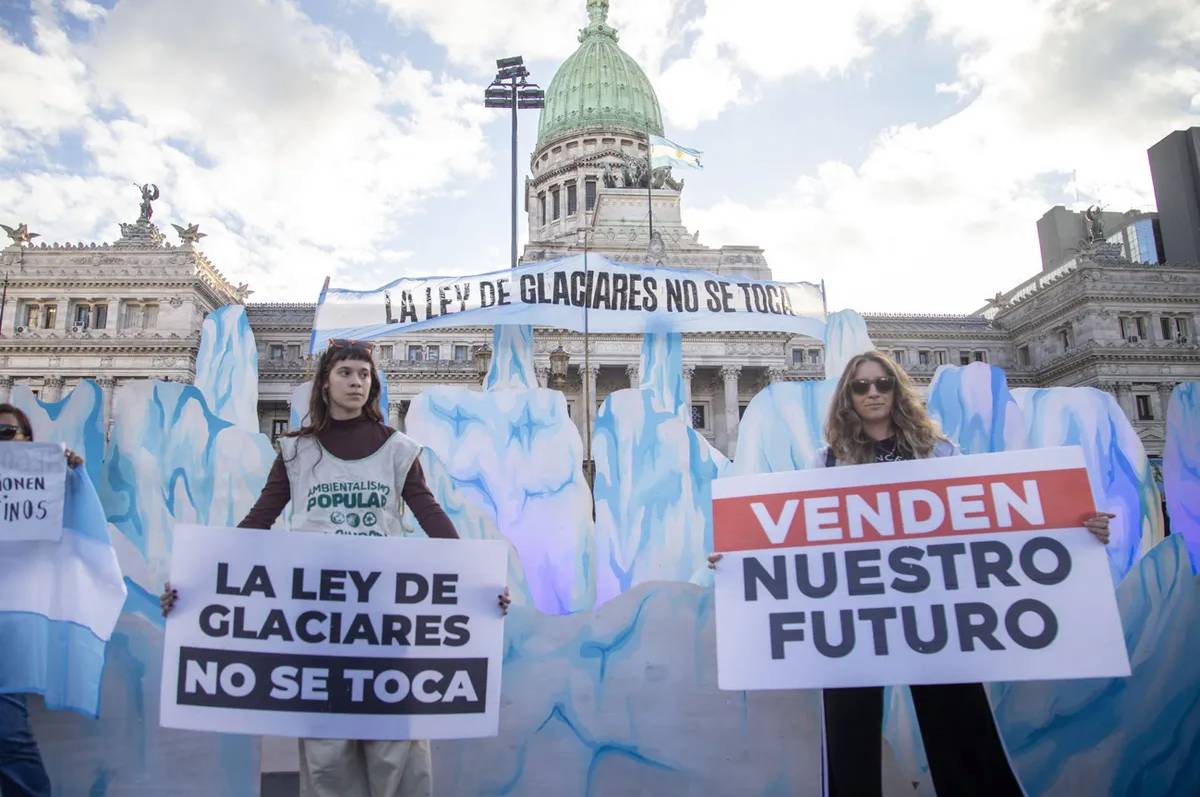
In a country marked by recurring economic crises, the promise of billion-dollar investments and job creation often emerges as an immediate solution. However, when economic growth comes into conflict with essential natural resources, an unavoidable question arises: how far are we willing to go? The recent reform of the Glacier Protection Law has once again placed that dilemma at the center of Argentina’s political and social debate.
Glaciers are strategic freshwater reserves and, for that reason, Argentina should maintain strict environmental protection against the advance of mining activities. The relaxation of these regulations represents an environmental risk that would be difficult to reverse and prioritizes short-term economic gains over resources that are fundamental for future generations.

The reform of the glacier protection law
The reform was approved by Congress with 137 votes in favor, 111 against, and 3 abstentions. The government argues that the changes will attract foreign investment, increase exports, and generate employment. From this perspective, mining is presented as a key driver of economic development, particularly given the growing international demand for minerals such as lithium and copper.
This is not the first attempt to modify the law. In January 2024, the so-called Omnibus Bill included changes to the legislation, but the proposal failed amid opposition from more than 150 environmental organizations. This time, however, despite a massive protest led by environmental groups outside Congress, the ruling coalition succeeded in turning the reform into law with the support of allied legislators and governors from Andean provinces.
The changes are significant: the reform redefines the concept of the “periglacial environment,” limits protection only to glaciers that fulfill an “effective and relevant hydrological function” for watershed recharge, and transfers to the provinces the authority to authorize activities in areas that were previously subject to absolute protection.
Glaciers: An invaluable water legacy
According to the National Glacier Inventory, Argentina is home to 16,968 ice bodies covering approximately 8,484 square kilometers—an area equivalent to 41 times the size of the City of Buenos Aires. The vast majority are located along the Andes mountain range.
According to the United Nations, glaciers store nearly 69% of the planet’s freshwater, and between 2000 and 2023 they lost an average of 273 billion tons of mass per year, contributing to rising sea levels. The World Meteorological Organization (WMO) also warns that 2025 ranked among the three warmest years on record, with an average temperature 1.44°C above pre-industrial levels.
Scientific projections indicate that before 2030, most Andean glacial basins will reach their peak water contribution. After that point, glaciers will no longer be able to sustain their historic contribution to river flows, and water availability will begin to decline steadily.
The economic argument
Those who support the reform are not without arguments. Growing global demand for critical minerals positions Argentina as a strategic player in the energy transition: the country possesses significant reserves of lithium—essential for batteries and energy storage—as well as copper. The national government and governors of mining provinces argue that the reform was an indispensable condition for attracting international investment.
The figures support part of this enthusiasm: in 2025, mining exports exceeded US$6 billion, setting a historic record and accounting for 6.9% of Argentina’s total exports. The sector estimates that major copper projects alone could attract nearly US$20 billion in investment and place Argentina among the world’s leading producers of the mineral.
However, despite record export levels, mining represents only around 1% of Argentina’s GDP—a strikingly low proportion for a country that holds a significant share of the world’s mineral resources. The gap between potential and the sector’s actual contribution to the national economy raises questions about the extent to which mining development has translated into economic benefits for the country as a whole.
The problem is not mining, but its limits
The issue lies not solely in mining activity itself, but in the limits established for carrying it out. Glaciers and periglacial environments serve a vital function: they supply water to millions of people, regulate ecosystems, and help mitigate the effects of climate change. Allowing extractive activities near these areas increases the risk of contamination, disruption of watersheds, and irreversible environmental damage.
As industrial water use for mining expands, access to water for small and medium-sized agricultural producers and local communities becomes increasingly restricted. Documented consequences include poisoning, loss of wildlife, water and soil contamination, and the progressive degradation of ecosystems.
Furthermore, numerous experts and environmental organizations warn that once these ecosystems are affected, recovery can take decades—or may even be impossible. In a global context where access to freshwater is becoming increasingly critical, weakening environmental protection mechanisms appears both contradictory and dangerous.
Although supporters of the reform argue that technological advances can reduce the environmental impact of mining, relying solely on future controls does not guarantee that damage can be prevented. Experience has shown that economic interests often prevail over environmental regulations.
Environmental federalism: Solution or risk?
One of the reform’s central pillars is the delegation of authority to the provinces, a concept the government describes as “environmental federalism.” The argument is that provinces own their natural resources and should therefore enjoy greater autonomy in managing them.
However, when dealing with water resources shared among provinces—as is the case with the watersheds of the Andes—regulatory fragmentation can create conflicts of interest and gaps in protection. A glacier that feeds an interprovincial river can generate impacts that extend beyond the boundaries of a single jurisdiction, making coordinated management mechanisms necessary. Law 25,688 on Water Environmental Management promotes the integrated management of watersheds, recognizing that their administration requires coordination among the various jurisdictions involved.
Conclusion: Water cannot wait
Argentina should not be forced to choose between economic development and environmental protection. The real challenge lies in building policies that enable growth without compromising resources essential for life. When water is put at risk, the debate is no longer just about a law—it is about the future of an entire country.
Andean glaciers are already retreating as a result of climate change. Relaxing their legal protection now amounts to accelerating an already alarming process and that, according to scientific projections themselves, will become critical before 2030. Faced with this reality, the question is not whether water is more important than mining revenues—it is whether we are willing to bear the cost of a decision that could prove irreversible.
The Glacier Protection Law should not be amended with immediate investments as the sole consideration. Because the water protected today will be the same water that millions of Argentinians will need tomorrow.
Autor

A lawyer trained at the Argentine University of Business and a legislative advisor. A role model for young people advocating for stronger institutions and a better country.