Is my president a dictator? Is he a tyrant? Do I live in a democracy? These are some of the questions many seem to be asking themselves these days without finding clear-cut answers amid an environment marked by deep political polarization that is confronting virtually all of humanity.
Part of the problem lies in the fact that the categories developed by the social sciences, particularly political science, respond to strict criteria that make it possible to establish a somewhat clearer typology of forms of government, but which are unable to keep pace with the mutation that current political actors are promoting within the system.

During the process of liberalization and democratization in the 20th century, identifying a dictatorship was relatively easy. A ruler would concentrate power around himself and his family, almost always through a coup d’état supported by the country’s armed forces or by some group of rebels who used force to seize and retain power.
Academia and international organizations denounced these types of governments because they prevented the population from exercising its right to participate in decision-making. In this way, backed by arguments developed in universities, think tanks, and multilateral forums, some governments in the Global North became promoters and champions of the fight against dictatorships and coups d’état, and fervent defenders of democracy.
This agenda brought an end to several dictatorships in Latin America, Africa, and, to a lesser extent, Asia. The mechanism for achieving the transition involved the imposition of diplomatic and economic sanctions and, in some cases, even military intervention. This prompted two types of responses from two opposing segments.
On the one hand, certain political sectors, particularly on the left, questioned the messages in defense of democracy, branding the criticism and acts of force directed at governments born out of popular revolutions with socialist aspirations as hypocritical and interventionist.
At the same time, a model of “evolutionary technical adaptation” began to take shape.
The 21st century began with a turn toward democratization that was applauded and warmly welcomed, particularly by liberal currents, as it was believed that humanity had learned from its mistakes and embraced democracy as the perfect model. What was not recognized in time was that authoritarianism had not disappeared, but rather had learned to camouflage itself.
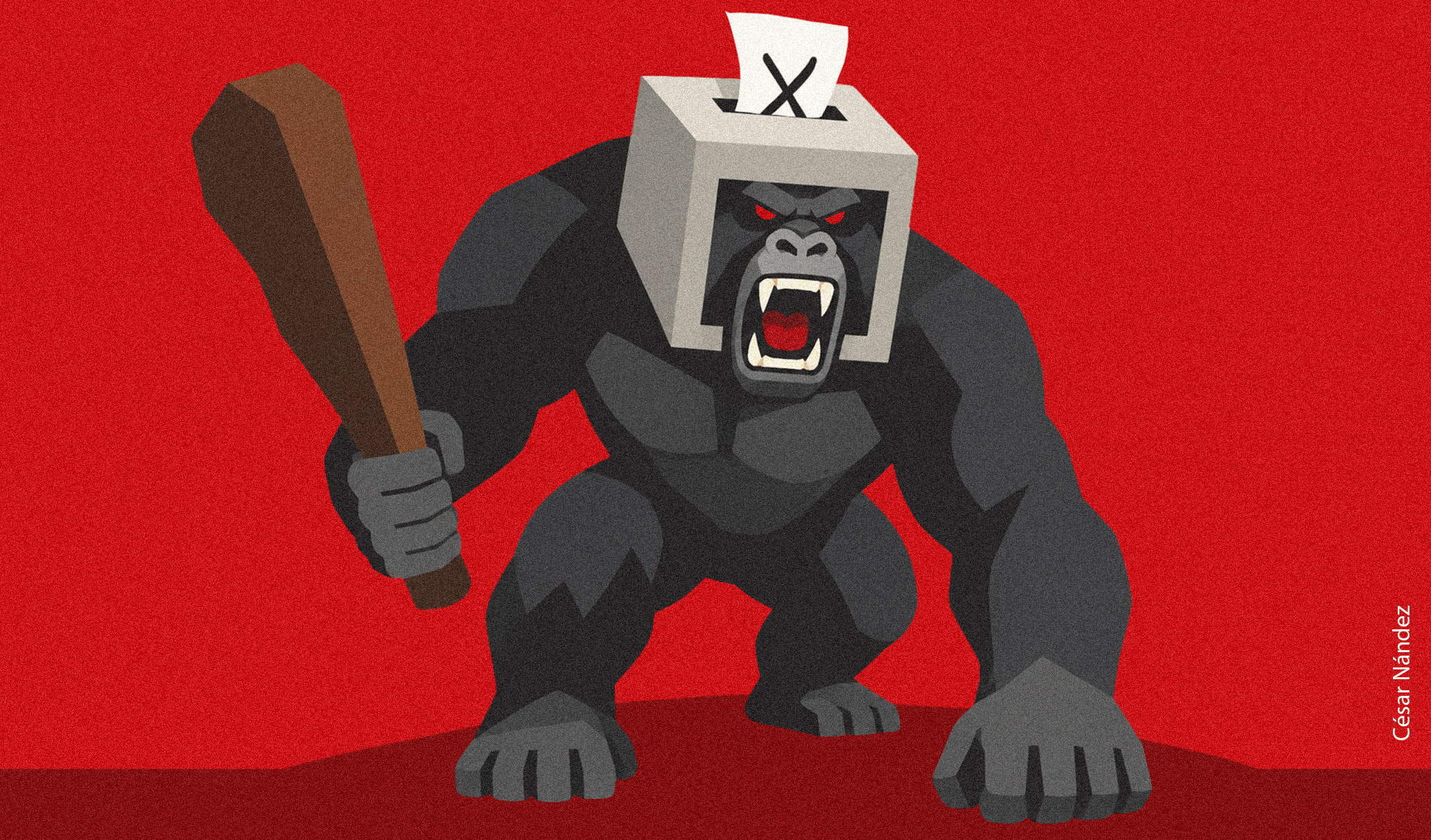
While some sectors questioned the legitimacy and usefulness of the social sciences, political advisers incorporated their findings in order to consolidate campaign and governing strategies that would guarantee impunity. If the risk for an authoritarian leader was being identified as such because of the way he came to power, then the best way to avoid rejection was to come to power through an election. Thus was born oclotyranny (from the Greek ὄχλος (ókhlos), meaning “mob,” “crowd,” or “the masses,” and the Latin tyrannus, an illegitimate ruler or a single man).
On a microscopic scale, this is what some viruses do to enter the body: they adapt, mutate, and change their composition so that the defenses do not react in time. The common flu virus does not go around announcing itself as an infectious agent; rather, it evolves in order to camouflage itself. Oclotyrants are doing the same thing.
These leaders arrive with proclamations of salvation and change that, although they fit within populism and demagoguery, are not alien to democratic debate. In this way, the electorate fails to identify the threat. In fact, it becomes part of a process of political community, turning into a fervent defender of a process that has not yet even begun.
And the oclotyrant does not act without a solid base of support. Just as a virus needs healthy cells to reproduce, oclotyrannies require an uncritical mass to receive and promote their message, both within and beyond the movement.
Once these leaders have established themselves with the legitimacy that can only come from the popular vote, the changes begin. Oclotyranny modifies constitutions (breaking the balance of powers through referendums and constituent assemblies), electoral rules (making it more difficult for others to participate, without breaking the electoral cycle), taking control of the media (but without making the mistake of communicating everything through public media), and, above all, displaying a strong sense of pragmatism.
Oclotyrants present themselves as “anti-politicians” and invite their supporters to distance themselves from politics as usual; although it must be acknowledged that this politics is worn out, it nevertheless preserves the historical lessons and warnings accumulated through centuries of struggle against the concentration of power in the hands of a few. If anything guarantees stability for oclotyrants, it is that institutions cannot fit them into categories that would be harmful to their own image.
Their opponents cannot accuse them of being tyrants, because the president is not the only one making decisions; nor can they call them dictators, because elections continue to take place; and concepts such as “illiberal democracies” or “hybrid models” may serve academic debates, but they have no impact on the day-to-day lives of ordinary citizens.
Their greatest victory comes in the judicial sphere. If the courts cannot sanction their decisions because the legal definition of an offense does not classify them as such, then the oclotyrant can act as long as he maintains popular support.
Isn’t that precisely what democracy is? A model in which decisions are made with the approval of the majority? In reality, this closely resembles Aristotle’s warning when he described democracy as a corrupt version of government by the many. His writings already warned that when the masses are allowed to take the helm of the ship, when they have neither the capacity nor the means to know how to steer it, sinking is the most likely outcome.
In the age of oclotyrannies, figures are manipulated and the negative externalities of decisions are concealed by taking advantage of voters’ discontent with democracy. Political marketing takes precedence over public policy, and artificial personas are constructed to satisfy basic impulses. As a consequence, discourses laden with violent expressions, visual paraphernalia, short messages, and the use of social media as the main means of reaching the masses are repeated almost to the point of boredom.
Democratic institutions have not known how to respond to this phenomenon. Universities and professors are attacked and marginalized. Traditional parties are consumed by their lack of adaptability. International organizations have been deprived of funding and are either languishing or being hijacked by oclotyranny. Public debate is clouded by troll and bot farms, while silence replaces the popular mobilization that is persecuted and vilified. Even the media find themselves trapped in an environment of survival, caught between ontological ethics and government advertising.
For now, there is no definitive response to oclotyrants, other than beginning to identify the problem as something that must be distinguished from the dictatorships and tyrannies of the past. Many of us must recognize that we do not live in a democracy, even though the virus tries to convince us that nothing has changed.
Autor

Master in Public Policy and Human Development with Specialization in Regional Integration and Multilevel Governance. Co-author of the books “The path to integration from identity: A South American approach”; “Strategic intelligence of the future: Critical and interconnected thinking in a global world.”