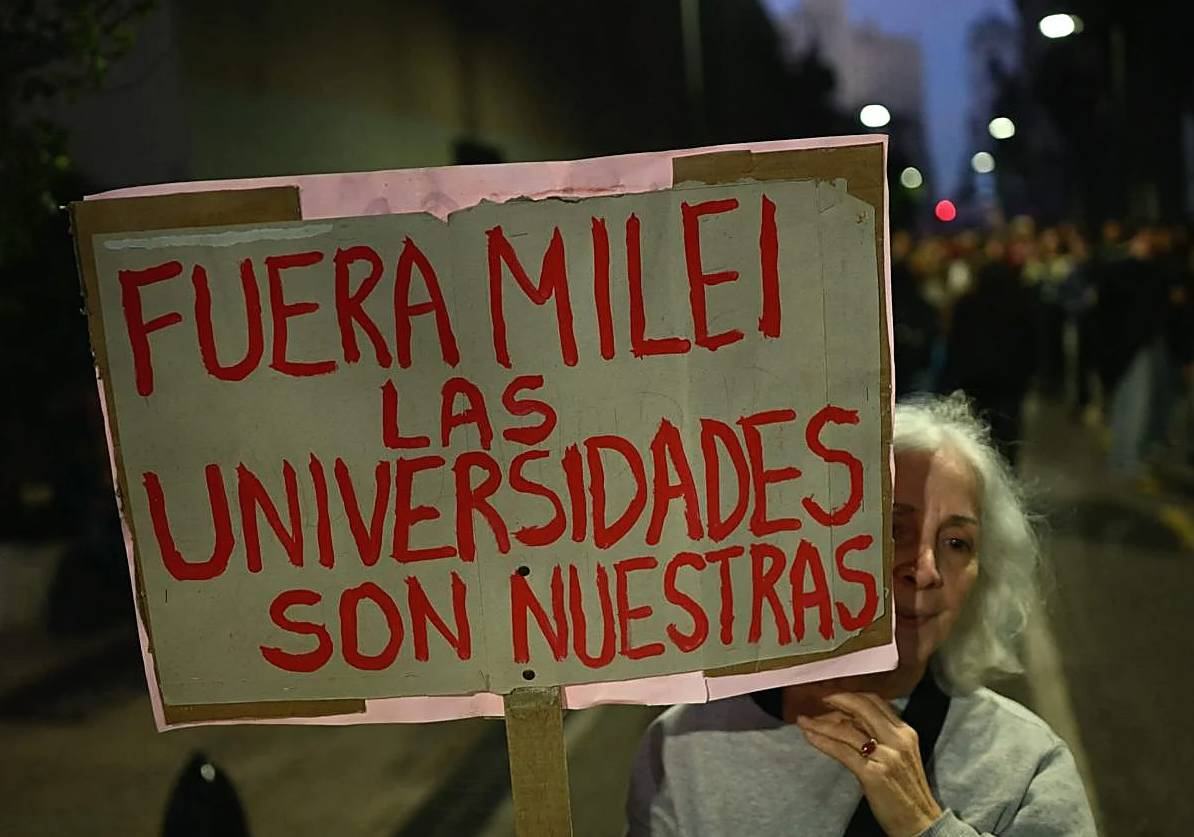
While Javier Milei was receiving the “Global Champion of Free Enterprise” award from the U.S. Chamber of Commerce in Washington, more than half a million people, according to initial estimates, were marching through Buenos Aires in the Federal University March, from Avenida de Mayo to Congress. Similar protests filled the streets of Córdoba, Rosario, Mendoza, and all the country’s major cities. On one side, an award bestowed by America’s big business community; on the other, at those very same hours, a crowd demanding that the state comply with its own laws: the contrast could hardly have been starker.
The march was unanimously called by Argentina’s 64 national universities and by the teaching and non-teaching staff unions, with the full backing of the National Interuniversity Council (CIN), which brings together the rectors of public universities. But the mobilization extended far beyond academia. Truck drivers and public-sector workers joined in, along with retirees and organizations representing people with disabilities, who were violently repressed last year while protesting cuts to their benefits, in one of the darkest episodes of this government’s tenure. It was the fifth mass mobilization with a single demand: that the government finally implement Law 27,795 on university funding, which it has kept frozen for more than a year.
The history is worth revisiting because it reads almost like a manual on how to hollow out a law without repealing it. Enacted in August 2025, the law has two objectives: to recover at least part of the purchasing power that inflation has stripped from teaching and non-teaching staff salaries, and to adjust student scholarships. On September 10, Milei vetoed the law in its entirety. Congress did not back down. On September 17, the Chamber of Deputies, and on October 2, the Senate, secured the two-thirds majorities required by the Constitution, rendering the veto null and void. The government then changed its strategy. On October 21, it promulgated the law through Decree 759 but, in the same text, suspended its implementation until Congress determined the sources of funding. On paper, the law is in force; in practice, it remains frozen. It is a second veto under another name.

The dispute then moved to the courts. At the request of the CIN, federal judge Martín Cormick issued an injunction in December ordering the government to pay the salary increases and adjust the scholarships. The Court of Appeals upheld the ruling in March, and the Supreme Court did the same in June. The government did not budge. It argues that the law would entail an unfunded expenditure of around 2.5 trillion pesos, approximately $1.6 billion or 0.3% of GDP, and even attempted to have the Supreme Court justices recused on the grounds that, as university professors themselves, they could not be impartial.
On October 6, Cormick declared the decree’s suspension clause unconstitutional and, in response to the continued failure to make payments, imposed a fine of 100,000 pesos for each day of delay on Chief of Cabinet Diego Santilli. That amounts to around $65: a penalty more symbolic than deterrent. The law remains unimplemented.
What is at stake is not a budget line but the survival of Argentina’s public university system. According to the teaching unions, implementing the law would mean a salary adjustment of around 35% for teaching staff, additional support for student scholarships, and updated operating budgets for universities: modest measures after years in which inflation has devoured salaries and scholarships. Behind the dispute lies an increasingly explicit project aimed at shrinking the public university system to the benefit of private institutions.
But the university conflict also reveals something broader about the nature of Milei’s project. It has become one of the clearest tests of this government’s relationship with the rule of law. Milei does not openly break with the constitutional order; he circumvents it. The veto, the decree that promulgates a law and suspends it in the same act, the attempt to disqualify judges, and the stubborn refusal to comply with court rulings: each is a tool for disabling the normal functioning of institutions. None, on its own, constitutes a rupture. Taken together, they amount to a sustained assault on Argentina’s constitutional democracy and set dangerous precedents for the rule of law that any future government could exploit.
In some respects, the conflict recalls Chile’s 2011 student protests, when the defense of public education became a rallying point for much broader discontent. Today, the university movement is the main opposition social movement against Milei. Its influence, however, is more expressive than decisive. It serves as an amplifier of social discontent and as a rallying force for a heterogeneous social coalition, but much less as a force capable of changing the government’s course. Its main limitation is the weakness of the progressive camp, which has yet to turn protest into a credible political alternative. Kirchnerism no longer offers one, while anti-Kirchnerism remains the country’s strongest political identity.
Finally, the university protests expose a deep divide within Argentine youth. On one side stands the public university system, which educated a generation with a communitarian vision of society and a trust in the state rooted in the Peronist tradition. On the other are the continuously expanding private universities and the vast world of young people who work instead of studying, often in the informal economy. This is where Milei finds some of his staunchest support. In this fertile ground, nourished by his theatrical rhetoric, take root a blind cult of all things new, an individualism impatient with every institution, and a radical contempt for politics, equated outright with Kirchnerism.
It is the ideal mix for the most ferocious version of anarcho-capitalism. And that is why, looking ahead to 2027, the battle over universities is not simply about how they are funded. It is about what kind of citizenry Argentina will choose to build its future.
Autor

Associate Professor of Political Sociology and researcher at the University of Bergamo. He holds a PhD in Social Sciences from the University of Cassino and Southern Lazio, Italy. He is the author of Populism: An Introduction (Routledge) and Populismo: Teorie e problemi (Mondadori Università), and co-editor of Multiple Populisms: Italy as Democracy's Mirror (Routledge).

Professor-Researcher at the Latin American Faculty of Social Sciences, Mexico campus (FLACSO Mexico). He holds a PhD in Political and Social Sciences, awarded with honors, from the National Autonomous University of Mexico (UNAM).