The Super Bowl long ago ceased to be merely an American football game. Today, it is a global cultural event where identities, values, and political narratives are projected through the language of spectacle. Its halftime show—followed by massive audiences around the world and amplified by digital platforms, streaming broadcasts, and real-time social media—has consolidated itself as a privileged space of symbolic visibility. The LX edition confirmed what was already evident: even when entertainment seeks to present itself as neutral, politics inevitably emerges on the public stage.
The scale of the event reinforces this dimension. The halftime show not only commands one of the largest television audiences of the year but also generates a parallel ecosystem of commentary, reactions, and reinterpretations that extend its impact for days. Within this hypermediated environment, every element—from the choice of artist to the stage design—acquires a symbolic density that exceeds the sporting framework and situates it within broader cultural debates.

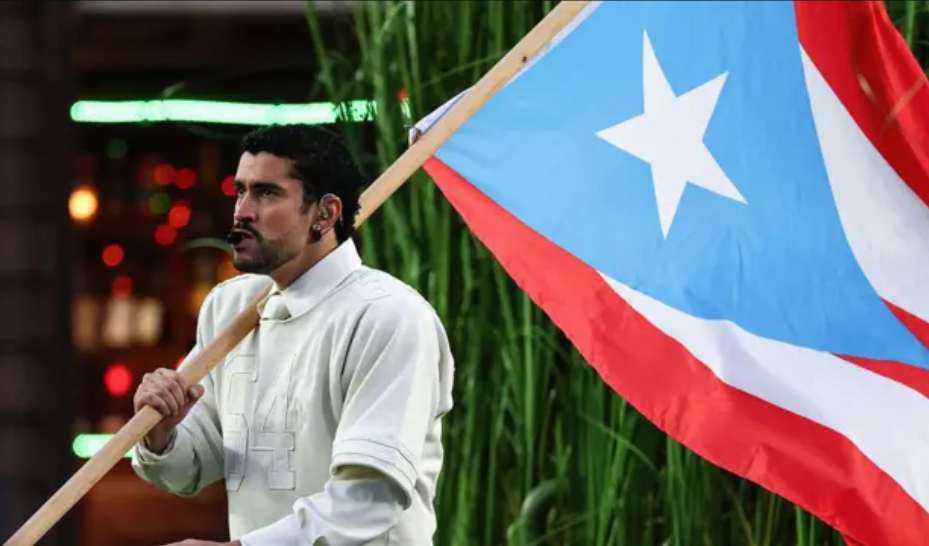
Bad Bunny’s performance made that tension visible. For the first time, the spectacle unfolded entirely in Spanish, incorporating Latin American cultural references aimed at a global audience. Beyond the musical aspect, the gesture sparked a discussion about belonging and cultural identity. The central issue was not artistic but narrative: who occupies the stage, in which language they communicate, and which audience is recognized as a legitimate interlocutor. In that shift, historical tensions between cultural hegemony and peripheral recognition resurfaced, recalling that language delineates spaces of authority and belonging.
The predominant use of Spanish functioned as a symbolic marker of cultural centrality. It was not merely an aesthetic decision, but the occupation of the most visible media space in the U.S. calendar with linguistic and visual codes traditionally associated with the periphery. In a country shaped by migration debates and demographic transformations, that presence acquired resonances that transcend spectacle and engage structural discussions about nation and identity.
The controversy did not arise in a vacuum. The choice of artist had already been the subject of prior criticism linked to his public positions and his explicit cultural identity. After the broadcast, the debate intensified, revealing resistance to the use of Spanish and questioning the “divisive” nature of the show. These reactions illustrate how popular culture has become a terrain where definitions of cultural normalcy are contested. The discussion laid bare that the conflict does not lie in aesthetics, but in the redefinition of symbolic frameworks that for decades seemed unquestionable.
Paradoxically, the show avoided an explicit political discourse. Celebration prevailed over confrontation, and visual display replaced any overt positioning. Nevertheless, the presence of subtle allusions allowed for multiple interpretations. This ambiguity encapsulates the contemporary logic of cultural politics: it is no longer articulated through direct slogans, but through visual and emotional codes that enable divergent readings. Politics is thus inscribed in representation itself, generating interpretive disputes that extend the event beyond its duration and insert it into the global public conversation.
The reaction transcended media discussion. Counterprogramming promoted by conservative sectors—which organized alternative broadcasts and digital campaigns—reveals the extent to which the halftime show has become a site of cultural confrontation. That a sporting spectacle triggers organized ideological responses demonstrates that popular culture no longer operates as a neutral space. In a saturated media ecosystem, every high-visibility stage becomes a strategic arena where collective meanings and cultural legitimacies are negotiated.
From Latin America, the reading acquires particular nuances. The centrality of Spanish and of regional references may be interpreted as cultural recognition within a historically asymmetrical system. But it may also be seen as evidence of the global market’s capacity to incorporate and capitalize on diversity. In both cases, the episode underscores the complexity of cultural power: inclusion and commercialization coexist within an ambivalent dynamic. Visibility does not eliminate structural inequalities, though it does redefine their forms of representation and turn them into objects of transnational consumption.
The political message of the halftime show, therefore, did not reside in explicit statements, but in its staging. Language, aesthetics, and identity functioned as vectors of meaning in a space where every gesture acquires geopolitical resonance. In the era of hypercommunication, cultural politics does not need to proclaim itself; it is enough to activate public conversations through the strategic occupation of the stage. The global circulation of images amplifies that effect, consolidates its impact, and transforms spectacle into a symbolic archive of its time.
The Super Bowl LX halftime show did not offer a political manifesto, but a cultural mirror. It reflected contemporary tensions over nation, migration, identity, and power, exposing the fragility of cultural consensus in polarized societies. Ultimately, the episode confirms that popular culture is one of the principal arenas where the meaning of belonging is contested in the contemporary world. And that even in the most massive and seemingly trivial spectacle, the fractures and aspirations that traverse global political life are projected.
Autor

National Coordinator of Electoral Transparency for Mexico and Central America. Master in Governance, Political Marketing and Strategic Communication from King Juan Carlos University (Spain). University professor.