When transitions to democracy took place in the late 1980s and 1990s, several autocratic regimes did so peacefully. Some of them legitimized themselves as temporary responses to specific threats; for example, the fight against communism during the Cold War. Repression and the suspension of liberties were presented as exceptional means to restore a threatened order. That difference in origin neither attenuates nor justifies the human rights violations committed, but it does help explain why those regimes accepted, when the time came, a negotiated exit from power.
Latin American military dictatorships legitimized themselves as responses to prior pressure for change, associated with the regional impact of the Cuban Revolution and the expansion of guerrilla movements. When containing communism lost its centrality, they accepted transitions to democracy. Their leaders acknowledged defeats in plebiscites called by those in power—as occurred in Chile and Uruguay—and assumed the end of their presence in government.

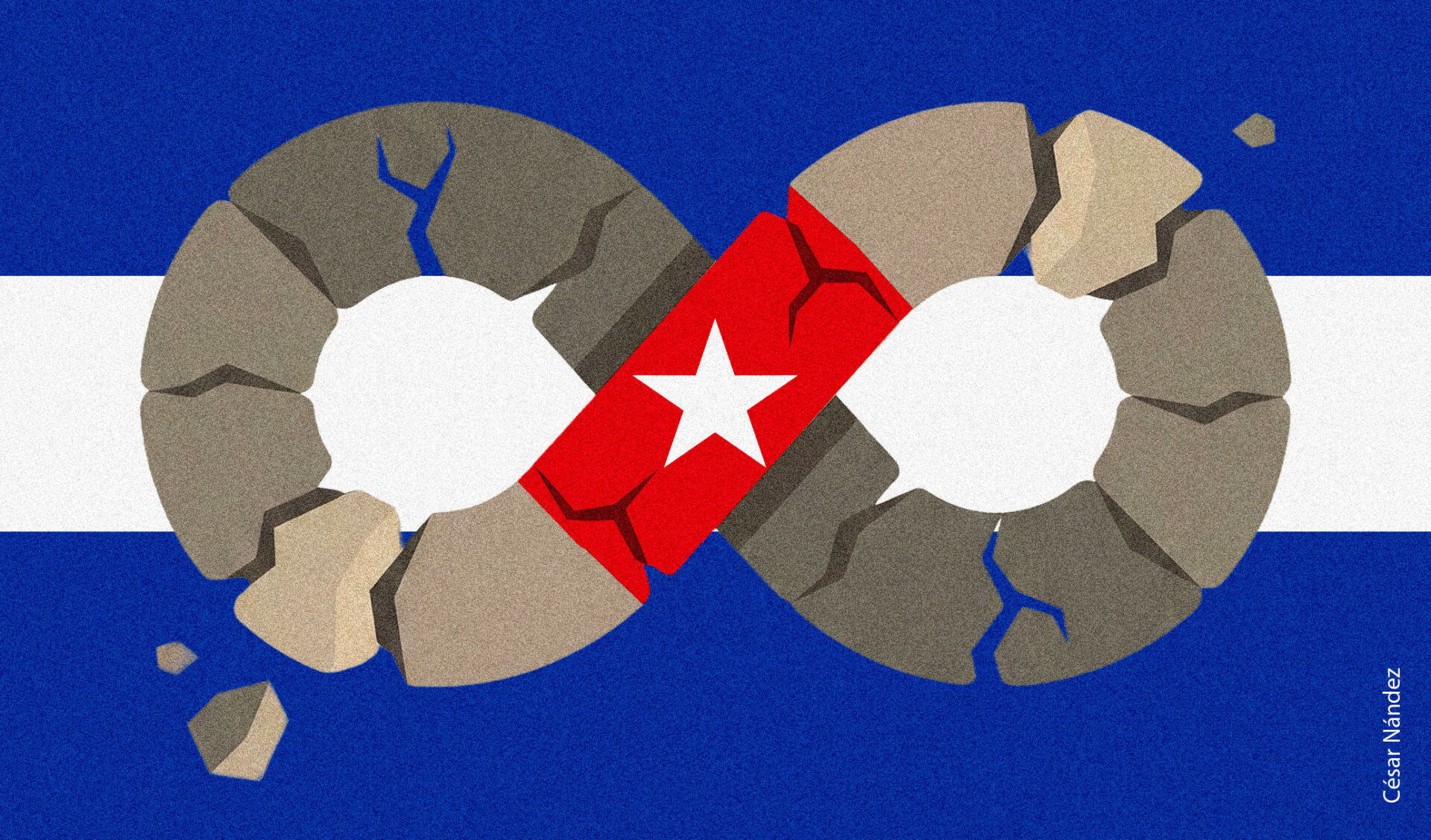
Revolutionary autocracies, by contrast, tend to display exceptional durability, because they incorporate a historical mission that renders them irreplaceable. They do not conceive of themselves as the solution to a crisis, but as the definitive crystallization of a political project. This was constitutionally verified in Cuba. In the 1976 constitution, no horizon for the expiration of power was recognized, because the regime never conceived of itself as a historical parenthesis—something later confirmed by the incorporation of the 2002 entrenchment clause, in which socialism was declared irrevocable. The 2019 Constitution maintains that clause.
This difference in the self-perception of the governing elite is not a historical or theoretical detail, but a variable that explains how much it is willing to risk to remain in power, what costs it will accept, and when—if it happens at all—it will negotiate a peaceful transition to democracy.
Since 1959, Fidel Castro and his followers have perceived themselves as a historical project without an expiration date. They did not govern in order to prepare a transition to democracy, but to embody, exclusively, the only legitimate political order possible. This self-perception explains why the Cuban regime has accepted levels of economic, social, and institutional deterioration that would be unthinkable for other autocracies.
Autocratic elites that conceive of themselves as timeless and unlimited do not calculate political risks in the same way as those that know their existence is based on the circumstances that gave rise to them. These elites can dispense with sources of legitimacy—such as economic performance, social inclusion, or limited political-electoral participation—without altering their survival. The economy and public services may collapse; political participation may become irrelevant; international recognition may disappear; and isolation and sanctions may persist for decades. All of this is bearable. The only unacceptable outcome is losing control of power.
In Cuba, economic and social failure has ceased to be a political problem for the elite. The crisis is not an anomaly, but a structural condition with which they have accepted coexisting as long as the current regime is maintained on the basis of repression. Poverty is not a temporary cost, but a permanent condition and a repressive mechanism. Mass emigration is not an alarm bell, but a safety valve for internal pressure on the regime. From the elite’s perspective, none of the above compels a change in course so long as the costs of repression remain lower than those of transitioning to democracy.
Cuba today
Cuba’s current situation confirms these arguments. Following Maduro’s departure from power and the loss of the strategic alliance with Venezuela, the Cuban regime faces not only a structural crisis. It has also lost the external support that for more than two decades allowed it to cushion its survival costs. The Cuban economy, which was already experiencing its worst crisis in decades—even before the arrival of the current U.S. administration at the White House—now faces an energy collapse that affects basic services and worsens the economic contraction. This demonstrates the regime’s extreme dependence on its international allies.
However, far from inducing an immediate transition, this context confirms that the governing elite does not interpret the crisis as a limit to its permanence, but as a bearable cost within its historical mission. The disappearance of the Venezuelan ally does not automatically alter its willingness to resist, but it does eliminate one of the factors that sustained the material viability of that self-perception of permanence, thereby increasing internal uncertainty.
The capacity to withstand unlimited risks has an additional explanation: the internal stability mechanisms that allow the regime to process conflicts without fragmenting. Within that framework, the figure of Raúl Castro is fundamental, as he fulfills an arbitral function within the regime. He has been the final instance for resolving inter-elite conflicts, the actor capable of containing disputes among civilian, military, and party factions, and the ultimate guarantor that disagreements do not escalate to the point of endangering the cohesion of power.
No relevant actor within the regime can disregard Raúl Castro’s word without incurring a high political cost. As long as that arbiter exists, the elite will tolerate external pressures, internal failures, and recurring crises without altering its self-perception of permanence. The certainty that there is always an instance capable of closing ranks reduces uncertainty and makes the notion of indefinite continuity credible. For that reason, the eventual death of Raúl Castro is not a symbolic event, but a political one. His disappearance will not automatically imply the collapse of the regime nor guarantee a transition to democracy, but it will eliminate one of the main informal mechanisms of internal stability.
The beginning of the end
In this context, it is possible that the self-perception of eternity may begin to crack—not because the ideology changes, nor because the economy or social situation improves or worsens, but because continuity ceases to feel assured. The regime may preserve control of the coercive apparatus, but doubt will arise: who will decide in the last instance? Who will guarantee that conflicts do not lead to ruptures?
But that internal fissure will not be enough. The death of Raúl Castro is only a window of opportunity. Timeless autocracies can recompose themselves with relative ease after the loss of their supreme leader. For the loss of the arbiter to decisively influence the elite’s self-perception, it is indispensable that external pressure on the regime be maintained—or even increased—which raises the cost of remaining in power at a moment of uncertainty. This, in turn, reduces room for maneuver, limits individual exit options, and makes the strategy of resisting indefinitely more costly.
When that pressure is relaxed, the regime gains time to reorganize, close ranks, reconstruct a narrative of continuity, and implement institutional adjustments that project an image of change that does not actually occur. When pressure is sustained, internal tensions are amplified and it becomes more difficult to pretend that nothing has changed. In the Cuban case, this is crucial, given the weakness of the political opposition and civil society—whose leaders are mostly exiled or imprisoned—in exerting effective pressure on the regime.
Autocratic elites that see themselves and the regime as eternal do not negotiate transitions because they become democratic. Nor because they recognize the social suffering generated by their governance. They negotiate when remaining in power becomes riskier than abandoning it in time. The transition begins in the psyche of those who govern before it reaches the negotiating table. In Cuba, that moment may arrive when two processes coincide: the disappearance of the principal factor of internal cohesion and international pressure.
Autor

Coordinator of the Legislative Observatory of Cuba. He holds a law degree from the University of Havana and a master degree in Constitutional Law from the same university.