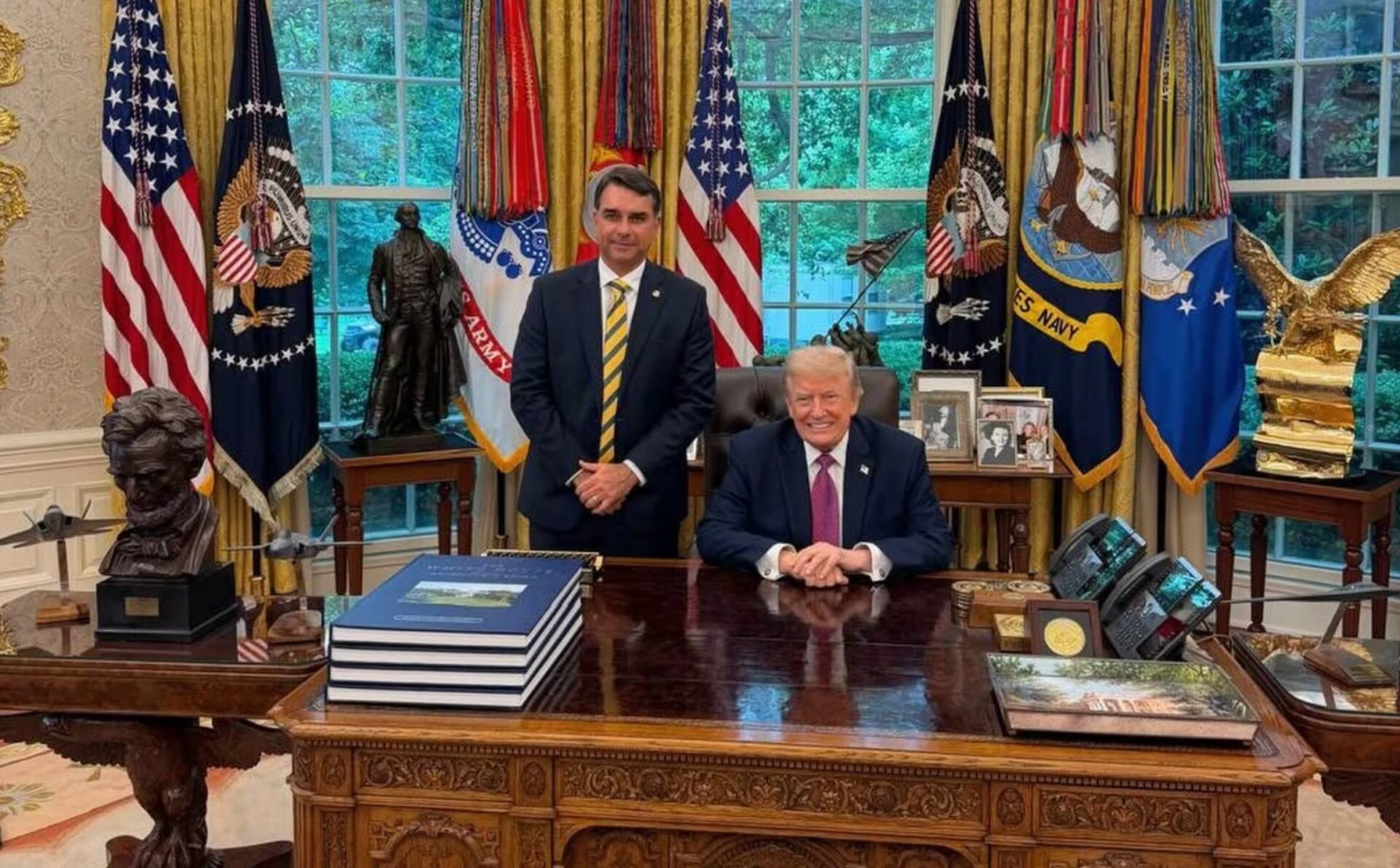
In Brazil, foreign policy has become an electoral battleground. The visits by President Lula and Senator Flávio Bolsonaro, the country’s two leading presidential contenders, to the U.S. capital reveal, beyond the substance of their respective agendas, a struggle to gain international prestige and political capital.
The bilateral relationship with the United States has taken on a prominent place in Brazil’s public debate and has become an important element in understanding the strategies of the country’s presidential hopefuls. This process has been driven both by the strengthening of presidential diplomacy as an instrument for projecting international leadership—a hallmark of Lula’s first administrations—and by the expansion and diversification of the issues that now make up Brazil’s foreign policy agenda.

In the case of the president’s official visit, the issues that occupied a central place on the agenda, reinforcing his administration’s emphasis on defending national sovereignty, were the escalation of trade tensions—particularly the so-called tariff hike—the exploitation of rare earth minerals, and reform of the UN Security Council. Senator Flávio Bolsonaro’s visit, by contrast, was predominantly symbolic, aimed less at shaping substantive foreign policy agendas than at generating political capital for the electoral contest.
The trip served as a counterpoint, reinforcing that while Lula maintains an institutional relationship with Washington, Trump’s ideological affinity in Brazil remains tied to the Bolsonaro right. Amid the scandal surrounding the audio messages Flávio Bolsonaro sent to banker Daniel Vorcaro (currently imprisoned in connection with one of the largest corruption scandals in the country’s history), in which he asked for money to finance a film about his father, former President Jair Bolsonaro, the Bolsonaro family’s international agenda can be interpreted as an attempt to relaunch its pre-election campaign by relying on the mobilization of transnational networks that connect the radical right.
The repercussions of the senator’s visit to Washington, however, may have unpleasant consequences for his participation in the presidential race. Although certain political sectors still view alignment with the United States as a valuable electoral asset, Brazilian public opinion toward the country has undergone significant changes.
Data from the Brazil, the Americas and the World (BAM/CEBRAP) project reveal a persistent disconnect between the different dimensions of Brazilians’ attitudes toward the United States. When asked about the state of bilateral relations, more than 70% of respondents consistently characterized them as positive throughout the 2010–2022 period, a stable proportion regardless of respondents’ political leanings. At the same time, distrust surpassed trust beginning in 2014 and reached its peak in 2018, during the Trump administration, when 63% of respondents expressed distrust, compared to only 31% who said they trusted the United States.
The result is a public opinion that views partnership with the United States positively at the state-to-state level, while increasingly distrusting the Northern power as a geopolitical actor. Consequently, it does not respond in a straightforward way to electoral appeals that equate diplomatic rapprochement with unconditional support for Washington. In this context, using closeness to the Trump administration as a source of political legitimacy may encounter a domestic environment that is less receptive than in previous electoral cycles.
This shift in public opinion was also accompanied by a reorientation in the approach adopted by a significant portion of Brazil’s mainstream press toward relations with the United States. Throughout much of the post-democratization period, closer bilateral ties were frequently portrayed positively in editorials and opinion columns. That consensus, however, came under strain with the foreign policy pursued by the Bolsonaro administration. Data from the CEBRAP Foreign Policy in the Press Observatory (OPEI/CEBRAP) also document this shift.
In 2014, favorable references to relations with the United States in editorials and opinion articles greatly outnumbered unfavorable ones. This pattern began to change during Michel Temer’s administration but became unmistakable under Bolsonaro. Media coverage increasingly emphasized criticism of what was perceived as automatic alignment with U.S. interests, highlighting issues such as the loss of autonomy, subordination to the objectives of the most conservative sectors of the United States, and departure from the diplomatic tradition of Brazil’s Ministry of Foreign Affairs. Alignment with Washington had brought Brazil few tangible benefits while generating friction with China, the country’s main trading partner. By the midpoint of Bolsonaro’s presidency, in the second half of 2021, 60% of the media outlets monitored by the Observatory had adopted a critical stance toward the government’s policies toward Washington.
Returning to more recent developments, the classification of Brazilian criminal organizations as terrorist groups and the new tariff front opened by the United States converged at the center of the political debate. New tariffs on Brazilian products—including PIX, Brazil’s most widely used electronic payment system, portrayed as unfair competition for major U.S. multinationals—along with criticism of decisions by Brazil’s Supreme Federal Court and alleged “legal uncertainty,” have placed these new measures squarely in the sights of Brazil’s manufacturing sector. The Brazilian government framed these developments as part of a single process linked to the Bolsonaro family’s international actions, arguing that they harm Brazil in order to strengthen ties with the U.S. president.
Against this backdrop, Lula and Flávio Bolsonaro are mobilizing distinct models of international engagement aimed at different audiences. While the former seeks to project an image of autonomy and diversification of Brazil’s external partnerships, the latter attempts to capitalize on ties with the transnational ultraconservative network associated with Trumpism. Foreign policy is no longer a peripheral issue in the electoral contest; it has become a significant axis of differentiation between the candidates. Recent events suggest that Washington has already entered Brazil’s presidential campaign even before the party conventions.
Yet the ground on which this dispute will unfold differs from that of previous electoral cycles. Recent research suggests that the growing politicization of Brazil’s relationship with the United States is taking place in a context of increasing Brazilian distrust toward the United States and, in particular, toward the political currents associated with Trumpism. If elections shape the course of foreign policy, foreign policy also shapes elections—though not necessarily in the way expected by candidates who assume that closer ties with Washington automatically translate into popular support in Brazil. Recent experience suggests that this connection no longer automatically generates the political dividends its advocates assume, especially when it is associated with the political universe of Trumpism.
Autor

Professor of Public Policy at the Federal University of ABC (UFABC, Brazil) and coordinates the External Policy Observatory at the CEBRAP Media. Doctor in Political Science. He was a Global South Fellow at the University of Illinois at Urbana-Champaign.

A researcher at the Brazilian Center for Analysis and Planning (CEBRAP), he holds a master's degree and is a doctoral candidate in Public Policy at UFABC. He coordinates the Center for Analysis and Monitoring of Public Policies (CAMPP) at UFABC and is a researcher at FGV Cidades.