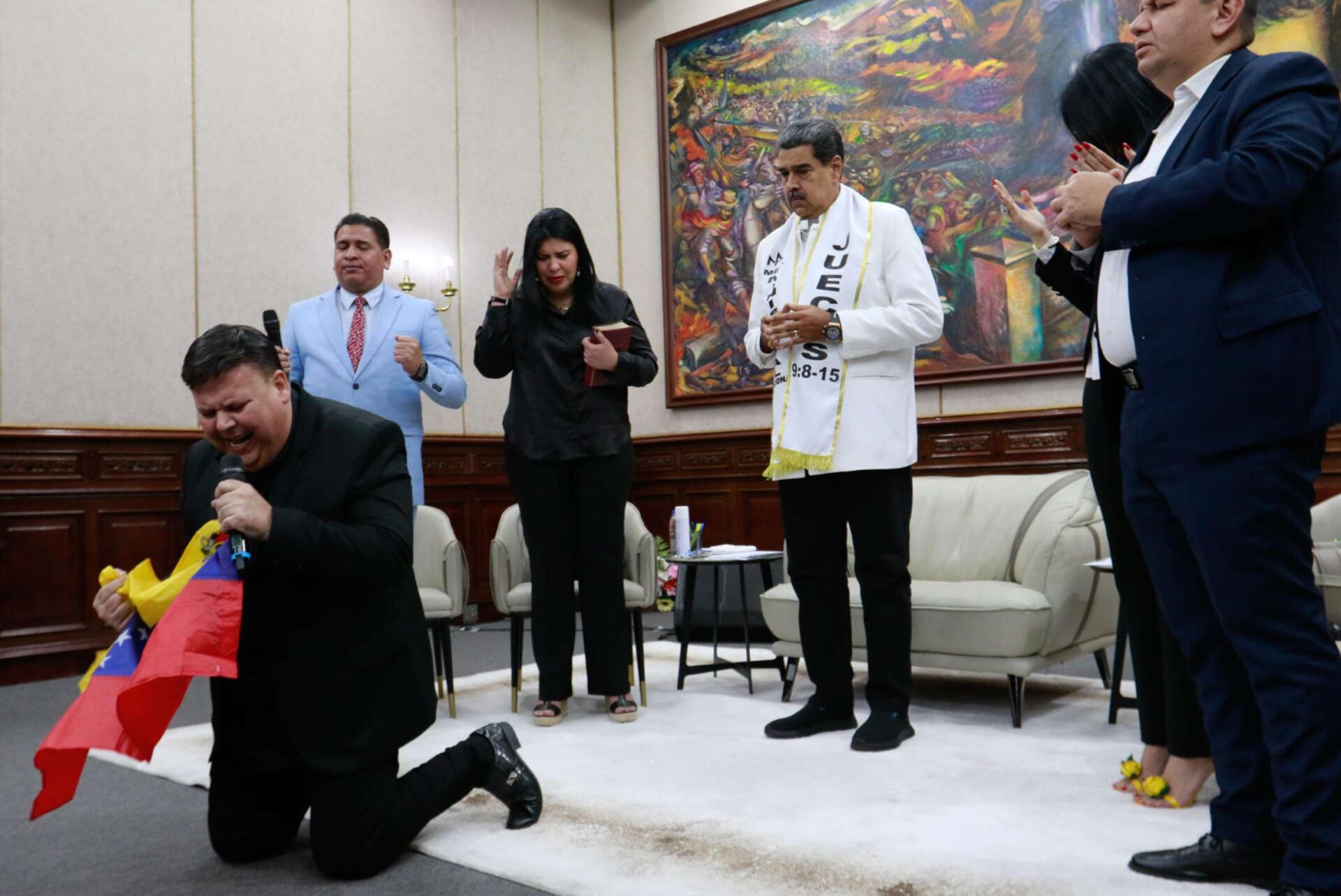
Jair Bolsonaro and Hugo Chávez, despite representing opposite ends of the political spectrum, share an important trait: both used religious language and symbols to present themselves as “saviors of the nation,” each assuming the role of a leader chosen for a divine mission amid political and institutional crises. Through narratives that mix faith and politics —what we refer to as messianic populism— both Bolsonaro and Chávez managed to reshape their public image, using religious elements to legitimize their actions and win followers.
Populism is a complex and multidimensional phenomenon. It can be understood as a movement, a strategy or an ideology, and it often clashes with liberal democracy, justifying the violation of its principles in the name of popular will. It manifests through leaderships that polarize society between “the people” and “the elite,” promoting power concentration, institutional distrust and constant rhetoric of crisis and threat.

Messianic populism, in particular, emphasizes the cult of the leader as a historic savior, relying on emotional mobilization and media manipulation to consolidate dominance and weaken the opposition. It is embodied by charismatic figures who present themselves as redeemers against corrupt elites or external threats, mobilizing religious discourse and symbolism to legitimize power. In Brazil, evangelical support was key for Bolsonaro, while in Venezuela Chávez benefited from the backing of the Catholic Church and left-wing Christian movements.
Both cases reveal the sacralization of leadership and the political polarization that erodes the foundations of liberal democracy.
Bolsonaro’s messianic populism: God’s chosen envoy
Alongside the rapid growth of evangelical Christianity in Brazil, Bolsonaro built his image as a messianic leader, using Christian symbolism to portray himself as a savior in a spiritual battle against evil, communism and corruption. Two elements were central to reinforcing this providential narrative and his connection with evangelical voters —who see him as a defender of traditional family and Christian values: his baptism in the Jordan River in Israel in 2016, and his survival of the stabbing attack during the 2018 presidential campaign.
The baptism in the Jordan River —a sacred place in Christianity— symbolized spiritual rebirth and a public commitment to faith, strengthening his legitimacy among evangelicals and expanding his political base. The 2018 attack was framed as a form of martyrdom preceding electoral victory, consolidating his image as a leader protected by God and destined to save Brazil. Social media reactions revealed polarization and conspiracy narratives surrounding the event, while the attacker, Adélio Bispo, was demonized to reinforce the dichotomy between good and evil.
This good-versus-evil duality follows a sacralizing logic: morally, Bolsonaro embodies good and Adélio represents evil; narratively, Bolsonaro becomes the savior while Adélio is the threat; symbolically, Bolsonaro represents the sacred, and Adélio is associated with the devil. In political discourse, Bolsonaro is framed as legitimate authority, while Adélio is tied to violence and fear.
Hugo Chávez’s messianism: the sanctification of the eternal commander
Chávez emerged during Venezuela’s institutional crisis of the 1990s, presenting himself as an anti-establishment leader and promoter of the “Bolivarian Revolution.” His strategy combined popular mobilization through social programs with institutional dismantling to centralize executive power. His close relationship with the armed forces and the symbolic power of his rhetoric strengthened his political identity, which incorporated spiritual and redemptive elements, linking himself to Simón Bolívar and creating a secular political religion that persisted after his death.
After his death, Chávez was popularly “sanctified,” with the creation of a chapel dedicated to him and the fusion of Catholic religious symbols with Chavista elements in devotional practices. Murals, the iconic “eyes of Chávez” imagery, and adapted prayers exemplify this blend of the sacred and the political, consolidating his image as a spiritual entity and moral symbol of the revolution. Although not officially recognized by the Catholic Church, this popular sacralization reinforces the continuity of Chávez’s charisma and political authority beyond his lifetime.
The relationship between religion and politics is central to the construction of messianic populism in Latin America, where leaders like Bolsonaro and Chávez use religious elements to legitimize their power, mobilize collective emotions and consolidate political identities. The instrumentalization of sacred symbols, divine mission narratives, and episodes of martyrdom or sanctification strengthen charismatic bonds with followers and challenge traditional democratic institutions. Despite their ideological differences, both cases show how politics and religion intertwine to give meaning and transcendence to power projects in the region.
*Machine translation, proofread by Ricardo Aceves.
Autor

PhD in Political Science (University of São Paulo – USP). Professor at UFMG - Federal University of Minas Gerais, president of ABRAPEL - Brazilian Association of Electoral Researchers. Member of the Board of Directors of Wapor - LATAM.

PhD in Political Science. Postdoctoral Fellow at UFMG and CNPq Fellow in the project funded by the Minas Gerais State Research Support Foundation (FAPEMIG). Researcher in the "Public Opinion, Political Marketing, and Electoral Behavior" Group (UFMG).

Master's degree in Anthropology and PhD candidate in Political Science at the Federal University of Minas Gerais (UFMG), Brazil. She is a researcher in the "Public Opinion, Political Marketing, and Electoral Behavior" group at UFMG.