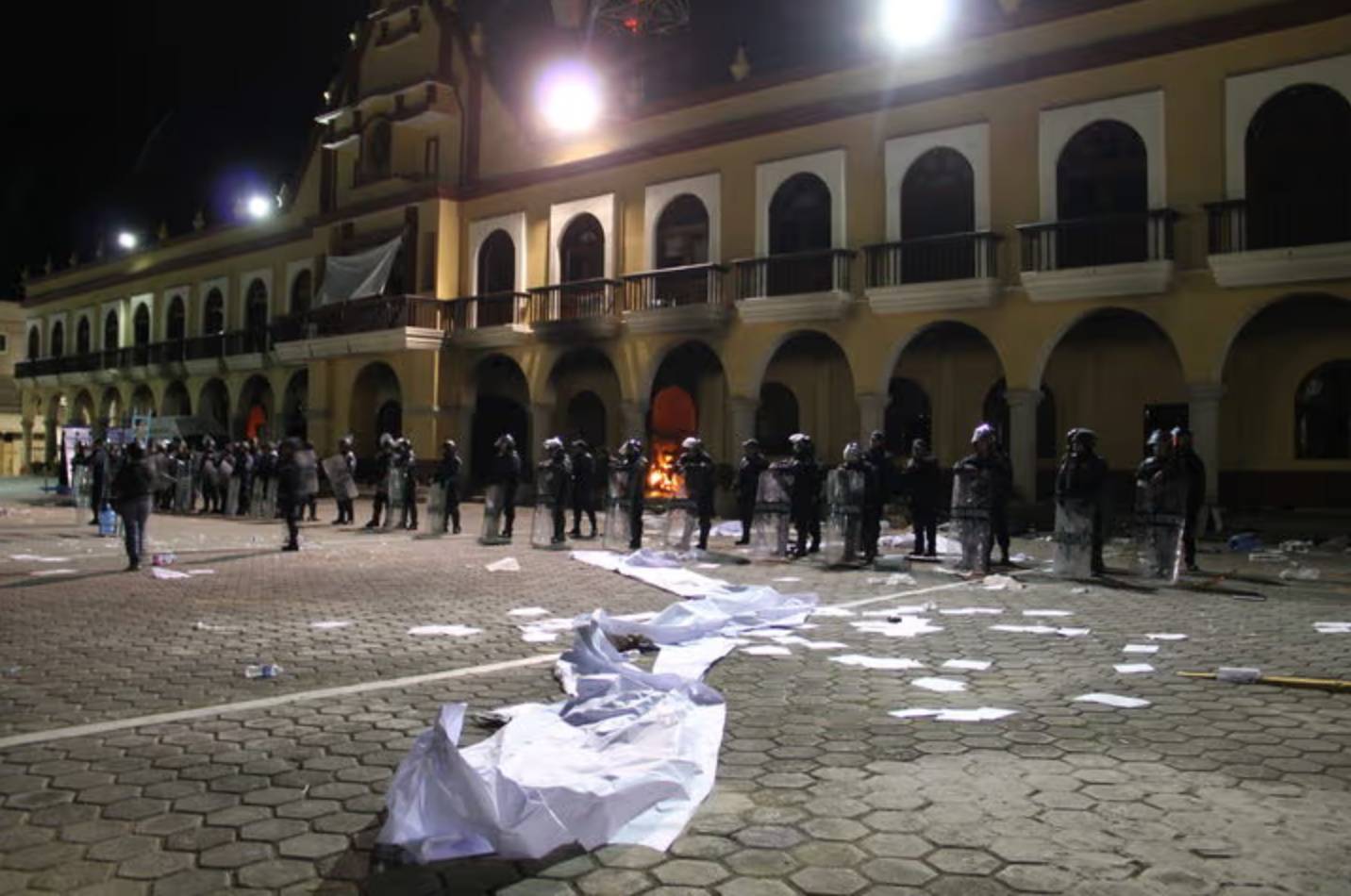
On May 27, an attempted lynching of a foreign national took place in Cancún. The incident occurred after the individual assaulted someone who had confronted him for allegedly being bitten by his dog. The victim recorded a video of the assault and later uploaded it to social media, where it quickly went viral. This sparked xenophobic comments and prompted a mass call for people to gather outside the foreigner’s home. Dozens of people assembled at the scene, threw objects at the property, and caused extensive damage. Municipal police and the armed forces eventually arrived to secure the area, and the foreign national and his wife were taken to a government facility. This episode reflects a persistent problem in Mexico: lynchings.
A lynching is a violent collective act in which a crowd seeks to administer justice into its own hands against individuals suspected of committing a crime, threatening their physical integrity and even their lives. In Mexico, this phenomenon occurs in both rural and urban areas and tends to be concentrated in several states in the central part of the country. However, there is no single official registry that allows the full scale of the problem to be measured with precision.

One of the available records was compiled by researchers Enzo Nussio and Govinda Clayton, creators of the Lynching in Latin America (LYLA) database at the ETH Zurich Center for Security Studies. According to this source, 1,134 lynching cases were documented in Mexico between 2010 and 2019, making the country the one with the highest absolute number of lynchings in Latin America and the third-highest on a per capita basis, behind Guatemala and Bolivia. Most cases occurred in the State of Mexico, Mexico City, Puebla, Tlaxcala, Hidalgo, and Morelos.
Additional data come from the Special Report on Lynchings in the National Territory (2019), prepared by Mexico’s National Human Rights Commission (CNDH) and the Institute for Social Research (IIS) at UNAM. The report indicates that between 2015 and 2018, 336 lynchings were recorded nationwide, involving a total of 561 victims, 121 of whom died. The report details that 69% of the cases were related to theft, 11% to kidnapping, and 7% to sexual assault. It also notes that theft accounts for the largest share of cases because this offense is more likely to involve catching the alleged perpetrator in the act.
Meanwhile, figures from the civil society organization Causa en Común, reported by various media outlets, indicate that 968 lynchings and attempted lynchings were recorded in Mexico between 2020 and 2024. Forty percent of these incidents occurred in the states of Puebla, Tlaxcala, the State of Mexico, and Hidalgo.
The three sources cited highlight the persistence of lynchings over the years and their concentration in specific states. Those responsible often argue that they are acting in pursuit of justice. In a context where organized crime violence affects large parts of the country and the Mexican state is perceived as incapable of guaranteeing security and justice, vigilante justice is viewed by some sectors as an alternative that promises a swift response to the crimes affecting them.
Public frustration, perceptions of insecurity and injustice, and distrust in institutions are among the main factors used to explain the phenomenon. These perceptions are reinforced by impunity levels that, according to INEGI (2025), exceeded 90% of all crimes. Nevertheless, lynching represents a denial of the rule of law, as the accused is stripped of the guarantees afforded by due process and is judged and sentenced by a mob.
This practice constitutes a serious human rights violation and undermines the social fabric of communities by normalizing violence as a means of resolving conflicts, generating psychological trauma and contributing to the stigmatization of the localities where these incidents occur.
In addition to these domestic challenges, tourist regions such as the Mexican Caribbean are also experiencing gentrification linked to a mass tourism model, in which individuals with greater purchasing power—primarily from North America and Europe—settle permanently in these areas. This drives up housing costs and displaces the local population. This situation may be contributing to growing tensions between nationals and foreigners, particularly in a context where various sectors have voiced criticism of gentrification.
Although national surveys show that most Mexicans do not express hostile attitudes toward migrants, perceptions of foreigners appear to have deteriorated in certain urban centers affected by this phenomenon. A 2025 El Financiero survey of residents in Mexico City found that 45% considered it negative for foreigners to move to the city.
Although the survey does not allow conclusions to be drawn about Cancún, its findings provide clues that may help explain what occurred. The attempted lynching of the foreign national took place amid growing resentment among part of the local population, where unemployment, insecurity, and other hardships are often blamed on outsiders—those who are not from the area—an explanation that is far removed from reality.
The complexity of lynchings in Mexico reveals a persistent phenomenon shaped by a range of domestic factors and, in some contexts, potentially linked to broader processes such as gentrification and the deterioration of perceptions toward foreigners among certain segments of the population.
The normalization of lynchings reflects institutional weakness and the erosion of the social fabric. Addressing this challenge requires strengthening public institutions and improving the administration of justice so that these acts are recognized as extreme forms of violence rather than legitimate expressions of justice. It is essential to establish strategies capable of preventing their recurrence and spread.
Autor

Professor of International Relations at the University of the Valley of Mexico. PhD candidate in Political Science from the University of Guadalajara and Master's in Political Affairs and Public Policy from the Colegio de San Luis.