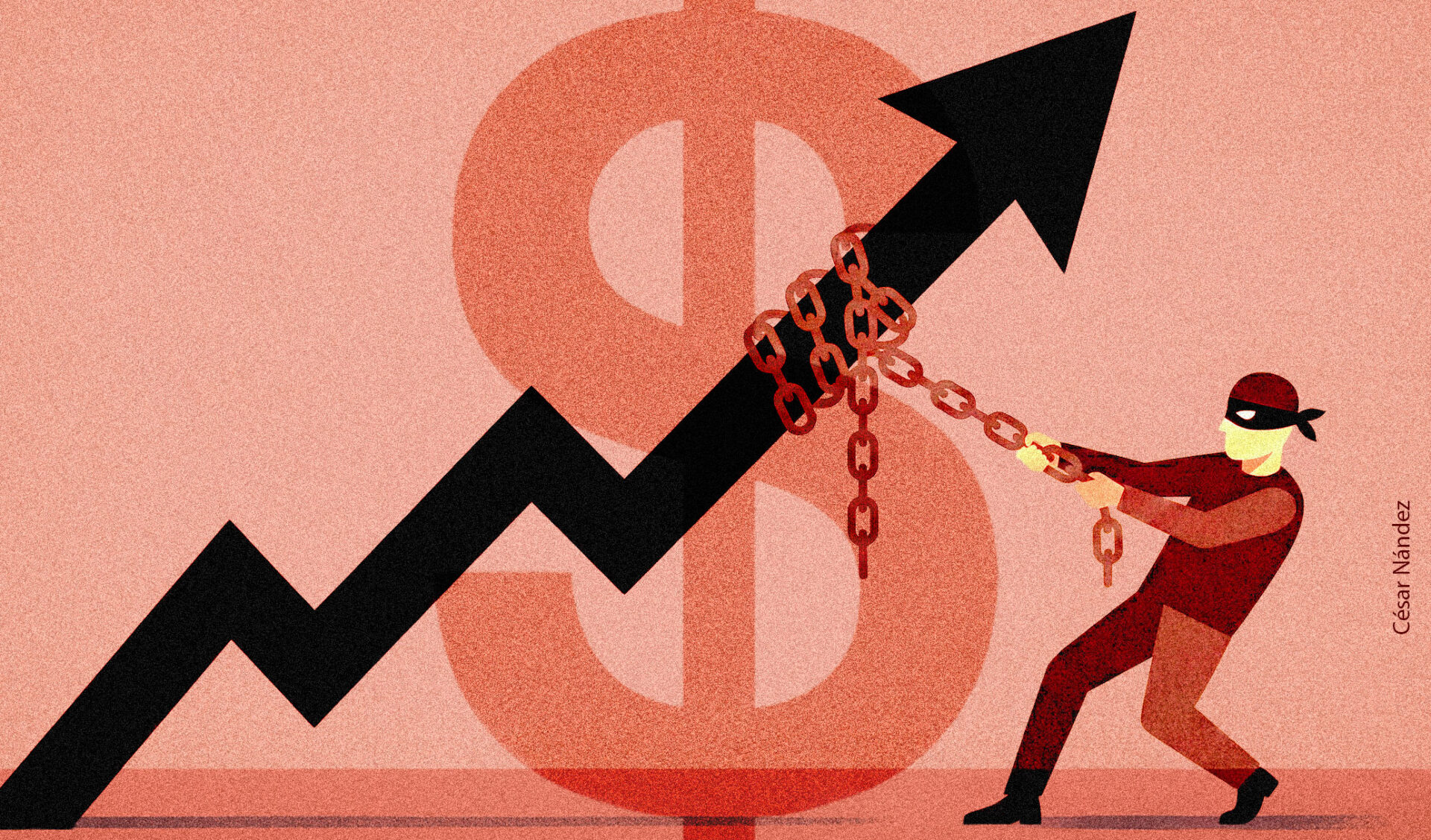
In Latin America and the Caribbean, crime has become just another economic variable. It is neither a marginal phenomenon nor a simple distortion of public security: it is essentially a silent tax that affects productivity, employment, investment, and confidence in the future. According to a recent study by the Inter-American Development Bank (IDB), violence and crime together cost the region 3.5% of its GDP each year. In absolute terms, this amounts to more than 170 billion dollars annually, a figure nearly equivalent to the total public spending on education across all countries in the region.
The IDB breaks down this cost into three major components. The first is private spending on security (47%), the second is public spending (31%), and the third is the loss of human capital (22%). Private spending is the most visible, as businesses, shops, residences, and even schools hire private security, install cameras, armor vehicles, and pay costlier insurance premiums. In 2024, the IDB estimated that Latin American families and companies spend more than 80 billion dollars a year solely on protective measures—an amount double what the entire region invests in technological innovation.

Public spending, meanwhile, has grown without translating into sustainable security. On average, Latin American countries devote between 2.5% and 3% of GDP to police, justice systems, prisons, and armed forces, but with enormous inefficiencies, since criminals continue operating from within these institutions using technological tools. While some prison systems operate with more than 100% overcrowding, judicial resolution rates remain below 25%. In the words of the World Bank, the region invests more in “containing violence” than in “structurally reducing it.” The third component—and perhaps the most tragic—is the loss of human capital. Every young person who drops out of school out of fear, every worker who is murdered or extorted, every displaced community, and every professional who emigrates due to insecurity represents a loss of future productivity. The IDB calculates that this component equals 0.7 percentage points of annual GDP, becoming a direct blow to growth capacity. It is a silent but cumulative cost that reduces schooling, deteriorates mental health, and discourages the return of talent.
Reducing the cost of crime to Europe’s average levels would free, according to IDB projections, at least one additional percentage point of GDP per year—enough to finance active employment policies, innovation, or the energy transition. In other words, insecurity is one of the region’s major macroeconomic problems. Its effects on productivity are multiple; for example, in the private sector, crime increases transaction costs and reduces competitiveness.
World Bank data show that one out of every three Latin American companies suffers at least one criminal incident per year, and that average security costs reach between 2.3% and 2.7% of gross sales—exceeding losses caused by power outages or logistical delays. Small and medium-sized enterprises, which represent a high share of the productive fabric, are the most vulnerable, as many operate in cash, without insurance, and without the capacity to pass these costs on to final prices. For large companies, crime acts as a transferable risk premium, since investors incorporate the cost of violence into their projection models and pass it on to consumers.
For example, cargo insurance at Latin American ports is between 20% and 50% more expensive than in Asia or Europe, and transnational organized crime—especially in drug trafficking and illegal mining—creates an environment of uncertainty that discourages long-term investment. Country risk now depends not only on debt or inflation, but on how many routes are controlled by gangs, how many prosecutors investigate without protection, or how many judges face threats.
In fiscal terms, the phenomenon is equally corrosive, given that states spend more on maintaining armed and police forces than on innovation infrastructure. Over the past ten years, public security spending has grown at twice the rate of spending on higher education. And yet, the region’s average homicide rate—close to 20 per 100,000 inhabitants—remains four times higher than the global average. This reflects a spending model that reacts, but does not transform.
Violence also has an economic geography. Brazil has managed to reduce its homicide rate to historic lows thanks to local prevention policies and federal coordination, although inequality in police lethality remains alarming. El Salvador has drastically reduced homicides under a state of exception, but at the cost of civil liberties that weaken democratic institutions. Mexico, Colombia, and Ecuador face the advance of transnational crime, which colonizes local economies, captures municipal governments, and infiltrates judicial systems. Each model offers lessons on effectiveness and sustainability.
Crime also affects social capital, a less visible but essential variable. Mistrust among citizens, the loss of community cohesion, and the normalization of fear have direct effects on productivity. The economy of violence is also an economy of isolation, as people avoid moving around, businesses shorten hours, and young people stop attending night school. In cities like Guayaquil, San Pedro Sula, or Acapulco, urban GDP contracts by up to 5% annually due to the reduction in mobility and consumption linked to fear.
What can be done in the face of such a cross-cutting phenomenon?
There are no single solutions, but there are measurable strategic pathways. The first is to strengthen the management of the criminal justice system, investing in better-trained prosecutors, faceless judges, forensic laboratories, and judicial systems capable of processing cases quickly. The region has impunity rates near 90% in homicide cases; cutting these in half would have a greater impact than doubling the number of police officers. The second is to follow the money rather than just the bullets, dismantling the illicit financial flows that sustain criminal networks.
Every dollar seized through financial intelligence is equivalent to twenty spent on patrols, according to IDB reports (Crime and Violence Report). The third strategy is urban: creating safe cities where lighting, transportation, and urban design converge to eliminate critical and dangerous zones. Experiences in Medellín, Recife, and Monterrey demonstrate that sustainable security is born from public space. The fourth is to incorporate prevention and traceability clauses into value chains; ports, agricultural exporters, and legal mining operators need integrity certifications that reduce the risk of illicit activity and, therefore, insurance premiums.
Ultimately, crime is a development issue, not just a policing one. A region that allocates more resources to containing violence than to educating its children is mortgaging its future. The challenge is not only to stop bullets, but to rebuild trust between citizens and the state, between justice and legitimacy, between everyday life and hope. If Latin America managed to reduce the cost of crime by just a third, it would free enough fiscal and psychological space to finance the innovation, education, and health it has demanded for decades. Because security, understood as a guarantee of development, is no longer a chapter in a government plan but has become a new economic program for the region.
Autor

PhD in Automation and Robotics. He has conducted research at various universities in France, Spain, and Ecuador on energy, technology, and development. His research focuses on the social economy, industrial transformation, and educational development.