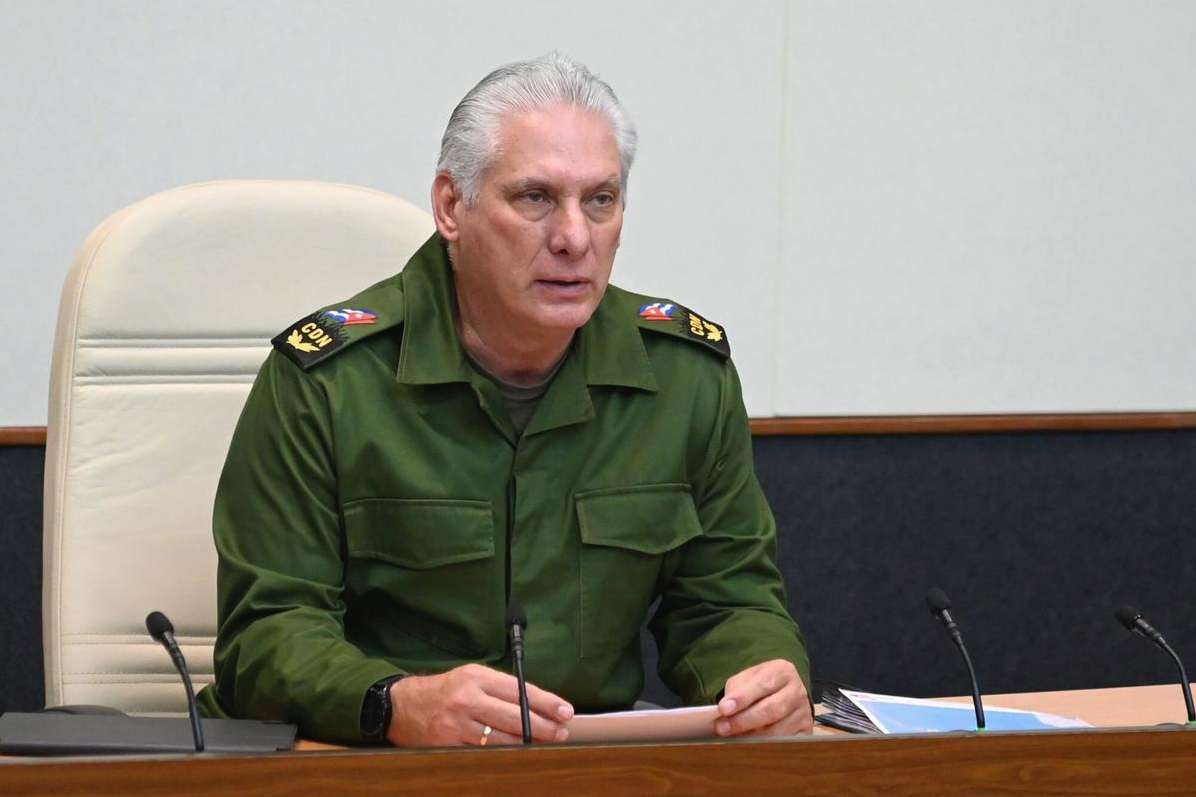
Amid citizen protests, massive blackouts across the island, economic crisis, food shortages, and pressure from the United States, President Miguel Díaz-Canel announced to the nation that he had initiated talks with the United States. The news sparked speculation about a possible change in power. And indeed, the capture of Nicolás Maduro on January 3, 2026, was a message to Havana: either open channels of dialogue or end up like the Venezuelan leader.
Donald Trump has insisted on a takeover of Cuba since February 24 in the State of the Union Address, when he pressured countries supplying oil to the island—such as Mexico—to stop doing so. Maduro’s capture was accompanied by an oil blockade against the island that has generated a profound energy crisis. The country has been left in darkness, triggering protests not seen since 2021.

However, beyond Trump’s pressures and the desperate conditions faced by Cubans, there is a fundamental element that may further complicate a possible Cuban transition: the island has a state party. Political scientists such as Seymour Martin Lipset or Stein Rokkan define this system as an extension of the mass party that merges with the structure of the state, where party members occupy bureaucratic positions. Socialist one-party states are characterized by having an official ideology defined by the ruling party, which controls the media, the economy, and the armed forces.
After the 1959 Revolution, Cuba suppressed all remnants of opposition through exile, imprisonment, torture, and a politics of fear. Fidel Castro replicated the institutional design of the Soviet Union—that is, the foundations for a socialist elite to govern indefinitely. The newspaper Granma is the government’s official media outlet, the Communist Party of Cuba is the only avenue for ascending the social pyramid, the intelligence apparatus is a pillar for controlling dissent, and Marxism-Leninism is the ideology that dictates how citizens should behave.
The state party is responsible for nominating candidates to the National Assembly of People’s Power and is the backbone of authoritarianism. The elite—composed of military figures and bureaucrats—is essential to the regime’s functioning. Meanwhile, the Central Committee, the highest body, is tasked with proposing candidates to the Politburo and outlining the party’s work at the national level. The state party maintains power, supported by affiliated organizations of students, unions, farmers, journalists, and the Committees for the Defense of the Revolution, which serve as the first point of contact with citizens.
Although the country approved a new Constitution in 2019 establishing that the president can only serve two consecutive terms, this was a superficial change. The elite’s argument was to promote leadership renewal in order to modernize the course of the revolution. The rotation of leaders and elites is essential, especially because generational turnover would bring fresh momentum to the revolutionary path.
With Díaz-Canel’s arrival to the presidency in 2021, Cuba began a process of “de-Castroization”—that is, the revolution’s direction shifted due to the exhaustion of its discourse and the absence of a strong caudillo. Since then, and particularly since the Covid-19 pandemic, the executive has faced major mobilizations. Blackouts and food shortages have become increasingly frequent, and repression has become a central element of his government.
Recently, the Cuban government opted for an economic reform in response to the crisis facing the island. The central objective is to attract investment that would allow the government to modernize electrical infrastructure, the hotel sector, the banking system, and mining. This internal “Perestroika,” as the government calls it, allows Cuban exiles to invest in state-owned enterprises, open bank accounts in Cuban institutions, and create strategic partnerships in the country’s agricultural sector.
These changes are not only aimed at reactivating the economy but also represent a shift in official ideology. Socialism does not allow private ownership of the means of production; therefore, the state’s association with private capital represents a radical change. For decades, the revolutionary government expropriated and collectivized enterprises; today, in order to survive, it seeks to introduce capitalist reforms.
Despite the deep crisis facing the island, this does not mean the regime’s collapse is imminent. In fact, at moments like this, the structure is put to the test and tends to become more radicalized. On the other hand, pressure from the United States is a decisive factor, but the elite negotiating with Washington will not surrender the structures of power—it will seek to bargain. As Díaz-Canel himself stated: “cooperation and respect within our political system.”
The structure of the Cuban state is solid, and its institutional design has allowed it to survive numerous crises. The state-party system has withstood U.S. pressure throughout the 20th century, the collapse of the Soviet Union, the so-called Special Period, and the Covid-19 pandemic. But this time, the Cuban elite has understood that it has no alternative but to open up to avoid the fate of Maduro.
Autor

Political scientist from UNAM with a diploma in journalism from the Carlos Septién School of Journalism.