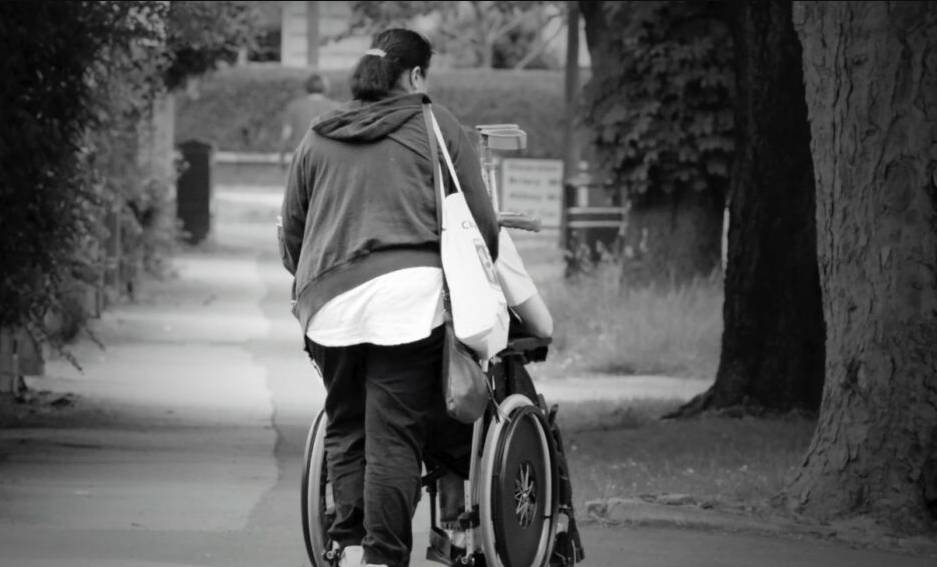
At five thirty in the morning, Carmen is already awake. Before she can even think about having breakfast, she has to help her mother get up, prepare her medication, get the food ready, and arrange for someone to stay with her during the day. Then she will go to work and, if everything goes well, return home in time to resume her caregiving duties. If something goes wrong, she will have to ask for permission to leave, miss work, arrive late, or deal with whatever no one else can handle. Carmen will probably say she is taking care of her mother, not that she is working.
Carmen’s story is, unfortunately, a daily reality for millions of Latin American women, upon whose shoulders rests the care of older adults, almost entirely alone.

The study Who Cares? How to Support and Ensure Recognition for Caregivers for Older People in Latin America and the Caribbean, prepared by the Inter-American Development Bank, the Organisation for Economic Co-operation and Development, and the French Development Agency, offers figures that should compel us to view care as an urgent economic and political issue. The region is aging at a breakneck pace, yet its social protection structures remain stagnant.
Currently, around eight million people aged 65 and older need assistance with basic activities of daily living. By 2050, this figure will have tripled. This is a serious concern because the gap between the demand for care and its availability is growing exponentially, while public care systems remain markedly inadequate.
Businesses need workers who arrive on time, can concentrate, and fulfill their working hours. Families need to meet care needs that public services do not cover. The economy needs someone to prepare meals, provide companionship, supervise, attend to people’s needs, organize medication, and remain available when a dependent person requires assistance. That someone is usually a woman.
Unpaid support and the gender trap
Currently, around 25 million people over the age of 15 provide unpaid care to older adults in the region, devoting an average of 7.5 hours per week to these activities. Nearly six in ten are women, who also spend more hours per week on caregiving than men.
But the hours devoted to these tasks tell only part of the story, because women tend to take on precisely the least flexible and most demanding responsibilities, such as preparing meals, bathing and feeding people, accompanying them to medical appointments, or remaining on call for a dependent person without support, resources, or specific training.
This so-called “passive care” is particularly revealing because it shows how women’s time can be held hostage, even when they actively participate in the formal labor market. The study notes that this burden limits their opportunities for paid employment, education, and leisure.
The result is a silent transfer of resources from women to their families, their employers, and the economy as a whole. Women absorb, through their time, a responsibility that would otherwise have to be met through public services or private solutions if it were not being provided free of charge.
Inequality persists in paid care work
The reality is that care is feminized, whether it is unpaid or paid. But when care enters the labor market, inequality does not disappear; on the contrary, it is reproduced. The paid care workforce is made up predominantly of women, and working conditions reveal worrying levels of precarity, illustrating a systemic case of “sticky floor”.
This burden exacts a severe toll on women’s employment and economic prospects because even those who manage to remain in the labor market must reduce their working hours by an average of two hours per week. According to the International Labour Organization, 47% of caregivers reduce their working hours or leave paid employment because their caregiving responsibilities are incompatible with the full availability demanded by the labor market.
This amounts to an “invisible and heavily feminized tax” that reduces their income, stalls their professional development, and condemns their future pensions to insecurity. Labor protections also fail to reflect the importance of their work. On average, according to the IDB survey, only slightly more than half of paid caregivers in the region contribute to social security.
Moreover, more than seven in ten caregivers surveyed report experiencing unhealthy levels of stress, loneliness, or symptoms of depression. The paradox is that caregiving can also bring satisfaction, strengthen bonds, and provide a sense of purpose. The problem arises when the ability to care becomes an obligation to remain constantly available. This is why including care on the public policy agenda is so important.
The IDB study warns that the region will need to significantly expand its care workforce and invest in training, professionalization, emotional support, and leave provisions for caregivers. The challenge is to build systems capable of distributing a responsibility that today falls disproportionately on women.
The challenge is enormous because public coverage remains minimal. Only 5% of older adults with care needs receive publicly funded services. Meanwhile, demand is growing, families are shrinking, and millions of women continue to subsidize a care system with their time, their physical and mental health, and their employment opportunities—a system that still depends far too heavily on them.
The debate on care should become an integral part of discussions about employment, productivity, social security, pensions, poverty, and economic growth. Businesses will have to ask themselves how much of their productivity rests on the invisible time of their female employees. Governments will have to calculate how much it costs them to continue leaving care in the hands of families, and men will have to recognize that the responsibility for sustaining life should never have fallen solely on women.
Carmen is not helping her family when she stops working to provide care; she is doing a job. When women are expected to care for older people for free, a cost that should be shared is being shifted onto them. The problem is that this female subsidy has operated for far too long on unfair, stereotypical assumptions, and what costs the state and businesses nothing is proving enormously expensive for women.
The region’s future well-being will depend on society’s ability to stop treating this kind of work as a morally sustainable, inexhaustible, and free resource.
Autor

Psicóloga. Master en Políticas Públicas con enfoque de género. Especialista en Transformación Cultural y Coaching Ontológico. Directora de FeminismoINC. Autora de "Incomodar para Transformar" y "Atrevidas: Manual de trabajo personal por el activismo feminista".