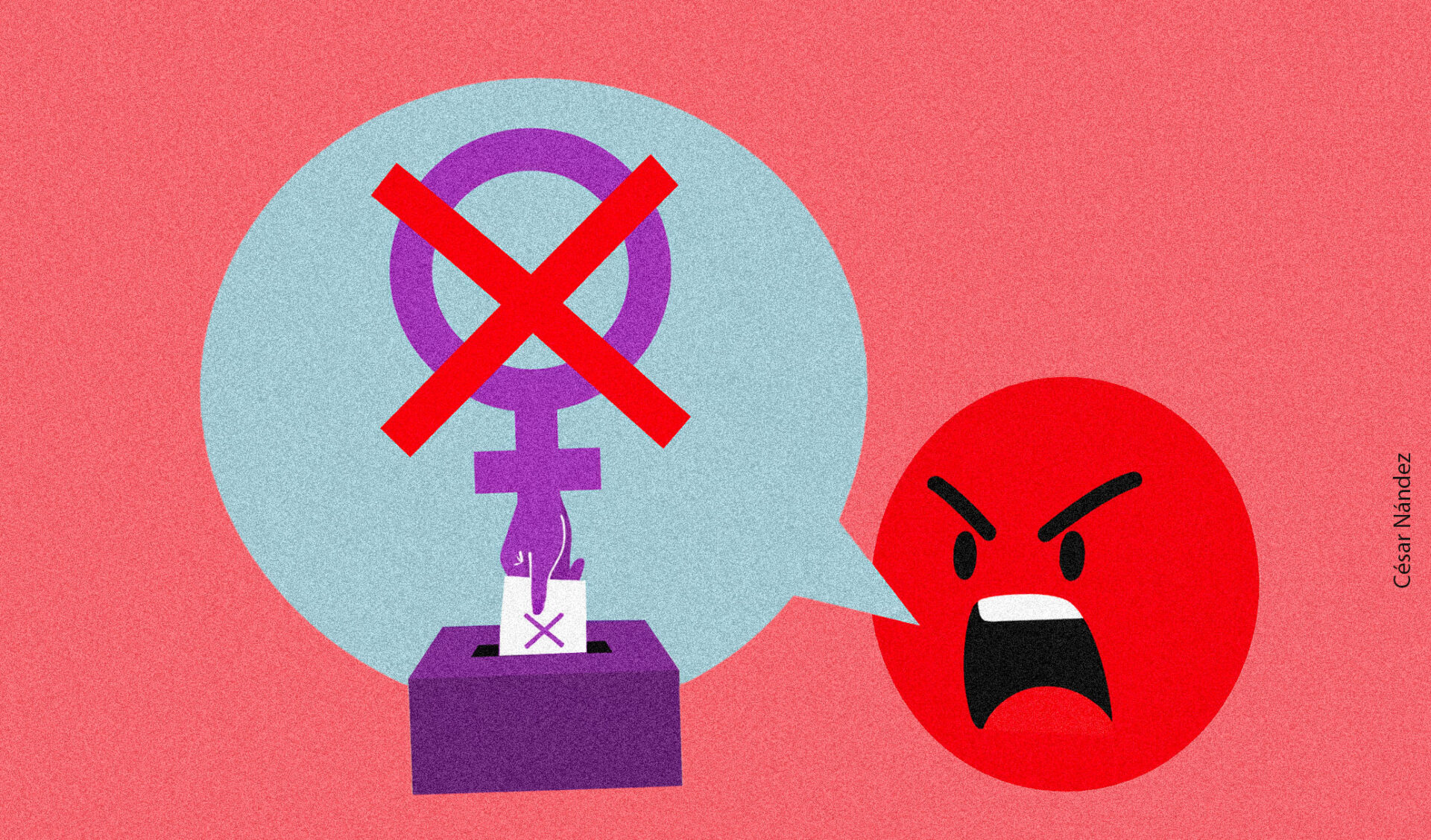
“Democracy was ruined when women started voting”; “Women vote with their emotions, not reason”; “Female suffrage was a mistake”; “Women should lose the right to vote to save civilization”… In digital forums, podcasts, and some public gatherings, an extremist discourse has begun to take shape—one that until recently seemed unthinkable—around the idea of stripping women of the right to vote.
These messages, often delivered in a provocative tone, have recently spread across social media to influence young men, echoing the misogynistic rhetoric that we have seen intensify recently. Some public or political figures have supported these positions, generating controversy by casting doubt on such fundamental civil rights. In the United States, for example, there is a social media movement called #Repealthe19th that advocates repealing the 19th Amendment to the Constitution to restrict or eliminate women’s right to vote in that country.

Although its actual reach remains limited, the transnational circulation of these messages is symptomatic of the radicalization of certain male spaces that, fueled by economic, cultural, and political frustrations—or by a sense of “wounded masculinity”—seek to redefine the values and basic rules of democracy.
These movements, often associated with the ultraconservative right, frame women’s empowerment and reproductive rights as threats to a Christian or nationalist culture, using the concept of “replacement” not only in demographic terms, but also cultural ones. They seek to roll back acquired rights by portraying women’s autonomy as a form of social division, labeling it “gynocentrism”—a word absent from the dictionary but intended to promote the idea that feminism is a vengeful movement.
The problem is that this argument functions as a mobilizing tool because it offers a simple and emotionally powerful explanation for those who perceive a loss of status. This current seeks to limit women’s political participation based on the belief that men hold ultimate authority within the family and that women are not meant for the public sphere. In other words, it represents a return to the traditional model of sexist public-private division.
This type of exclusion is not merely theoretical. We have the case of various Indigenous communities in Mexico, particularly those governed by internal normative systems commonly known as “customary practices and traditions,” where numerous cases have been documented of men limiting or preventing women’s political participation under the claim of preserving tradition. This is political violence, not the rescue of traditional values — though it seems that certain privileged, self-described “civilized” male groups want to imitate it.
Digital platforms such as Reddit, X, and YouTube have enabled the proliferation of communities where currents within the so-called manosphere converge, alongside incel (involuntary celibate) activism and the tradwife (traditional wife) movement, all of which continue to expand and fuel debate over the role women, according to them, should play in contemporary society.
Some actors linked to ultranationalist and authoritarian movements find this type of discourse to be a useful tool for polarizing and mobilizing their bases. For that reason, the delegitimization of women’s voting rights fits into a broader framework of questioning democratic institutions, media outlets, and electoral systems. It is no coincidence that these messages appear alongside conspiracy theories about electoral fraud or an alleged global “social engineering” agenda. On the other hand, these views have gained greater traction following the perception that women tend to vote predominantly for the left, generating discomfort among ultraconservative sectors.
When women’s suffrage is questioned, the principle of political equality that has underpinned modern democracies since the 20th century is also called into question. Women’s right to vote is neither a recent nor fragile concession, but rather the result of decades of struggle by the suffragist movement, which transformed entire political systems. Dismantling it would therefore open the door to a far broader regression in civil rights.
The danger lies not only in the possibility—hopefully remote—that such proposals could translate into public policy. For me, the real risk is the normalization of the discourse itself, because when openly anti-democratic ideas like these begin circulating with less resistance, the threshold of what is considered acceptable shifts. This phenomenon has been widely documented in studies on political extremism, which warn that the constant repetition of radical messages can erode basic social consensus even without becoming law.
Feminists already know all too well that advances in equality are never completely guaranteed. Therefore, what remains for us as organized citizens is to explicitly strengthen young people’s critical digital literacy so that they question not only what they hear or see, but also understand what lies behind platforms designed to provoke anti-rights reactions. We must prevent, at all costs, ideas that today seem marginal from finding more fertile ground tomorrow.
Universal suffrage is the foundational pillar of any democratic society. Questioning it through arguments rooted in misogyny and gender prejudice is ethically and intellectually indefensible and, above all, politically dangerous, because history has shown with sufficient clarity that rollbacks in rights rarely happen to only one group.
Autor

Psicóloga. Master en Políticas Públicas con enfoque de género. Especialista en Transformación Cultural y Coaching Ontológico. Directora de FeminismoINC. Autora de "Incomodar para Transformar" y "Atrevidas: Manual de trabajo personal por el activismo feminista".