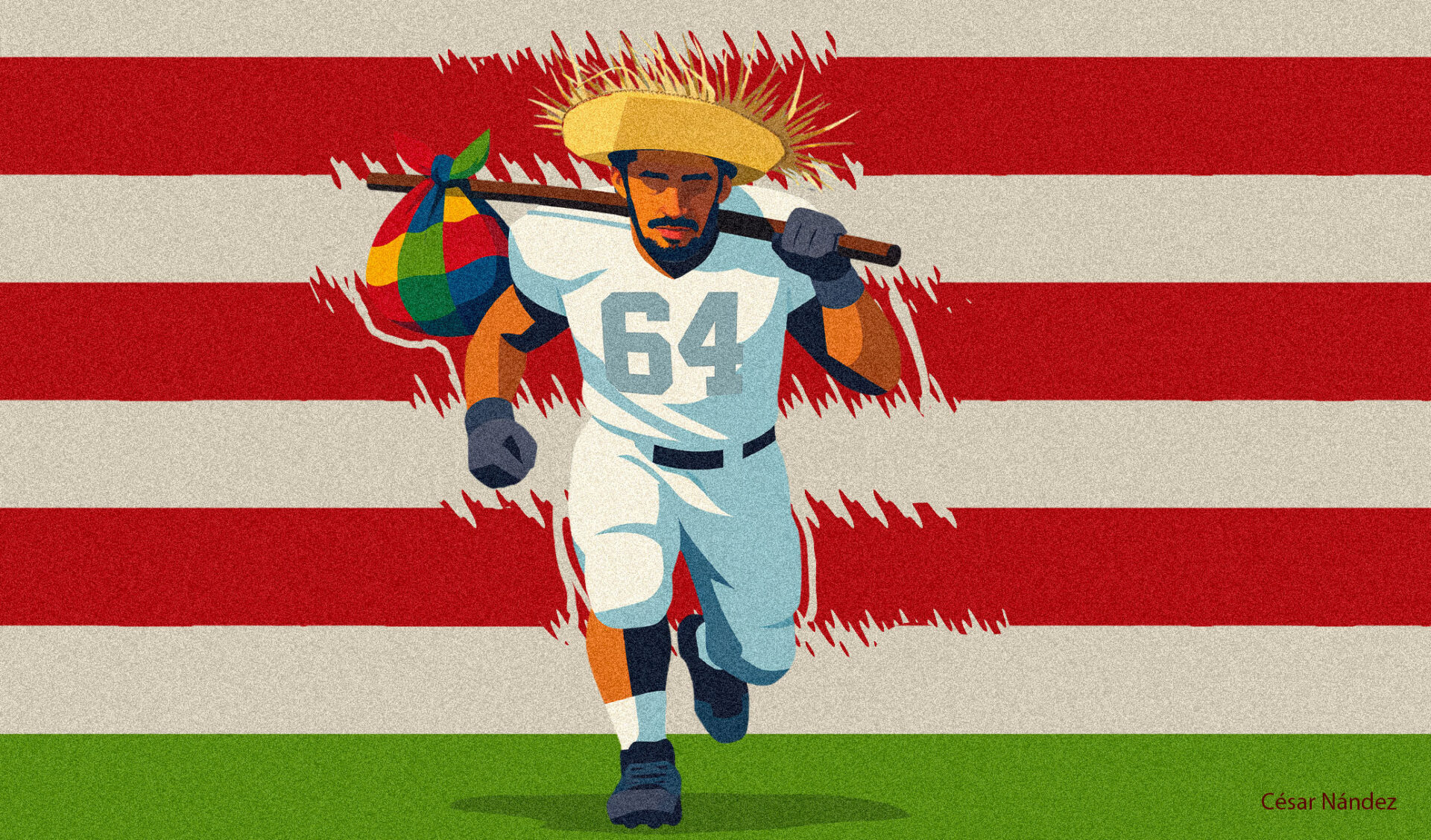
Amid the most polished, commercial, and quintessentially American spectacle—the Super Bowl—a Puerto Rican dressed like a Harlem street vendor climbed onto a beat-up car and, without asking permission, took the microphone. He did not come to assimilate or to smile, nor to thank anyone for the opportunity. He came to set up an entire barrio in the middle of a football field, to pour drinks in a corner store, to recall the bloodied hands of the sugar harvest, and to make 134 million people perrear. Bad Bunny did not merely offer a show; he detonated a perfectly choreographed act of cultural insubordination, a political manifesto wrapped in reggaeton that laid bare the wounds of a migrant Latin America and unleashed the predictable fury of a right wing in the midst of a geopolitical and domestic offensive.
This was not mere entertainment. It was the spearhead of a battle for hegemony, in the most Gramscian sense of the term. While Donald Trump and his accomplices ranted with the utmost contempt on social media, millions of Latinos—from grandparents in Miami and Chicago to young people in California and New York—recognized themselves in every detail of that set design. The message was clear and confrontational: this is our story, this is our music, this is also our country, and we do not need your approval to sing and dance, to exist.

From perreo to urban symphony: the artistic evolution of a marginal genre
For decades, cultural elites—including many within Latin America itself—looked down on reggaeton. It was labeled simplistic, repetitive, vulgar, confined to explicit sexual expression and ostentatious clothing. Bad Bunny’s show elevated the language of the alleyway into a visual and sonic epic. He did not abandon perreo; he set it in dialogue with history.
The most sublime and political moment was the transition. As backup dancers performed salsa in an elegant red convertible, Bad Bunny, at the center, imposed a cavernous, percussive rhythm. It was not a mashup; it was a generational conversation with salsa, that genre created by Caribbean and Puerto Rican migrants in New York neighborhoods in the 1970s. Reggaeton is its rebellious, digital, streetwise grandson. Together on that stage, they traced an uninterrupted lineage of sonic resistance. It was the artistic answer to an unasked question: “Where does this come from?” The reggaeton artist replied defiantly: from us. From our ability to create beauty in adversity.
This qualitative leap is not innocent. It demonstrates that artists born in the marginalized neighborhoods of San Juan, Puerto Rico, or Panama have the capacity, complexity, and depth to create and recreate musically their past and present experiences at the very center of the empire and, from there, tell their own version of history. It is no longer the music that casually plays at the party; it is the music that gives meaning to the celebration.
The little house, the corner store, and the sugar harvest: the visual dictionary of migration
Any Latino who grew up in a U.S. city instantly recognized that stage. It was not a fantasy; it was collective memory turned into scenery. The Puerto Rican little house with its tiles and bright colors: it is not a quaint cottage, it is the dream of owning a home, the nucleus of the extended family, the piece of the island rebuilt in the Bronx or in Orlando.
The folding metal chairs: the universal furniture of garage parties, of grandma’s birthday, of the child who falls asleep at 3 a.m. while the adults keep dancing. It is the chair of community, easy to arrange and move because the indoor space is small, but the desire to celebrate is immense.
The streetlight on the neighborhood corner, witness to childhood games, furtive romances, and late-night conversations. The reference point on an emotional map. A streetlight that goes out every week because of the authorities’ incompetence.
Toñita’s corner store: this was a pivotal detail. Toñita, owner of “Toñita’s Sports Bar & Grill” in the Williamsburg neighborhood of Brooklyn, is a living legend. For decades, her business has been much more than a bar: it is a community center, an unofficial social assistance office, a refuge. Seeing her there, serving Bad Bunny a drink, was to canonize the figure of the community matriarch, the one who sustains the invisible network the American Dream neither knows nor acknowledges.
The sugar harvest: the hardest and most poetic blow. Men with machetes, sweat, and agricultural labor. It is the memory of origins, of the colonial exploitation that forced massive migrations. A lyric that seemed to say: “Before our rhythm filled your stadiums, our hands filled your cups with sugar.”
And then, the culmination: the parade of flags. Not only the Puerto Rican flag, but those of all Latin America. The message was a slap to the idea of “America” as the exclusive property of one country. This continent has many names, many histories, and all of them were there, walking across a football field. It was the reclamation of an entire hemisphere within the borders of the nation that appropriated its name.
The rage of power: why Trump and his court reacted with visceral hatred
The reactions were immediate. Donald Trump, on his Truth Social platform, called it “horrible” and “the worst performance in history.” Commentators on Fox News spoke of “trash,” “vulgarity,” and an “attack on American values.” They did not criticize pitch or choreography (a legitimate aesthetic critique). Their attack came from the gut, loaded with acidic adjectives and a contempt that betrayed panic.
Why this fear? Because they understood the message better than anyone. Bad Bunny was not asking for a seat at the table. He was shaking the table and showing that millions were already seated at it, eating their own food, speaking their own language. The show was an act of hegemony in real time: the seizure of the supreme symbol of commercial American sport to narrate a story contrary to “Make America Great Again.” A story of diversity, of migrant resistance, of racial pride, and of joy as a political weapon.
The furious reaction proves the blow landed. Gramsci would say the cultural “trench” had been successfully stormed. This is not a war of tanks; it is a war of meanings. And that night, the meaning of “American” expanded violently—and some reacted for powerful reasons.
Grandparents perreando: the expansion of the audience and collective emotion
A myth collapsed: that perreo belongs only to Generation Z. Cameras captured mothers, fathers, and grandparents swaying and moving in the stands. In homes across the continent, entire families sang “Tití Me Preguntó” and recognized grandma’s little house through the images delivered by the most sophisticated technology.
The emotion unleashed was not about Bad Bunny’s fame, but about the act of recognition. For the first time on a stage of that magnitude, the Latino migrant experience was not the joke, the stereotype, or the exotic backdrop. It was the absolute protagonist, in all its texture: nostalgia, effort, community, celebration as catharsis. Those tears were the surprise of feeling fully seen, without filters and without apologies. Reggaeton thus completed its cycle: from dark-room music to a cross-generational anthem capable of uniting the diaspora in a single cry of belonging.
Beyond the show: the dawn of a narrative
Does this constitute an alternative narrative to Trump’s? I believe it goes further; it is his real-time antithesis and his greatest nightmare. For various reasons, each of which can be widely debated and enriched:
This narrative generates a powerful emotional response. While Trump mobilizes through fear and nostalgia for an imagined white past, this narrative mobilizes through love, combative joy, and nostalgia for a real and shared origin. It also spans historical time: it connects the colonial agricultural past, the migrant urban present, and projects a future of Latin American unity (the flags). An epic in 12 minutes.
This discourse was also instantly decodable by its community: each symbol was a word in a language that 63 million Latinos in the United States understand perfectly. No translation was needed. At the same time, it provoked a reaction from its adversary: the fury of the right is the certificate of authenticity of its disruptive power.
Finally, it defined the battlefield. On one side, exclusionary, white, nostalgic nationalism. On the other, the diverse, mestizo, multicolored Latino archipelago proclaiming that “love is stronger than hate,” the closing slogan that dazzled across the stadium’s giant screens.
Bad Bunny’s halftime show was far more than a concert. It was the storming of the cultural Bastille. It demonstrated that true power does not always lie in formal political authority, but in the capacity to tell the story that millions live. And that story, told through the art of music and dance, is unstoppable. This battle for hegemony presents itself as decisive in a war that began forcefully at the start of this century, and that a decade earlier had been foreshadowed by Samuel Huntington in his book The Clash of Civilizations.
Autor

Professor and researcher at the Center for Research in Social Sciences and Humanities of the Autonomous University of the State of Mexico. Former President of the Mexican Association of Political Science (AMECIP). PhD from FLACSO-Mexico.