After years of political crisis, mass migration, and social fragmentation, Venezuela has not only been divided geographically. It has developed two parallel experiences of the country: that of those who remain within it and that of those who sustain it from afar.
This separation is no longer merely a consequence of the crisis. Today, it functions as a structural obstacle to any process of national reconstruction. It is not a matter of two different countries, but of two experiences of the same country that have failed to recognize one another.

The idea of two Venezuelas has shaped how the country has been understood in recent years. However, a broader perspective—similar to what occurs in other migratory processes in Latin America—reveals that while the experience is fragmented, the wound is shared. This disconnection does not only describe the present; it conditions the viability of any scenario of reconstruction.
Those who remain in the country carry the burden of daily wear, uncertainty, and a largely unrecognized resilience. Those who emigrated face guilt, nostalgia, and the experience of living between two places. Both perspectives are partial, yet indispensable for understanding the country. The problem is not their existence, but the lack of recognition between them.
This lack of recognition is not merely symbolic. It has direct effects on politics. It hinders the construction of common agendas, fragments priorities, and weakens the possibility of articulating leadership with broad legitimacy. While one part of the country operates under daily urgency and another from a distance, coordination among actors becomes fragile and dependent on circumstances rather than sustained structures, limiting the ability to maintain forms of collective action over time.
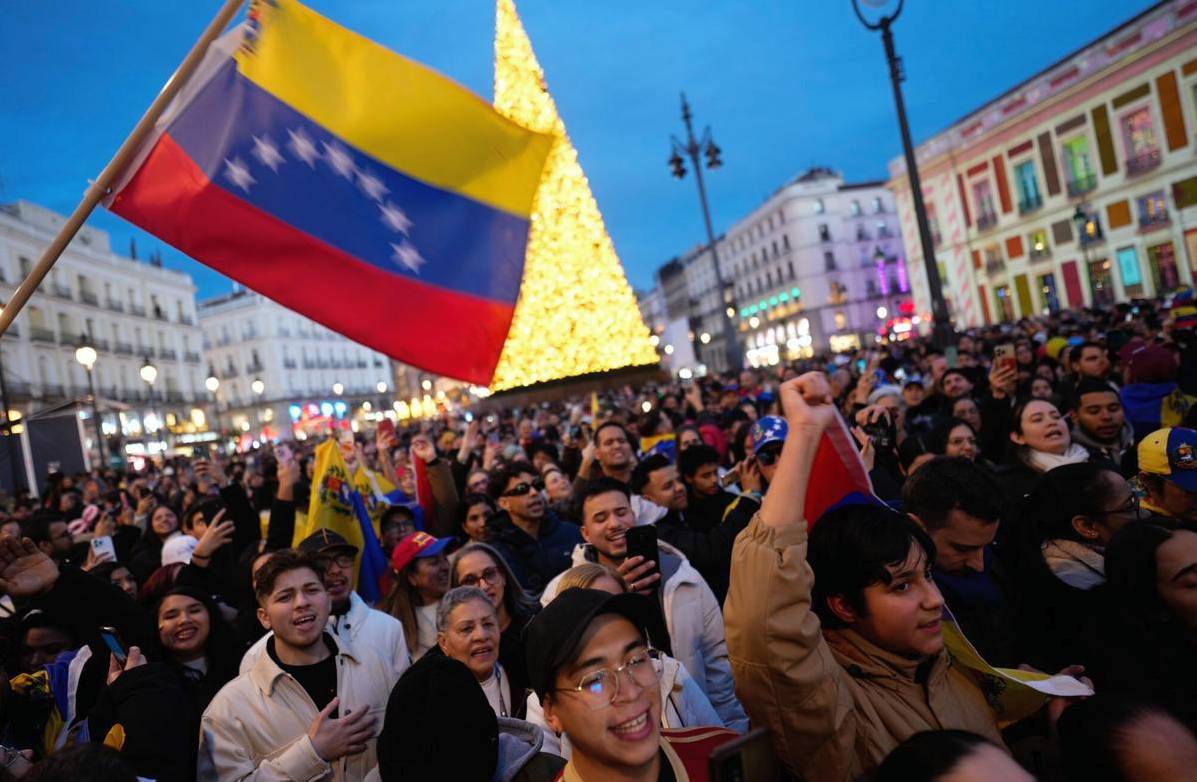
Recent episodes, such as the racist chants at the event led by María Corina Machado in Plaza del Sol in Madrid, show the extent to which polarization is reproduced outside the country. In spaces of political mobilization abroad, the language of confrontation tends to replicate the same logics of exclusion that have marked the country’s internal dynamics, making it difficult to build minimal frameworks of recognition among actors. This type of language not only reflects polarization; it reproduces and normalizes it as a form of political action.
The subsequent reaction, which included public corrections, sets a limit. It does not resolve the problem, but it confirms that even in contexts of high confrontation, the need for restraint persists. This point of friction reveals that reconciliation is not a symbolic gesture, but an unresolved condition.
In this context, reconciliation ceases to be a slogan and becomes an operational condition. Without reconciliation between the Venezuela inside and the one abroad, any attempt at institutional reconstruction will be incomplete and fragile. Without that recognition, the fracture not only persists: it becomes a mechanism that reproduces distrust, limits coordination among actors, and weakens the capacity to build sustainable minimal agreements.
Comparative experience in Latin America shows that transition processes are not sustained solely by agreements among political elites, but by the ability to integrate actors operating outside the immediate territory of the state. In Colombia, for example, the diaspora was incorporated into participation mechanisms through consultations and deliberative spaces linked to the peace process. In El Salvador, the recognition of external voting rights and the structural weight of remittances forced a redefinition of the relationship between the state and its citizens abroad.
These mechanisms did not by themselves resolve internal tensions, but they allowed the integration of a dimension that otherwise would have remained disconnected from the political process. The difference in the Venezuelan case is that such integration is not yet part of its political architecture.
In Venezuela’s case, the diaspora is not a peripheral actor; it is a structural component of the contemporary country. Its exclusion from mechanisms of political deliberation not only reduces the representativeness of any agreement, but also introduces a form of fragmented political legitimacy that limits its long-term viability.
The dispute over legitimacy—who understands the country better, who suffers it more—is not merely symbolic. It has concrete effects on the capacity for coordination among political actors, on the definition of common agendas, and on the construction of sustainable agreements. When this dispute remains unresolved, fragmentation ceases to be a diagnosis and becomes an operational obstacle.
Reconciliation, in this context, cannot remain an abstract appeal. It requires concrete forms of articulation between both experiences of the country. This implies opening mechanisms for transnational political participation, recognizing the representation of the diaspora in deliberative processes, and building institutional spaces where these two experiences can meet without one invalidating the other. This becomes even more relevant in a context where mass return is not an immediate possibility, making transnational participation an operational path to integrate this dual experience of the country. Without these mechanisms, the diaspora remains a relevant but politically incomplete actor.
Ultimately, reconciliation is not only an agreement among actors, but a redefinition of the political community: who belongs to it, from where, and under what conditions.
A society’s capacity to reconcile with itself defines its ability to move forward. Without this step, any political change will continue to operate over an unresolved fracture—a dynamic also observed in other Latin American societies marked by prolonged migratory processes.
Reconciliation between the Venezuela inside and the one abroad is not an automatic outcome of political change. It is a prior condition for that change to be sustainable. Without this mutual recognition, any transition process will begin with incomplete legitimacy and a limited capacity to sustain agreements over time. The question, then, is not whether reconciliation is desirable, but whether the country is willing to assume the political cost of building it.
Autor

Writer and consultant in political and institutional communication. He analyzes politics, society, and mobility dynamics in Latin America, with an emphasis on their institutional implications and the construction of political community.