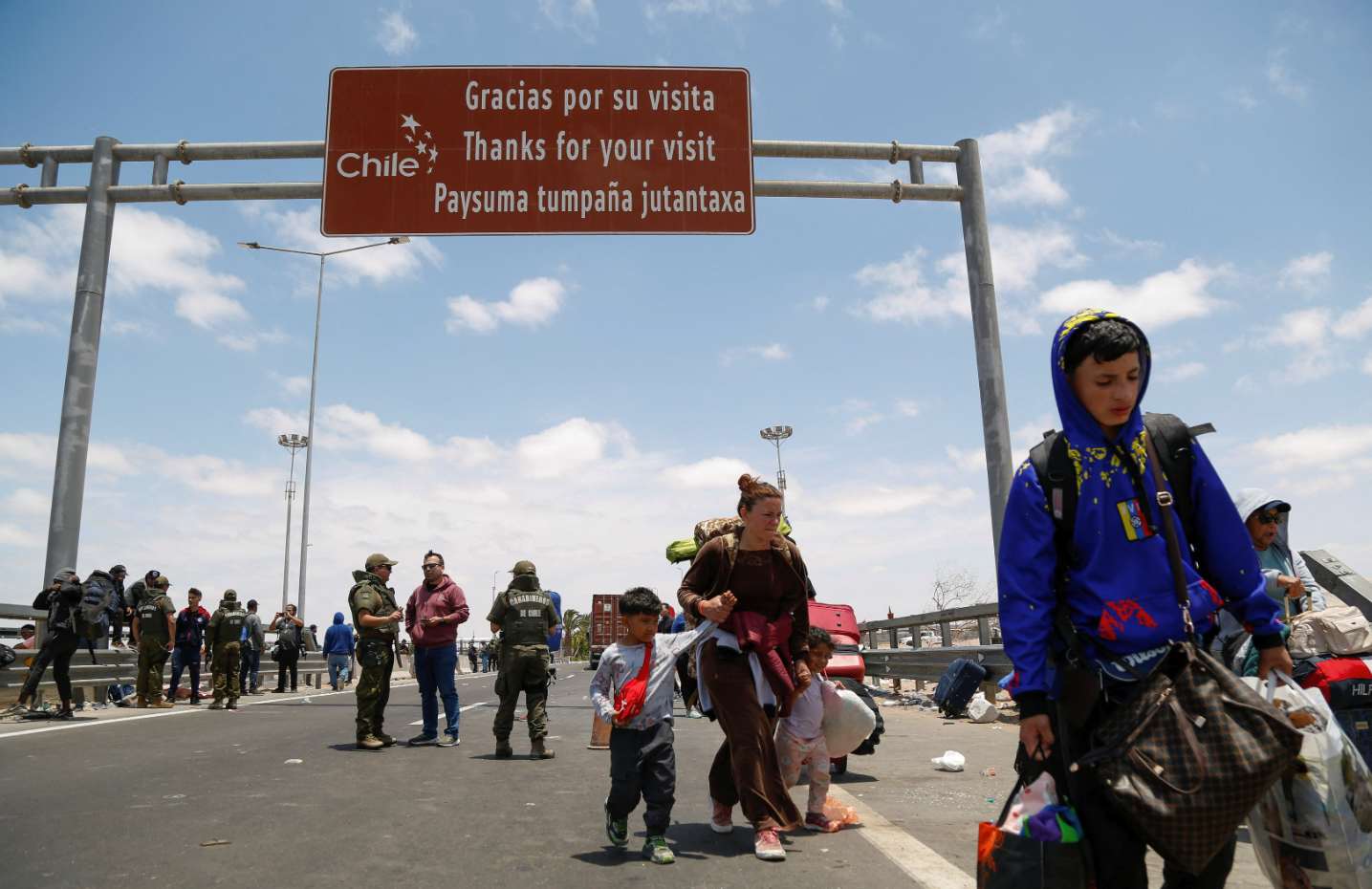
The proposal to expel irregular migrants promoted by President-elect José Antonio Kast, and particularly the idea of a so-called “humanitarian corridor” from Chile to Venezuela, has managed to firmly establish itself on the public agenda. The relevance of this proposal lies in the fact that it connects with a widespread sense of public unease regarding the loss of border control, the local impact of irregular migration, and the feeling that the State arrived late and poorly prepared to confront the phenomenon.
However, it is not clear that the proposal is viable and sustainable, as it implies coordination among Chile, Peru, Ecuador, and Colombia in a region where foreign policy is volatile and overly dependent on the political orientation of governments. Even in cases of governments with ideological proximity, such cooperation can be difficult. The President of Peru, José Jerí, has stated that he has ruled out the idea of the humanitarian corridor.

With regard to domestic politics, beyond the initial support it may generate, this proposal poses at least three risks that deserve close attention.
The first is the risk of political tension between the government and the parliamentary opposition. The expulsion of irregular migrants is not a neutral measure when it involves people with high levels of rootedness—that is, established families with Chilean children, labor ties, or community connections. In such cases, expulsion is not merely an administrative decision, but an act with strong human and symbolic implications. It is foreseeable that these episodes will generate friction not only with the opposition, but also within the governing coalition itself, where more moderate sensitivities exist regarding how to address irregular migration. In a highly fragmented political system, this type of tension can become a centrifugal force that complicates the relationship between the Executive and the Legislative branches.
It is likely that, in an initial stage, this policy will enjoy majority support, both among public opinion and within the party system. But that initial backing could prove fragile in the medium term. As the process encounters difficulties such as complex cases, adverse media coverage, or judicial conflicts, reputational costs will begin to accumulate. And in politics, few things erode a coalition more quickly than a measure that generates high symbolic costs without visible long-term results.
The second risk is judicialization. In a state governed by the rule of law, expulsions do not take place in a vacuum. If there are no clear protocols, transparent procedures, and well-defined criteria—if, for example, the expulsion decision were to override any of the principles that inform Sanctioning Administrative Law (legality, typicity, proportionality, culpability, due process, non-retroactivity, and non bis in idem)—it is highly likely that many migrants will turn to the courts to halt imminent expulsions. The constitutional action of amparo has historically been one of the effective tools in this area: the Supreme Court has upheld in the past more than 40% of such amparos filed against administrative expulsions. Moreover, there is a special action that is widely used in practice: the appeal provided for in Article 141 of Law No. 21,325.
The questions that immediately arise are obvious: does the Chilean State have the capacity to face this process? Do we have an administrative authority capable of issuing tens of thousands of expulsion orders, with full respect for the aforementioned principles and addressing each case individually? Will the courts of justice be able to resolve tens of thousands of actions that may be brought before them as a consequence of those administrative acts without further clogging an already overburdened judicial system?
This means that a policy designed to be rapid and effective in the short term can turn into a slow, fragmented, and judicially blocked process. Added to this is the fact that many migrants can demonstrate significant rootedness in Chile, whether for family, labor, or social reasons, which strengthens their chances of success before the courts. In addition, international law is clear in stating that expulsions must be individual. The jurisprudence of the Inter-American Court of Human Rights expressly prohibits mass expulsions without a case-by-case analysis, which severely limits any attempt to speed up the process through administrative means.
The third risk is fiscal and budgetary. The figures being discussed—more than 320,000 migrants in an irregular situation (SERMIG–INE)—imply a considerable volume of resources. Transfers, custody, administrative processing, consular coordination, and potential judicial proceedings involve costs that are far from marginal. In a context of fiscal constraints, indebtedness, and commitments to austerity, it is legitimate to ask how long a policy of this magnitude can be sustained without generating growing objections to the use of public resources, especially when other social priorities are equally urgent.
Taken together, these three factors—political tension, judicialization, and fiscal constraints—configure a significant risk scenario for the sustainability of this policy over time.
The migration debate in Chile demands firm but also realistic responses. Policies with high discursive impact are often effective in structuring debate and winning elections, but not always in solving structural problems. In this case, the real challenge lies not in the announcement itself, but in the State’s capacity to manage its political, legal, and fiscal consequences without the solution ultimately worsening the problem it seeks to resolve.
Autor

Professor in the Department of Political Studies at the University of Santiago, Chile. PhD in American Studies and Master's in Political Science from the same university.