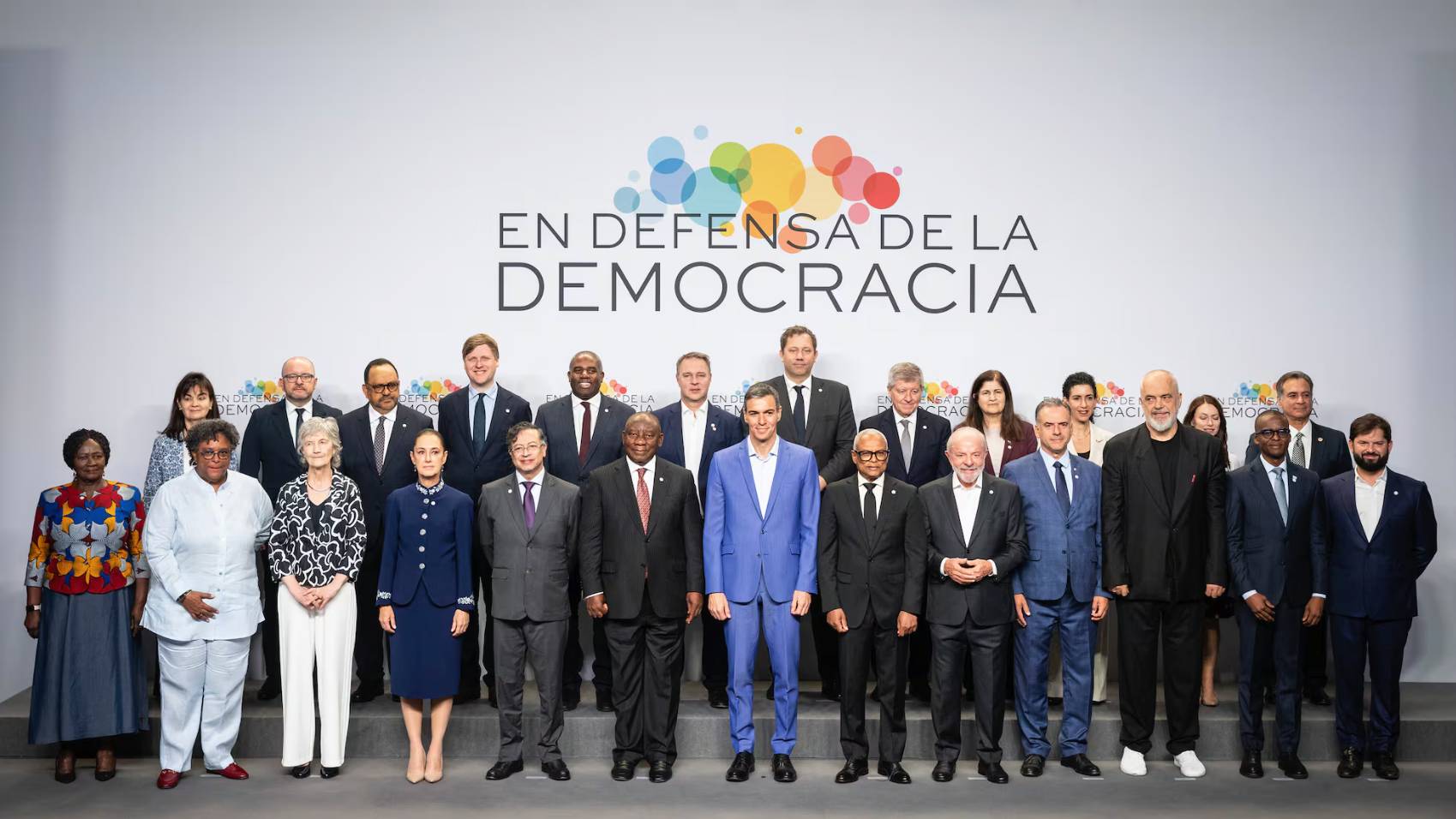
The Global Progressive Mobilization held in Barcelona deserves closer analytical attention than it has received. What superficially appeared as another gathering of like-minded leaders on a European stage was, in fact, something more structurally significant: an attempt to rebuild a shared ideological architecture for Latin American progressive foreign policy at a moment when multilateralism is visibly cracking, as evident in the little involvement of the OAS and CELAC in the variety of crises affecting the region. The meeting was not a coincidence of schedules. It was a political statement.
The talking points were not coincidental either. Mexican President Claudia Sheinbaum pushed for renewed engagement with Cuba. Brazilian President Lula offered an open critique of Washington’s foreign policy under the second Trump administration. Colombian President Gustavo Petro articulated his ongoing mediation efforts in Venezuela, explicitly framing them as a regional alternative to further military escalation. Read in isolation, these are three distinct political calculations from three distinct national contexts. Read together, they constitute something approaching a coherent strategic posture: the reassertion of progressive multilateralism as a counterweight to the consolidation of conservative alignment with Washington.

The historical resonance is difficult to ignore. The Pink Tide of the 2000s demonstrated that when South American progressive leaders coexisted, their foreign policies converged around a proactive diversification of diplomatic, economic, and political relations across the Global South — a strategy aimed at reducing structural dependency on Western hegemonic pressure. The coexistence of Néstor Kirchner, Lula, and Hugo Chávez was not simply an ideological coincidence. It was a structural precondition for the kind of South-South foreign policy activism that produced the rejection of the Free Trade Area of the Americas at the 2005 Mar del Plata Summit.
The Barcelona Summit suggests that the region’s current progressive leaders understand this lesson and are attempting to apply it under qualitatively different, and in several respects more challenging, circumstances.
Those circumstances matter enormously. The 2020s multipolar landscape is not that of the 2000s, as recognized by Brazil’s top diplomatic advisor, Celso Amorim. Trump’s second administration has moved with considerably greater urgency and coercive force in Latin America than his first, as evidenced by the military intervention in Venezuela in January 2026, which violated foundational principles of international law.
Where the Pink Tide could exploit a period of relative US distraction toward the Middle East during the War on Terror, current progressive governments face an administration that has explicitly reasserted the Monroe Doctrine as operational foreign policy. The political space for autonomous maneuvering has not disappeared, but it has been substantially compressed. Progressive governments in the region are no longer navigating a moment of US distraction; they are navigating one of active US reassertion.
The electoral calendar adds further urgency to this ideologically selective form of multilateralism, which seems to be the new normality on the right and the left specters of Latin American politics. Colombia’s upcoming elections, Brazil’s 2026 highly polarized presidential race, and the evolving landscape in Argentina, with Milei’s popularity in dramatic decline but no announced Peronist contender, will determine whether Barcelona represents a durable realignment of progressive forces or a moment of symbolic solidarity without lasting institutional expression. The Global Progressive Mobilization may work to endorse progressive candidates in across Latin America. The presence of Axel Kicillof and Luisa González in Barcelona, representatives of progressive forces in Argentina and Ecuador and possible candidates for their respective presidencies, could signal such a project.
The leaders gathered in Barcelona are attempting to normalize ideologically-selected multilateralism — coordination among progressive governments in the face of conservative hemispheric consolidation — as a standard feature of Latin American foreign policy rather than an exceptional conjunctural response. In doing so, they are responding to The Shield of the Americas and to the alignment of conservative forces with the Trump administration, which represents one vision of Latin America’s future.
Barcelona represents a different case, in which progressive leaders encounter ideologically aligned representatives of the Global South with a sizeable interest in Latin America, as expressed by South Africa’s President, Cyril Ramaphosa. Furthermore, leaders like Boric, Lula, Sheinbaum, and Orsi have built ideologically aligned relations with European partners, primarily with Spain’s Prime Minister, Pedro Sánchez, that are underpinned by material foreign policy components.
For instance, Brazil signed a record number of bilateral agreements with Spain, covering everything from critical raw materials to cooperation in combating racism. Progressive ideology, with populist connotations, represents a starting point for building diversified external relations. This is the best possible outcome for Latin American foreign policies that still need to assert their autonomy in a multipolar world. As shown by Milei’s ties with Israel, which have not produced any sort of tangible outcome, ideology by itself does not benefit foreign policy if not accompanied by a real agenda of political and economic diversification.
Barcelona demonstrated that progressive ideology could serve as a catalyst for foreign policy autonomy and diversification, but ideology alone is insufficient. The Pink Tide precedent shows that South-South momentum requires institutional consolidation to survive electoral cycles and the tumultuous shifts proper to Latin American politics.
Current progressive leaders face a more coercive Washington than their predecessors, making the stakes of the upcoming electoral tests in Colombia, Brazil, and Argentina considerably higher. The material agreements signed with Spain and the engagement with Global South actors like South Africa signal that Barcelona was not merely rhetorical. Whether this translates into durable autonomous foreign policies will depend on whether progressive leaders can convert ideological alignment into a lasting diplomatic and economic architecture.
Autor

PhD candidate at UNU-CRIS and Ghent University. Master's degree in Latin American Studies from Georgetown University and a Master's degree in Diplomacy and International Relations from the Diplomatic School of Spain.