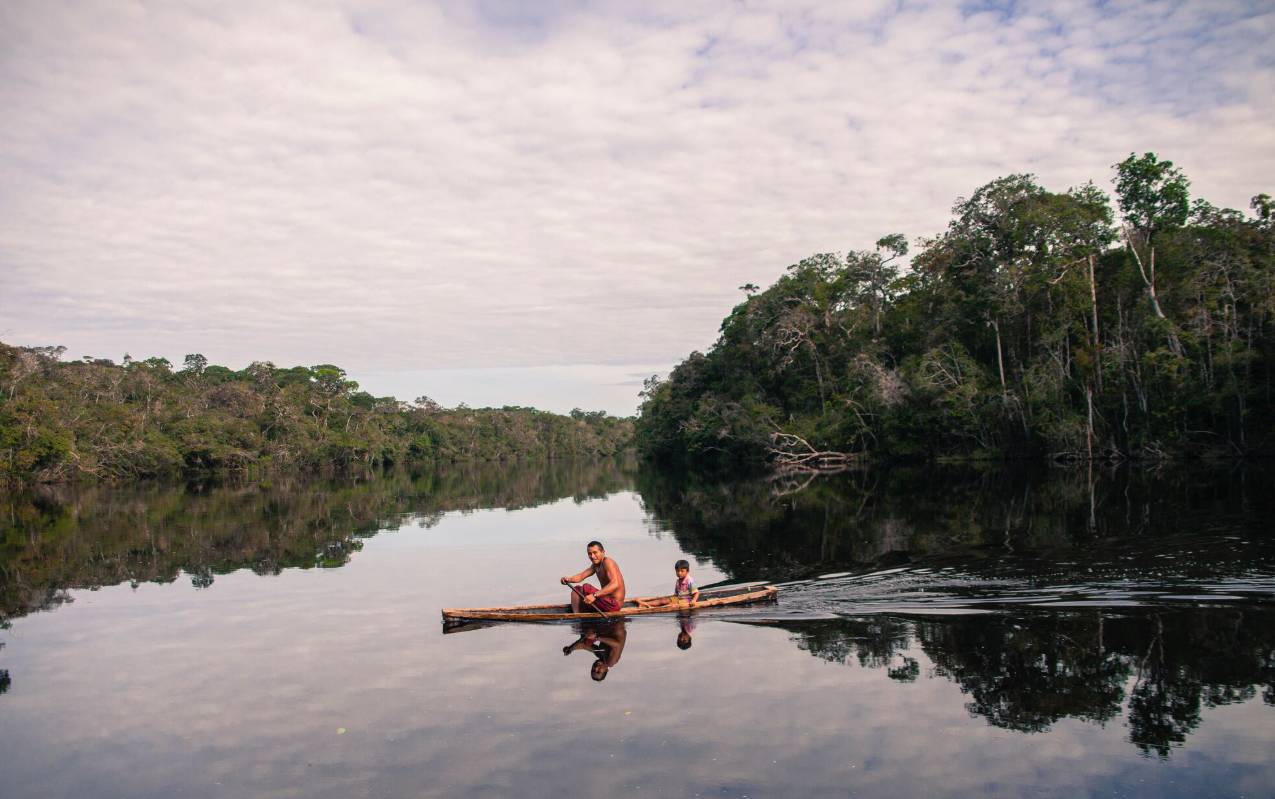
The Amazon is a living fabric and a biome of rights, a strategic ecosystem for global climate stability, inhabited by nearly 47 million people—including more than 500 Indigenous peoples—whose ways of life, knowledge systems, and forms of governance sustain one of the planet’s greatest reservoirs of biodiversity. Yet across this same territory, a polycrisis is now deepening, marked by the advance of extractivism, environmental crime, democratic erosion, and the rollback of human rights.
What is happening in the Amazon can no longer be understood as a sum of isolated conflicts. It is a structural dynamic of territorial dispossession that continues reorganizing power over Amazonian territories through extractive concessions, illegal economies, militarization, institutional capture, and the weakening of rights. Under the rhetoric of energy transition, development, or conservation, activities continue to expand that fragment ecosystems, displace communities, and deepen historical inequalities.

Illegality is no longer exceptional. It coexists and seemingly intertwines with weak or permissive state structures that, while formally recognizing environmental and territorial rights, maintain conditions that favor the advance of economic interests over community life and buen vivir. This contradiction produces a dangerous normalization of violence and progressively erodes the social and political conditions that sustain life in the Amazon.
For this reason, guaranteeing territorial security has become an imperative for global climate governance. It must be grounded in resilience actions driven from within the territories—particularly by Amazonian women—which are emerging as key responses for defending life and ensuring the sustainability of the Amazon for the benefit of all humanity.
From regressive Amazomorphosis to women’s resilience
At Oxfam, we have warned that violence against environmental defenders is merely the most visible expression of an architecture of territorial vulnerability. Murders, threats, and criminalization processes are not isolated events: they respond to systematic patterns aimed at weakening community organization and eliminating resistance to both legal and illegal extractivism.
In this context, Amazonian women face particularly severe impacts. Violence against women defenders is shaped by racism, patriarchy, and territorial inequality. Thus, when a woman defender is persecuted, displaced, or murdered, the harm does not fall solely on one individual: the social fabric that sustains territorial defense and collective life is fractured.
Yet Amazonian women are also fundamental political actors in processes of territorial resilience. They restore forests, protect water sources, sustain community governance systems, and defend alternative ways of relating to nature in the face of development models based on dispossession.
The Amazon and the unfulfilled promise of the Escazú Agreement
It is precisely in this context that the Escazú Agreement acquires historic relevance. The agreement recognizes the rights of access to information, public participation, and environmental justice, while also establishing specific obligations to protect human rights defenders in environmental matters. In Latin America—the most dangerous region in the world for defending land and the environment—this recognition represents an unprecedented political breakthrough. However, the gap between normative commitment and territorial reality remains profound.
The recent COP4 of the Escazú Agreement produced important advances in procedural and institutional terms. Monitoring mechanisms were strengthened, rapid response tools for threats against women defenders were incorporated, and the need to apply intersectional, intercultural, and gender-sensitive approaches was acknowledged. Opportunities for public participation and oversight of state compliance were also expanded.
However, COP4 also exposed the limits of environmental multilateralism when states fail to translate their international commitments into concrete policies within their own territories.
While official delegations speak of regional protection mechanisms, across much of the Amazon illegal economies, drug trafficking corridors, illegal mining, indiscriminate logging, and extractive projects continue to expand under weak environmental oversight and growing restrictions on civic space. In several Amazonian countries, processes of institutional regression persist, weakening environmental protection, limiting citizen participation, and reducing guarantees for Indigenous peoples and rural communities; when we look at women’s well-being, the regression poses an even greater risk of reversing hard-won rights.
The contradiction is evident: regional mechanisms are being strengthened while the material conditions of risk in the territories continue to deteriorate.
National protection systems remain insufficient, reactive, and bureaucratic. Public participation continues, in many cases, to be merely consultative and non-binding. Environmental justice remains permeated by structural impunity. And climate financing mechanisms often fail to reach those who are effectively sustaining the protection of ecosystems that benefit humanity.
The situation is even more critical in Latin American and Caribbean countries that are not Parties to the Agreement, or where implementation is minimal and the political context is regressive. The absence of ratification or political will deepens scenarios where environmental crime, territorial control by illegal economies, and democratic erosion converge. In these contexts, defenders are left exposed to armed actors, corruption, and the absence of state guarantees.
For this reason, the effective implementation of the Escazú Agreement requires far more than multilateral declarations. It demands strengthening protection systems with territorial, intercultural, and gender-sensitive approaches; guaranteeing timely and transparent access to environmental information; ensuring binding participation for Indigenous peoples and local communities; investigating and sanctioning attacks against women defenders; and allocating direct and sustainable funding to community-based territorial protection initiatives.
It also requires acknowledging an uncomfortable truth: climate sustainability cannot be built upon paramilitarized territories, displaced communities, and defenders living under grave threat or being murdered.
Amazomorphosis: a contribution to a necessary debate
In this context, Oxfam presents the publication Amazomorphosis: Amazon, territoriality, life at risk, and resilience, which not only documents the Amazonian crisis. It also functions as a political tool that directly challenges states and the regional system regarding their capacity—or incapacity—to respond to it. We demonstrate that Amazonian women are territorial experts and indispensable political subjects for any climate and democratic protection strategy.
Because without the women of these territories, there will be no effective implementation of the Escazú Agreement. And without territorial, gender, and intercultural justice, there will also be no real possibility of protecting the Amazon or the region’s climate future.
The table is set.
Autor

Coordinator of Oxfam's Multi-Country Amazon Initiative.