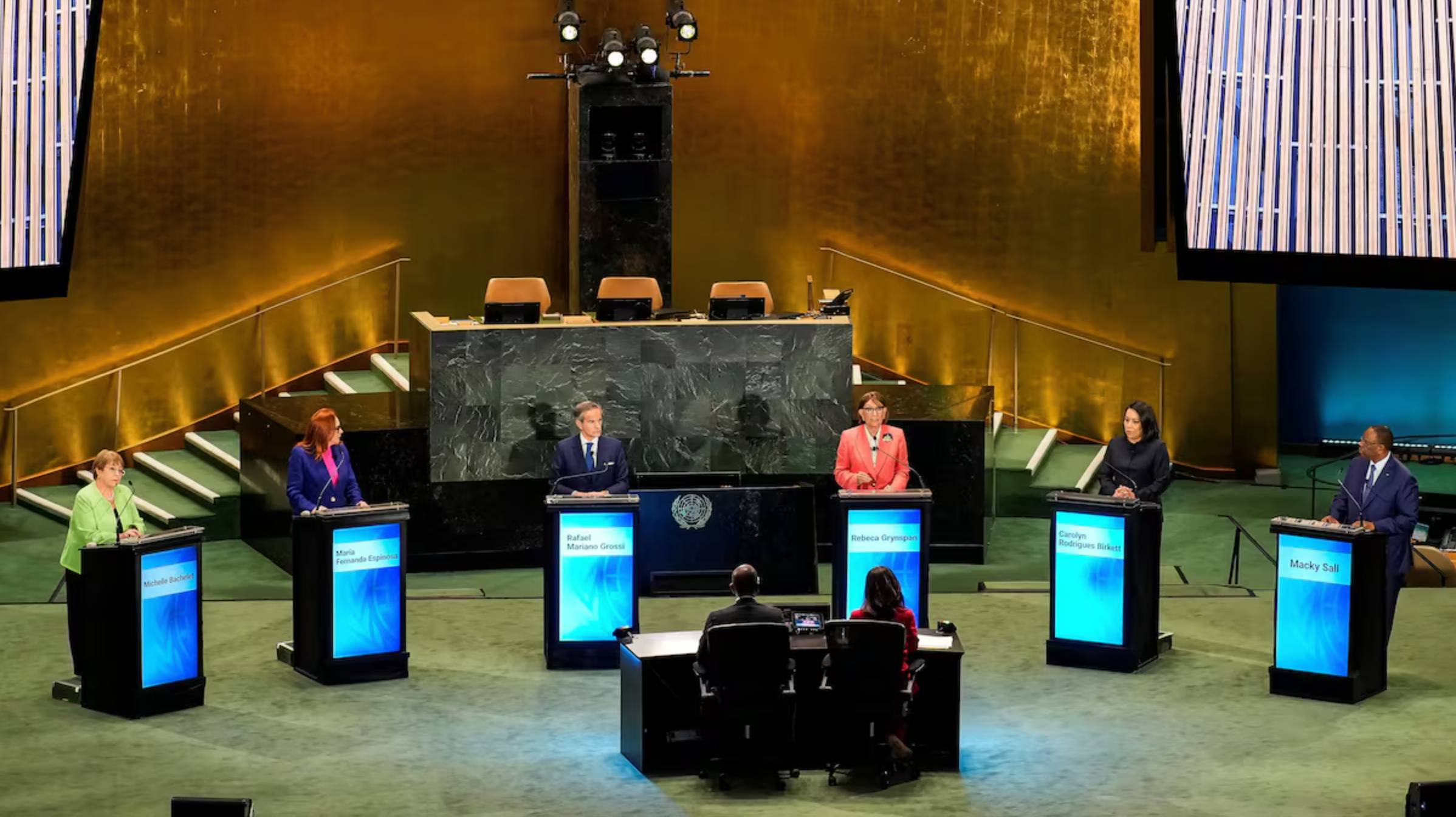
Based on institutional norms, the next Secretary-General of the United Nations will probably, though not certainly, come from Latin America and the Caribbean (LAC). As of the Security Council’s fourth straw poll on September 29, the three best-placed candidates are Rebeca Grynspan of Costa Rica, Carolyn Rodrigues-Birkett of Guyana, and Rafael Grossi of Argentina.
While a home-grown Secretary-General would be welcomed by many in the region, this moment is bigger than any one candidate. LAC is in the spotlight, and the region must find a way to turn this extra attention toward advancing a common agenda. The office of the Secretary-General can confer real benefits on its holder’s home region, but not automatically¾a Secretary-General can act as an amplifier for ready-made priorities. The problem is that LAC arrives at this election with all likelihood of placing one of its own yet has no shared statement on which issues to elevate. Before the Council settles on a name, that can change.

The stakes
A Secretary-General from a given region would attend its diplomatic events, speak sympathetically of its institutions and agendas, and give it a level of soft-power clout. A LAC win would tee up the region to boost its global profile and influence. The office’s limits, however, are plain. The Secretary-General serves the UN Charter rather than any country or region and does not directly deliver policy for home. The bloc, not the officeholder, delivers; the officeholder makes the bloc’s task easier by amplifying its voice.
As a bloc, LAC is hindered by fragmentation, making consensus and any potential benefits elusive. The risk at hand is the region losing the chance to amplify its issues and remaining on the periphery of global governance.
There are several areas where the region could benefit from greater global attention.[AR1] Poor development finance and security cooperation are two interlinked challenges that could be amplified. The UN Economic Commission for Latin America and the Caribbean projects LAC will meet just 19% of 2030 development targets at its current pace, and that its climate commitments require annual investment of 3.7 – 4.9% of regional GDP through 2030; actual climate finance stands at 0.5% of GDP. The region’s security needs are live concerns on many fronts. The Security Council authorized a “Gang Suppression Force” for Haiti last September to replace a previous UN police-action mission that faced persistent shortfalls.
With clear vision and priorities for such challenges under a unified agenda, the region could seek commitments from candidates. But, as things are, LAC is far from unified.
Dispersion preventing consensus
Political dispersion drives LAC’s fragmentation. Latin American states cannot coalesce behind one candidate, let alone an agenda. Shifting commitments that kneecap multilateral engagement and failing regional organizations exacerbate the issue.
The region is rife with fault lines that make coalition-building for candidate selection a struggle, and doubly so for agenda-setting. The progressive-conservative divide creates partisan camps of intra-ideological engagement. Within, there are policy divides. Many in the conservative camp disregard climate, development, and human rights considerations, invoking a hardline focus on security concerns. Conversely, progressive leaders in Brazil and Mexico support rights-based and development-sensitive policy alongside security management—albeit through different approaches.
Interweaving these fault lines is a deeper divide over the virtue of multilateralism. Galvanized by U.S. criticism and selective engagement, many leaders in the region have voiced skepticism toward multilateralism and global institutions. Colombian President Abelardo de la Espriella even campaigned on withdrawing the country from the UN and actively signals sweeping realignment[AR2] in all multilateral institutions.
Taken together, these differences make it difficult for LAC to reach consensus on shared issues. If consensus is to be had, it should be deliberated in cooperative forums, but LAC’s weak institutional record does not instill confidence. The region hosts a “spaghetti bowl” of overlapping and ineffective intergovernmental organizations that flounder at cooperation. The 10th Summit of the Community of Latin American and Caribbean States (CELAC) in Bogotá, for example, drew only five heads of state from thirty-three members, prompting Brazilian President Luiz Inácio Lula da Silva to warn that LAC is “cornered and divided,” and that a weakened CELAC invites external influence. Sub-regionally, coordination in the Caribbean fares slightly better. Unlike Latin America, the subregion consolidated behind one candidate, with the Caribbean Community’s heads of government giving Rodrigues-Birkett their full endorsement in July. However, that endorsement still makes no direct asks of the office.
The Group of Latin American and Caribbean Countries (GRULAC), the UN body where regional electoral coordination should happen, has also taken no position on the race. While political dispersion has hamstrung LAC’s governance both regionally and on the global stage, GRULAC members should formulate and forward an agreed-upon statement of what the region seeks from the next Secretary-General. With luck, Colombia and Panama sit on the Security Council this year and could support GRULAC priorities in Council voting. However, given Colombia’s critical stance, that is easier said than done.
Overcoming fragmentation
While LAC remains divided, other countries are not waiting and are already working to position their own interests with the next Secretary-General. For instance, U.S. Ambassador to the UN Mike Waltz told Congress that Washington is meeting with candidates, forwarding clear priorities for UN reform, budget cuts, and embedding Americans in senior posts throughout the system. The United States’ effective pressure shows it knows what it wants from the UN’s top diplomat¾and it is exactly the kind of external influence Lula warned of in Bogotá. Even if the region has proponents for the U.S. vision of a pared-back UN, it is one that clashes with LAC’s development, human rights, and security needs.
Through unified voice and action, LAC can leverage its present position and visibility to be seen as a serious actor and advance diplomatic agendas that promote the region’s development and security. Moreover, an agreed position could outlast this selection cycle and travel into every forum where the region now speaks in fragments, providing cascading reinforcement to LAC’s own cooperative governance structures.
Autor

Asociado de Pan-American Strategic Advisors y trabaja en la intersección entre las instituciones multilaterales y los asuntos del Congreso estadounidense. Maestría en Pensamiento Global por la Universidad de Columbia.