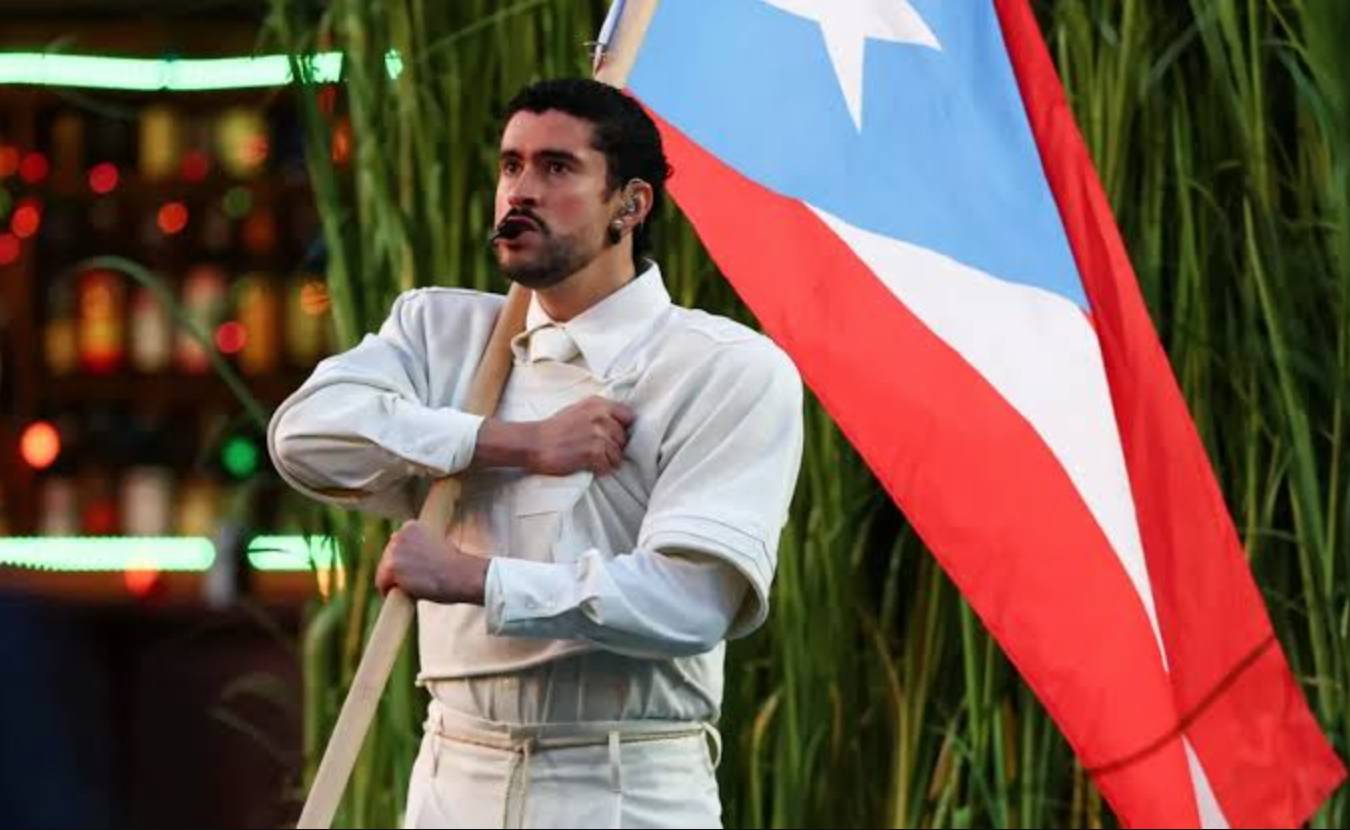
Bad Bunny (Benito Martínez Ocasio) has just surpassed one billion dollars in cumulative tour revenue. His success is primarily the result of a highly structured strategy that, beyond the legitimate debate over his actual artistic merit and the content of his work (which many consider vulgar and simplistic), has promoted him as an icon of resistance and Latin American cultural affirmation. This was recently confirmed in one of the world’s most important cultural markets, Spain—a country that is home to millions of Latin Americans—where his tour, which concluded on June 16, attracted approximately 750,000 attendees.
Mr. Martínez Ocasio is internationally known for repeatedly expressing Latino pride and criticizing President Donald Trump’s immigration policies. However, much less is known about the political background of some of the executives who built and manage his career, or about his political agenda in his homeland, Puerto Rico, which has been a U.S. colonial territory since 1898.

An anti-establishment artist?
Since its beginnings in 2016, Bad Bunny’s career has maintained close ties with Rafael Jiménez Dam, a retired army captain and former Deputy Minister of Legal Security under Hugo Chávez (2007–2013). Now a businessman based in the United States, Jiménez Dam was the majority shareholder of Rimas Entertainment—the company that produces Bad Bunny—until 2023, and he remains one of its principal shareholders.
It is important to note that Hugo Chávez’s government consistently supported Puerto Rican independence within the United Nations Special Committee on Decolonization (the Committee of 24) and co-sponsored annual resolutions on the matter alongside the Cuban government. It is also worth recalling that international law (UN General Assembly Resolution 1541 (XV), adopted in 1960) recognizes Independence, Free Association, and Integration into an existing state as equally legitimate forms of political status for a territory.
Martínez Ocasio presents himself as an anti-establishment artist, often through provocative lyrics about everyday life. In Puerto Rico, he has also portrayed himself as a nationalist committed to defending Puerto Rican culture, arguing that Puerto Rican identity is at risk of being absorbed by what he describes as an “exploitative and assimilationist” metropolis. Since 1898, Puerto Rico has been an unincorporated territory of the United States, and in 1952 it was designated a Commonwealth (Estado Libre Asociado, or ELA), a status that differs from that of incorporated territories such as Hawaii. Since its annexation in 1898, there has also been an understanding between the territory and the mainland regarding the pursuit of full statehood rights—that is, admission as a state of the Union.
Bad Bunny’s electoral defeat
During Puerto Rico’s 2024 election campaign, Bad Bunny openly endorsed Juan Dalmau, the candidate of the Puerto Rican Independence Party (PIP), who throughout his political career has also participated in events organized by the Venezuelan government in Caracas during the Chávez and Maduro administrations. Dalmau finished second in the November 6 election with 31% of the vote. He was defeated by Jenniffer González Colón of the New Progressive Party (PNP), which advocates statehood and won 41% of the vote. González Colón is affiliated with the U.S. Republican Party, although the PNP itself includes both Republicans and Democrats.
The statehood movement differs from the independence movement in that it does not view Puerto Rican culture as being under threat. Instead, it argues that the island’s principal colonial problem is one of legal and civic inequality compared with the rights and opportunities guaranteed to U.S. citizens living in the fifty states, where approximately six million Puerto Ricans have migrated. This migration enables Puerto Ricans living on the mainland to enjoy rights unavailable to residents of Puerto Rico, such as voting in presidential and congressional elections and receiving broader benefits from federal government programs.
On the same day as the general election, Puerto Rico held another status plebiscite, in which statehood won for the third consecutive time with 58% of the vote, compared with 12% for independence and 30% for free association. The result has not been acted upon by Congress because Donald Trump—another ultranationalist, albeit a conservative one—opposes Puerto Rican statehood, believing that the cultures of the United States and Puerto Rico are incompatible.
The controversial case of Hawaii
In 2025, Bad Bunny released his sixth studio album, Debí tirar más fotos (I Should Have Taken More Photos). One of its standout tracks, “Lo que le pasó a Hawái” (“What Happened to Hawaii”), criticizes Hawaii’s annexation on the grounds of gentrification and cultural assimilation, drawing parallels with what he believes is currently happening in Puerto Rico.
Hawaii’s case remains controversial. In 1959, with overwhelming electoral support from its citizens, it became the fiftieth U.S. state. Today, in economic terms, Hawaii’s income, productivity, and wealth are roughly twice those of Puerto Rico. Its economy is heavily centered on tourism and military activity.
Hawaii declared Hawaiian an official language in 1978, and according to official data from the U.S. Census Bureau (2020), more residents identify themselves as Native Hawaiian today than there were in 1959.
Recent geopolitical changes
The removal and capture of Nicolás Maduro, together with the Trump administration’s strategies and rhetoric regarding drug trafficking, have led to the reactivation of the U.S. naval base at Roosevelt Roads in Ceiba, in northeastern Puerto Rico, while reinforcing installations such as Fort Buchanan in San Juan and parts of Ramey Field in Aguadilla on the island’s western coast. The U.S. military presence in Puerto Rico is permanent, and its recent expansion appears irreversible. Indeed, according to polls and surveys conducted by Puerto Rican media outlets, it enjoys majority public support.
Combined with the separatist movement’s limited electoral backing, these developments weaken—at least in the short term—the prospects for any independence project, despite the influence of a globally successful artist such as Bad Bunny. Puerto Rico is therefore likely to maintain for a long time its current territorial/colonial model of political and civic inequality (the Commonwealth, or ELA), while statehood also appears to remain an unattainable aspiration, at least during Donald Trump’s presidency.
Autor
Professor of Management and International Trade at the School of Business Administration, University of Puerto Rico.