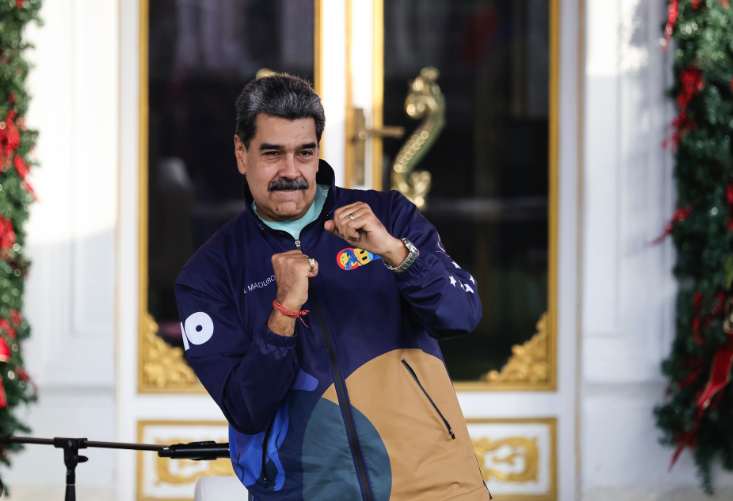
After the electoral fraud of 2024, Maduro shouted, “Come get me! Here I’ll be waiting for you in Miraflores—don’t take too long, coward!” Following a series of threats against Washington and nationalist speeches, the United States government began operations in the Caribbean in 2025. But the world woke up on January 3, 2026, to the news of the capture of Venezuelan dictator Nicolás Maduro and his wife, Cilia Flores.
Maduro employed a belligerent discourse, ranging from insulting the Venezuelan opposition to claiming that U.S. Secretary of State Marco Rubio wanted to stain Donald Trump’s hands with blood. He also bet on the song “No war, yes peace,” held massive events in an effort to unite all Venezuelans, and even convened peace summits. All of this did nothing more than reveal his desperation.

In the study of transitions to democracy, there is a school of thought that has analyzed the role of foreign powers as triggers of change in authoritarian regimes. Political scientists such as Huntington, Linz, Stephan, Diamint, and Pion-Berlin studied how international pressure led to the collapse of twentieth-century authoritarianisms. In Latin America, the comparable example to Maduro’s downfall is that of Panamanian dictator Antonio Noriega, arrested on January 3—though in 1989.
The outcome of the fall
In December 2025, Trump and Maduro spoke by phone to lay the groundwork for a negotiated exit—that is, to avoid an invasion, civilian deaths, and material losses. The objective was to appoint a transitional government, hold free elections, release political prisoners, and pave the way for democracy. The refusal to relinquish power and the use of bellicose rhetoric toward Washington ultimately led to Maduro’s capture.
When a regime falls, various political actors and pressure groups begin to reposition themselves. Negotiated transitions, in which authoritarian leaders bargain with moderate sectors, occur gradually; they are not radical ruptures. A transitional government is appointed, and civil liberties begin to be liberalized.
In the Venezuelan case, this will not be so. On the contrary, factions within Chavismo will seek to maintain the authoritarian structure through new leadership. Although the United Socialist Party of Venezuela (PSUV) holds power, there are factions within it that will attempt to take the reins of the country. For the moment, Vice President Delcy Rodríguez has constitutionally assumed power; however, leaders such as Interior Minister Diosdado Cabello—responsible for repressing the opposition and a pillar of the regime—will likely seek to inherit power.
It is likely that the formation of a Chavista transitional government will not generate stability, but rather accelerate the regime’s collapse or radicalize it further. Meanwhile, power groups such as pro-Maduro business elites, criminal groups allied with the government, the military high command, and the party’s grassroots will seek to obtain benefits from whoever assumes leadership.
The armed forces are the backbone of the regime. Protests following the 2024 elections—whose supposed victory the Chavismo failed to substantiate by presenting official tally sheets—have been repressed by the military, police, and paramilitary groups. Hugo Chávez left Maduro a militarized country in which the armed forces participate in civilian tasks and sustain power through weapons.
What happens to the opposition
Another element to consider is the fate of Edmundo González Urrutia, winner of the 2024 elections, and Nobel Peace Prize laureate María Corina Machado, since conditions are not yet in place for them to assume leadership. For now, we are going through crucial moments that will determine whether there will be openness or radicalization. In the words of the renowned political scientist O’Donnell: “the transition is the indefinite interval of time between one regime and something else.”
Even in an interview with Fox News, President Trump stated: “we cannot risk letting someone else run Venezuela and simply take over what he left behind.” This statement not only opens the door for U.S. troops to impose order in the South American nation, but also for the regime to be restructured by force, as occurred with Noriega in Panama, Duvalier in Haiti, or Ubico in Guatemala.
In conclusion, the fall of the tyrant is not the end but the beginning of a path of uncertainty in which democracy and authoritarianism will battle until the very end. Maduro was not the cornerstone of the regime, but rather the most visible face of authoritarianism. Nevertheless, the Chavista machinery has other, less visible gears that have been ignored in the equation.
Autor

Political scientist from UNAM with a diploma in journalism from the Carlos Septién School of Journalism.