Contemporary politics is marked by a peculiar theatricalization. If the exercise of power has always carried a strong dose of staging conflict through different mechanisms, today this is no different, even if things look different. Lies, insults, institutional disloyalty, the absence of limits, grotesque play-acting, delirium—all have habitually shaped the landscape, without the positive attitudes that represent their opposite facets ever ceasing to be present as well. A counterpoint that is often in force. Nevertheless, it is well known that the negative outlook seems to end up predominating.
Recent times have defined a framework of confrontational situations whose exemplary character, when correlated with public attitudes, has been evident. Leading by example has been a mantra frequently invoked and rarely followed.

To the extent that forms of communication in the era of the great digital revolution have been upended, the relationship established by Niklas Luhmann between container and content has likewise been affected. Actors today have mechanisms for approaching the masses that are autonomous, immediate, direct, and universal in reach. For their part, more than ever, people voraciously consume segmented news of minimal duration without validating its origin or cross-checking the narrative. The effect is perverse and distorts any type of established political order. The superimposition of all this establishes a frame of reference in which what is displayed underpins a large part of the guidelines along which politics proceeds.
Examples pile up, and digesting them is arduous.
In December, Bolivia’s vice president Edmand Lara, elected on a ticket led by Rodrigo Paz, declared himself a “constructive opposition” to the government. His speech is a clear case of constitutional disloyalty that adds to a capricious mode of action according to which his interests stand above the obligatory disciplinary respect owed to the formula—indissoluble—voted for by a majority of the citizenry.
Nayib Bukele inaugurated a new project to build a maximum-security prison in Costa Rica, less than three weeks before that country’s presidential elections, where the rise in violent crimes linked to drug trafficking has been a central concern for the electorate. The Salvadoran government provides technical support to the penitentiary project based on its CECOT model (Terrorism Confinement Center), while the government of Rodrigo Chaves states that the new Center for High Containment of Organized Crime (CACCO), located in a prison complex in San Rafael de Alajuela, 18 kilometers from San José, will cost 35 million dollars and have capacity to house 5,100 inmates. The hegemonic discourse of fear and of supposed authoritarian effectiveness prevails thanks to a masterfully crafted communications campaign.
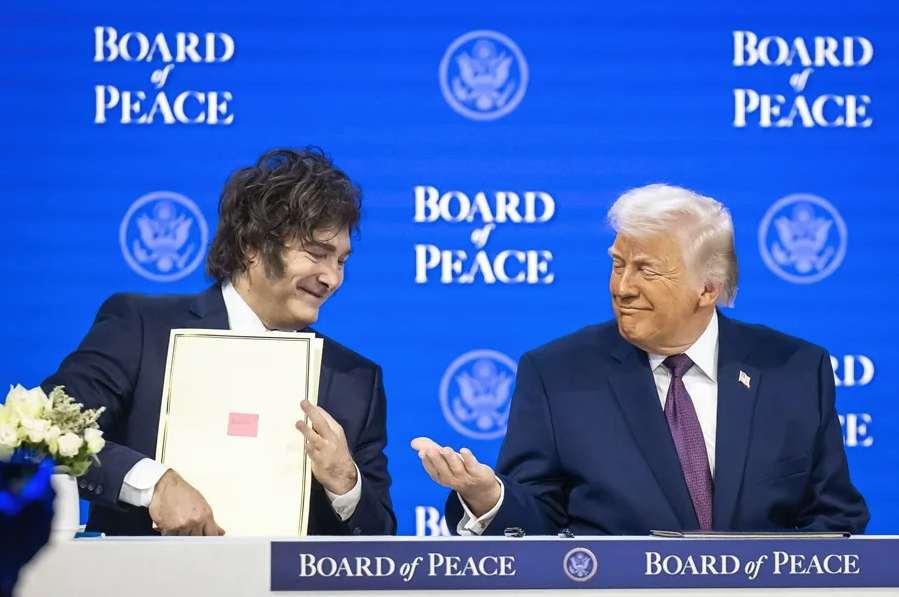
Donald Trump, who at a press conference had just ridiculed his French counterpart with a crude imitation of his accent, declared without batting an eye, when asked by a New York Times journalist about checks and balances on power: “My only limit is my morality.” Something that, by that criterion, endorses all kinds of abuses and tosses into the trash Max Weber’s call to combine the ethics of one’s convictions—according to the Kantian vision still embraced today by much of humanity—with the ethics of responsibility.
Jerome Powell, bearer of the Weberian vision and chairman of the Federal Reserve, personally suffers gratuitous presidential harassment over alleged cost overruns in the renovation of the institution’s headquarters. Powell has forcefully argued that “the public interest must prevail over the president’s arbitrariness.” A solid argument that is today vilified.
Before the January 3 attack, which culminated in the kidnapping of Nicolás Maduro and his wife, and the death of some one hundred people, last September the Pentagon used a secret aircraft painted to simulate a civilian plane in its first attack on a ship that, according to the U.S. administration, was transporting drugs, killing 11 people, as reported by the New York Times. The aircraft also carried its munitions inside the fuselage, rather than visibly under the wings, which constitutes not just any act but a war crime known as “perfidy.” At least one hundred more people lost their lives in the months that followed.
A survey published by The Economist on January 13 indicated that Venezuelans are also dissatisfied with the assumption of Delcy Rodríguez as acting president, whom Trump openly supports, at least for now. A public opinion she scorns, as she made clear in her address to the Nation before the National Assembly on January 15.
While 13% hold a favorable opinion of Rodríguez, only 10% agree, even partially, that she should complete Maduro’s term (based on fraudulent elections) through 2031. Thirty percentage points behind María Corina Machado, whom Trump denies support in Venezuela’s political future and who, despite this, does not back down and stages a shameful performance by gifting him her award in a grotesque ceremony that should fall into oblivion as soon as possible. Shortly thereafter, Norwegian prime minister Jonas Gahr Støre confirmed that on January 18 he received a message from Donald Trump in which the latter demanded “total and absolute control of Greenland” because “Norway has decided not to grant me the Nobel Peace Prize for having put an end to eight wars.”
That Machado—dismissed shortly beforehand by Trump himself—would join the farce constitutes yet another milestone in the sequence of gestures, attitudes, words, and acts whose exemplary character is pernicious. This serial swells the list of factors that generate the rampant distrust everywhere that paves the way for the new order of vassalage that is sought to be established. Nevertheless, the words of Mark Carney, Canada’s prime minister, in Davos on January 20 counteract discouragement by leading the moral and political opposition to Trumpism.
Autor

Director of CIEPS - International Center for Political and Social Studies, AIP-Panama. Honorary Emeritus Professor at the University of Salamanca and UPB (Medellín). Latest books: "El oficio de politico" (Tecnos Madrid, 2020), "Huellas de la Democracy Fatigada" (Océano Atlántico Editores, 2024) and "Cuando la política dejó de ser lo que era" (Océano Atlántico Editores, 2025).