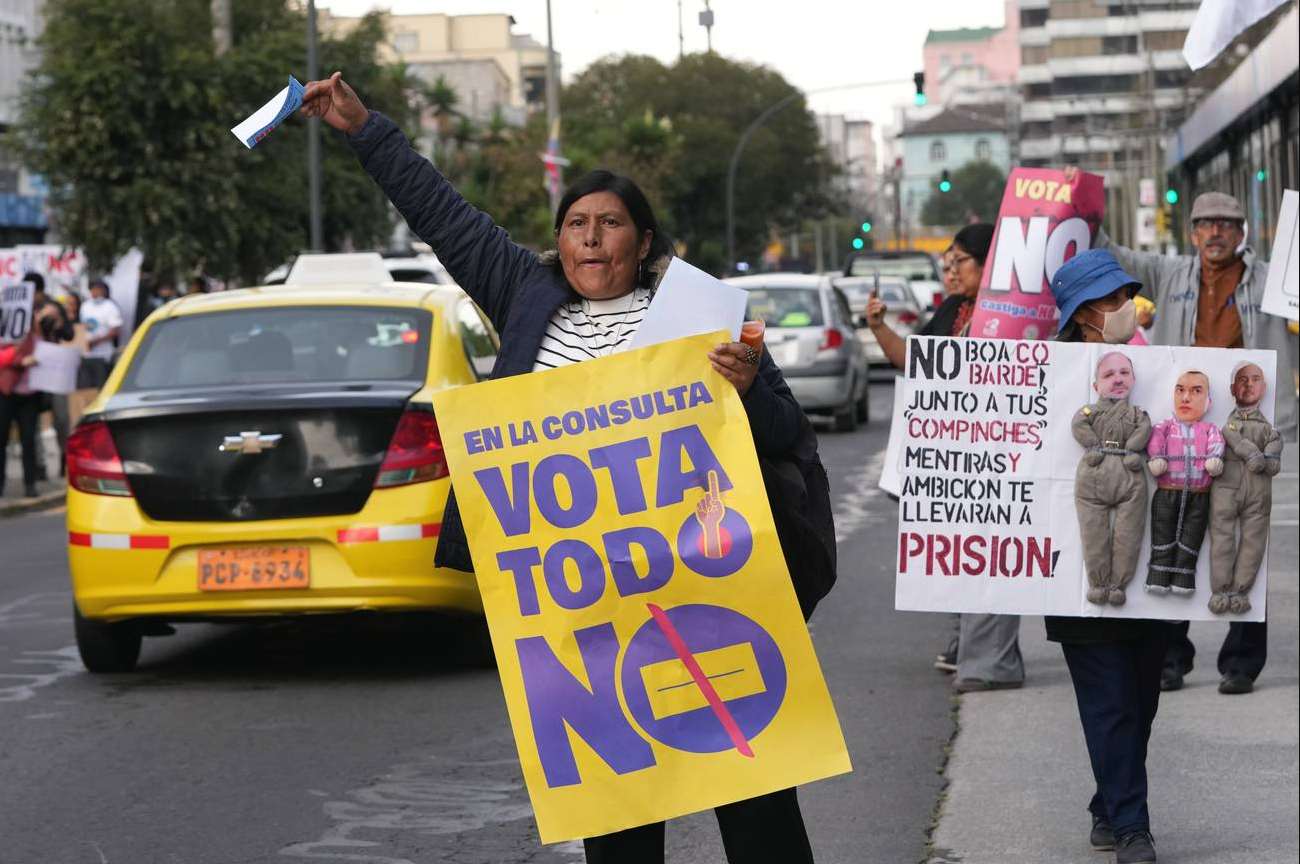
In the most recent popular referendum, Ecuadorians voted overwhelmingly against the reform proposals put forward by President Noboa. While there may be multiple interpretations, the main takeaway is that a government’s performance is fundamental to the success or failure of exercises in direct democracy.
History has given us several examples. In the 1992 U.S. presidential campaign, American political consultant James Carville coined the phrase “it’s the economy, stupid” to explain that, in electoral success, ideologies or poll results matter little or not at all; rather, what matters are the results people perceive in their day-to-day lives, their economic situation, and whether their needs are being met.

In Ecuador, the scenario prior to the referendum gave the impression that the table was set for the executive branch: as of October, the president had a 53% approval rating (in the midst of a national strike); sales of goods and services increased by 8.4%; and the construction sector saw a 21.6% recovery compared to the previous year. On the political front, the executive controls parliament with 66 legislators from its own caucus plus 11 allies, which has allowed it to pass the constitutional reforms submitted to referendum and approve three laws in record time (18 days). And as if that were not enough, the government has taken credit for the recapture of two leaders of the criminal gangs “Los Choneros” and “Los Lobos”: Adolfo Macías and Wilmer Chavarría, in the context of the insecurity the country is experiencing.
Polls showed a completely favorable scenario for all the questions posed by the government: eliminating the prohibition on establishing foreign military bases in the country; eliminating the fund that finances political parties; reducing the number of legislators from 151 to 73; and convening a Constituent Assembly to draft a new constitution. Pre-election surveys announced that affirmative votes for the government’s reforms would range from 53% to 62%.
What the national government and polling firms neither observed nor understood is that beyond this narrative—beyond the photographs, the announcements, and the meetings between President Noboa and U.S. Secretary of Homeland Security Kristi Noem—what people expect from the State and from those who administer it is effective management to solve their everyday problems.
As of October, 7,349 violent deaths have been recorded nationwide, the highest figure for that period to date. Public health has been facing a deep crisis since early 2025: not only is there a shortage of essential medicines, but there have also been reports of the absence of cleaning services in healthcare facilities, a lack of security services, and even a lack of food for patients in public hospitals.
Budget execution data for 2025 to date reflect serious problems in government management. Economist Jairon Merchan published, through his account on the social network X, details of how the government has managed its finances, showing that only 58.42% of the budget allocated for this year had been executed by the time the referendum was held. By spending category, public debt payments, bonds and direct transfers, and other liabilities are what have driven the national government’s management. By contrast, only 4% has been executed in infrastructure and long-term assets.
While there may be other variables that contribute to the analysis, the equation is simple: it is the responsiveness to demands that sustains specific support for the political system, as David Easton theorized more than 60 years ago. Unfortunately, the Ecuadorian government has relegated its management to a secondary or tertiary role and has fallen into the current whirlwind of political communication, in which politics has become a mere contest of marketing and narrative imposition—where those called upon to administer public affairs as an expression of the general will have become actors more concerned with the angle of the photo, whether the camera light falls on the leader giving a close-up, or whether every word spoken adheres to a prefabricated and brief script.
As one of the government’s unofficial spokespersons, the politician Antonio Ricaurte, put it: “everything is image, all the time, and President Noboa has a brilliant strategy, since he does not present himself, dress, or speak like a traditional politician… and I’m not talking about whether that’s good or bad—that’s for the very intelligent—I only talk about images and political communication, about what needs to be done, because in life and in politics what works solely and exclusively is strategy and political communication.”
It seems that Ricaurte does not understand what the average citizen clearly does: you cannot communicate what does not exist. And if there is no public management to sustain a narrative, it becomes a house of cards that collapses at the first shake, as has happened to the Ecuadorian government. It seems the famous phrase by Carville has still not been understood, nor has the second part of the same strategy that brought Clinton to the presidency been revisited: “don’t forget the health care system.” This shows that beyond ideologies, debates over the size of the State, discussions of democracy versus authoritarianism, or even “dazzling communication strategies,” what matters to citizens is how the State solves their everyday problems.
If the Ecuadorian government does not understand this, it is worth reminding it of the popular adage: “when you see your neighbor’s beard being trimmed, soak your own.” In other words, when you see that your people have stopped supporting you, government, it is time to govern.
Autor

student at the University of Salamanca (Spain). Master in Interantional Relations from the Instituto de Altos Estudios Nacionales (Ecuador) and in Political Science by the Univ. of Salamanca.