On February 17, Peru once again found itself without a president. What in any democracy would amount to an exceptional crisis has, in the Peruvian case, become a recurring episode. Since 2016, no president has managed to complete their term. Instability is no longer an accident of the political system—it is its dominant feature.
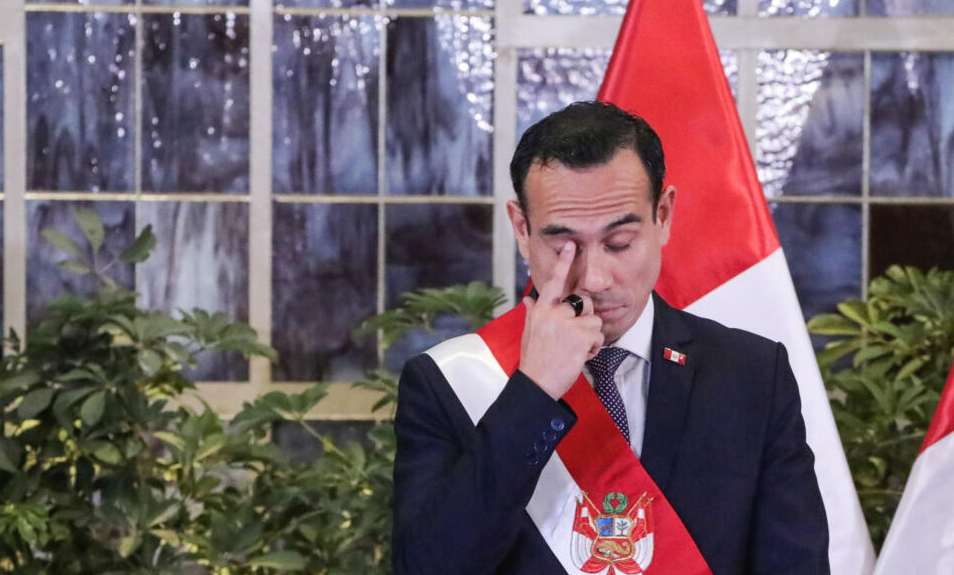
José Jerí, who had been president of the Congressional Board until Boluarte was replaced, assumed the presidency in accordance with the constitutional order for a period of 130 days. Jerí had entered Congress as an alternate following the disqualification of Martín Vizcarra. During his brief tenure, he attempted to project an image of firm leadership, visiting penitentiary centers and employing rhetoric focused on order and security. However, his popularity quickly eroded.

The polling firm Ipsos recorded a 60% disapproval rating, in a context marked by public scrutiny, including meetings with Chinese businesspeople, rape allegations, and deteriorating citizen security indicators. While the reasons cited by members of Congress for his removal were linked to these episodes, his ouster forms part of a broader political strategy by parties with an eye on the upcoming elections. Following his departure, José María Balcázar, an 83-year-old leftist congressman, sadly known for his support of child marriage, has become Peru’s new president.
One after another
The last head of state to complete his term was Ollanta Humala (2011–2016). Since then, succession has accelerated. Pedro Pablo Kuczynski resigned after just over a year and a half in office, harassed by a Congress largely controlled by Fujimorismo. His vice president, Martín Vizcarra, who assumed office after the resignation, was removed through the mechanism of “presidential vacancy.” Manuel Merino, then president of Congress, assumed the post in accordance with the constitutional order but resigned five days later following intense social protests in which two young people died. Francisco Sagasti completed the transition until the 2021 elections. Pedro Castillo, elected that year, was removed after attempting to dissolve Congress. His vice president, Dina Boluarte, assumed the presidency and, after weak pacts with legislators, was also removed through vacancy.
Beyond the names and the number of days each remained in power, what matters is that Peru faces institutional fragility that allows for the frequent removal of the head of state. The Peruvian Constitution includes the figure of “vacancy due to permanent moral incapacity,” which empowers Congress to declare the president’s removal with a two-thirds vote (a simple majority in the case of censure of the president of the Congressional Board).
This is an exceptional mechanism, designed for extreme situations; however, in practice, it has become a tool of political pressure. The expression “permanent moral incapacity” is sufficiently ambiguous to allow for various interpretations. In recent years, it has been invoked for diverse reasons, ranging from corruption accusations to political disputes, without the existence of a clearly defined legal standard.
This instability has concrete consequences. Public policies require continuity, planning, and interinstitutional coordination. When governments succeed one another rapidly, ministerial teams change, priorities are redefined, and structural reforms lose momentum. Complex problems such as citizen insecurity, economic informality, or the precariousness of public services can hardly be addressed effectively in an environment where political survival is the immediate objective.
On the other hand, it is important to note that there was no constitutional reform that formally altered the balance of powers after 2016. What changed was the way political actors chose to use the available instruments. Vacancy shifted from being an extraordinary recourse to becoming a constant threat against presidents without a majority. In this context, the stability of the Executive depends less on legal criteria than on legislative arithmetic. Added to this is that, following the dissolution of Congress during Martín Vizcarra’s government, the Legislative has sought to reinforce its powers, limiting, for example, the possibility that the Senate may be dissolved.
What the country really needs
A far-reaching political reform is therefore indispensable. Strengthening the system of government and the party system is a necessary condition for reducing fragmentation and permanent confrontation. However, modifying the rules is not enough. Recent experience shows that a genuine commitment by political elites to democratic stability is essential. In 2018, then-president Martín Vizcarra promoted a package of reforms that was submitted to referendum. Although it received citizen participation, part of its content was diluted in the subsequent legislative process and failed to generate the expected structural changes.
In the coming months, Peru will return to the polls to elect the president and vice presidents, as well as members of the Senate and the Chamber of Deputies. Given the institutional weakness that characterizes the country, an inevitable question arises: is it decisive who occupies the presidency if the rules of the game allow their mandate to be interrupted with relative ease?
The context suggests that the stability of the system depends not only on the presidential figure but also on the design and functioning of the institutional framework as a whole. Without adjustments to that framework, the risk that history will repeat itself will remain ever present.
Autor

Consultant and researcher. Master's degree in Political Science from the University of Salamanca and political scientist from the Pontifical Catholic University of Peru. Member of the #NoSinMujeres Network of Women Political Scientists.