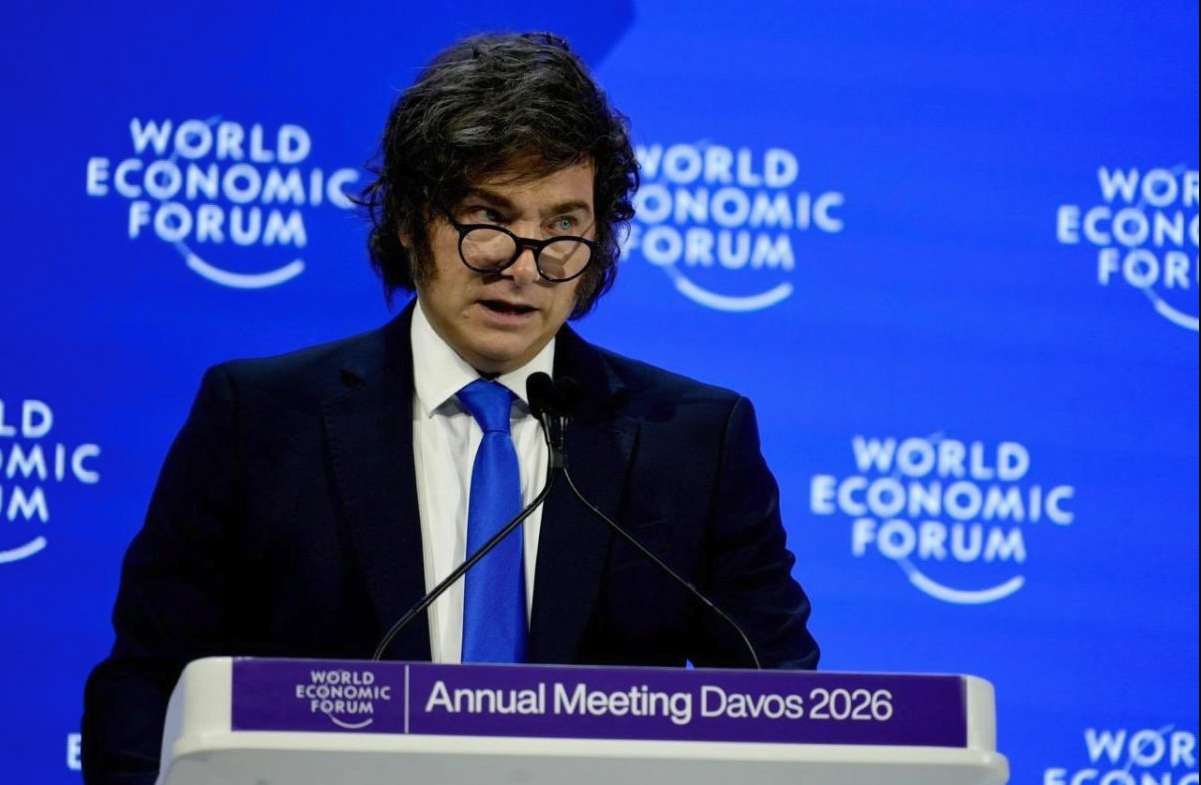
Javier Milei’s intervention at the Davos Forum has barely received the attention the Argentine president was seeking. Despite his striking opening announcement—the death of Machiavelli—political and journalistic media, especially in his own country, have made only positive or negative references to specific political aspects, while ignoring the central content of his speech.
I believe, however, that this cultural disdain is unproductive, particularly on the part of those who oppose Milei’s approach, and especially within left-wing circles. It may well stem from that moral and intellectual arrogance so often attributed to progressive thought.

I hold this view because it is rare to hear such a broad line of argument at the level of political culture. It does not matter whether Milei’s way of presenting it is unsophisticated, both in substance and in form. Nor is his petulant opening—“I am here before you to tell you categorically that Machiavelli is dead”—of much importance. Nor does it matter greatly that his delivery was notably flawed (poor diction, mistakes, stammering). It is well known that Milei is not good at reading speeches. What truly matters is the attempt to deploy an approach grounded in political culture and philosophy to lend luster to his governing action. This, in itself, is a significant fact: apparently, a governmental project cannot be sustained solely through the raw exercise of power, but requires a discourse, an argument, a narrative that morally and cognitively justifies it.
The Argentine president claims that Machiavelli is dead because his best-known maxim no longer holds: the end justifies the means. To be sure, the reflections of the Florentine author are broader and more complex, but that is not particularly relevant here (one might reasonably ask how far Milei has gone in his reading of Machiavelli).
In any case, the president does not adequately explain how the supposed death of Machiavelli’s thesis relates to the rest of his speech in Davos. He seems to suggest something that the non-authoritarian left confirmed long ago: that means must possess moral consistency with ends. It is not morally acceptable to employ perverse means to achieve a good end—an idea that has been reiterated at least since the mid-twentieth century (for example, by the master Norberto Bobbio, who, incidentally, was an honorary doctorate recipient at the University of Buenos Aires). Thus, invoking Machiavelli’s supposedly defunct maxim, rather than certifying its demise, amounts to its surprising resurrection.
The two main components of Milei’s intervention were, on the one hand, what polemicists call “dressing up the Manichean”—that is, turning the opponent into a stereotype in order to attack them—and, on the other hand, the more interesting element: offering a substantive alternative framework in terms of political culture.
The Argentine president speaks of socialism as an unspecified universe of ideas that ranges from Stalinist totalitarianism to the pacifism of Olof Palme. In any case, it is portrayed as the disruptive element that has distorted Western values. Thus, the difference between a pro-freedom, pro-democracy labor party and Maduro’s bloody dictatorship becomes merely a matter of degree. The aim is to dress up the Manichean in a way that makes it easy to beat him. But the nature of this fallacy becomes clearer when Milei lays out his alternative proposal.
Although it is not made explicit, the cause of the death of the Machiavellian maxim seems to be that, in the pursuit of the common good (the ultimate end), it can no longer be argued merely that free-enterprise capitalism is the most efficient means, but rather that it is also a means inherently just from a moral perspective—that is, a means consistent with the goodness of the end.
To demonstrate this, Milei embarks on a somewhat scattered journey that runs from Xenophon to Pareto, while frequently referencing the Spanish libertarian Jesús Huerta de Soto, an economist who moved from liberalism to radicalization, ultimately becoming an anarcho-capitalist. Thus, Huerta, in his effort to combat statism, now proposes the total elimination of the State. He offers no alternative political system: in the purest paleo-anarchist style, he claims that this sociopolitical order will be built spontaneously once the State disappears entirely.
In light of historical experience, including in Spain, it can be said that there is a high risk that the cure may be worse than the disease. One must not confuse the existing consensus against statism, and the resulting appreciation of the market as a resource-allocation instrument, with the utopia—an old one, at that—of anarchist spontaneism.
When Milei enumerates the value-based elements that justify the goodness of the free market, he refers to traditional Western values: Greek philosophy, Roman law, and Judeo-Christian values—in other words, Western values “before they were corrupted by socialism.” This considerable leap backward conceals a brazen moral sleight of hand. It simply ignores the historic milestone of the revolutionary triad (American and European) that ushered in modernity: liberty, equality, and fraternity. By retaining only the first element (with which he often angrily concludes his speeches), without situating it within the context of the triad, his approach becomes substantively premodern.
It is therefore false that socialism of any kind was responsible for corrupting Western values, although it is true that violent and statist left-wing movements have done so. Milei’s sleight of hand consists in concealing modern Western values, which—as has been repeated countless times—incorporate dilemmas that must be addressed democratically, most notably the need to find a value-based and instrumental balance between liberty and equality.
Rivers of ink have been spilled on how to confront this dilemma and on the disastrous consequences of ignoring it and opting exclusively for one of the elements of the dyad. The utopia of obsessing over equality while letting liberty fall by the wayside has led to authoritarian political systems that foster corruption and destroy democratic coexistence. From the opposite angle, the claim that radical freedom—leading to political and economic anarchism—allows for maximum social performance in a harmonious and spontaneous manner is another disastrous utopia. It inevitably leads to social Darwinism, where only the most gifted are entitled to social well-being; in Milei’s terms, those who are capable of maximizing the entrepreneurial function that drives society.
In sum, avoiding the dilemma of the modern triad is nothing new, and even less revolutionary. Moreover, historical experience clearly shows that stubbornly ignoring the dilemmas posed by the value framework of modernity is unsustainable and causes great harm while it lasts.
The pompous announcement that Machiavelli is dead was nothing more than a desperate search for a headline, in the hope that it would multiply across social media. The maxim attributed to the Florentine intellectual was long ago discarded by political theory, including by the non-authoritarian left, precisely on the basis of the value framework of modernity. Only a monumental ignorance of the evolution of political ideas in the twentieth century could attempt to bring this corpse of political culture back to the table, merely to stage once again its demise.
Autor

Enrique Gomáriz Moraga has been researcher at FLACSO in Chile and other countries in the region. He was a consultant for international agencies (UNDP, IDRC, IDB). He studied Political Sociology at the Univ. of Leeds (England) wit R. Miliband.