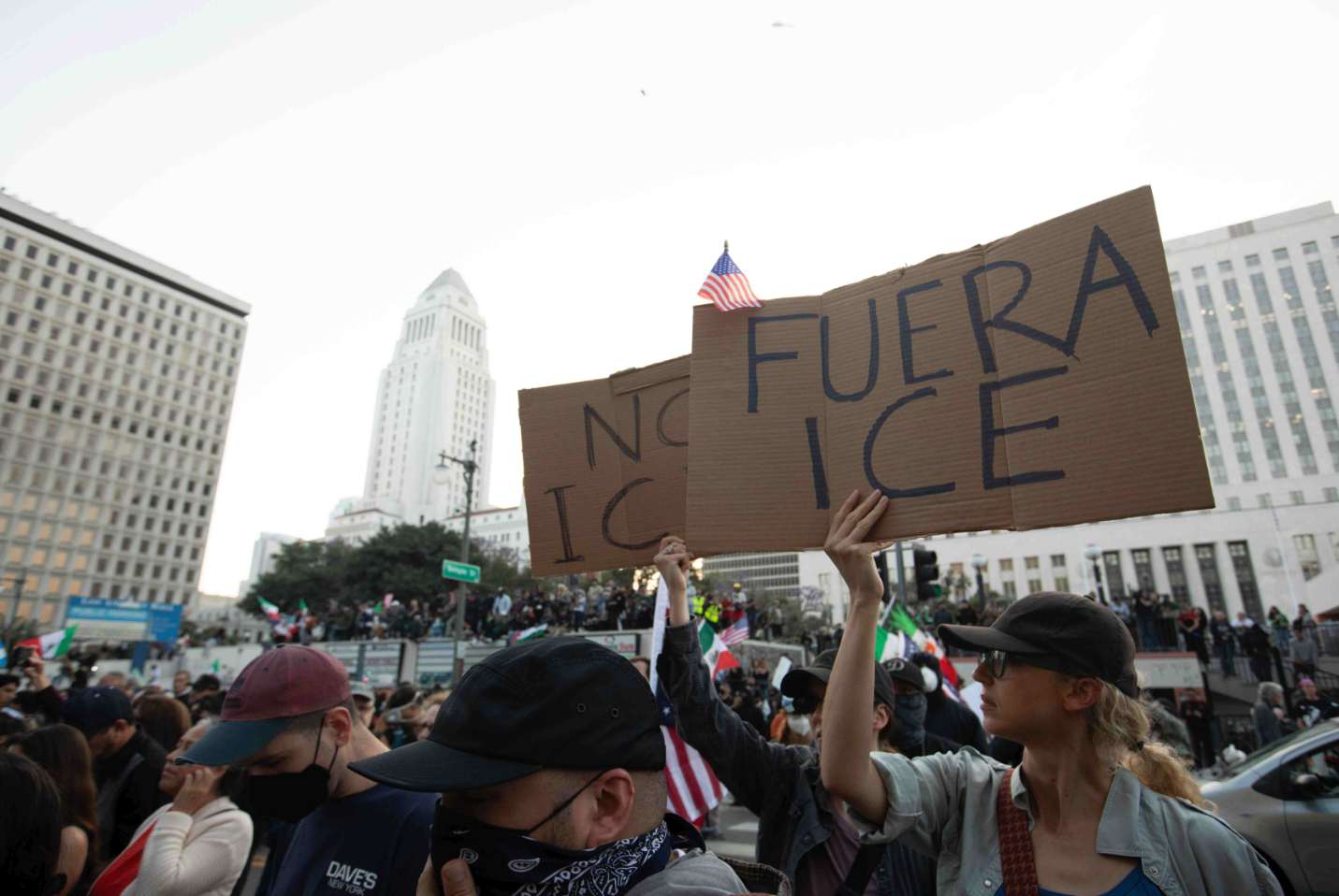
Donald Trump’s anti-immigrant policies marked a dramatic shift in border management. Toward the end of his first year in the White House, the initial public support he enjoyed is now beginning to show signs of waning.
A segment of the citizenry—who feel threatened, with or without reason—is beginning to draw an ethical line: they support greater immigration control, but reject the persecution of immigrants when it involves violating minimum guarantees or degrading their human condition.

Rejection of extreme methods
A Harvard-Harris poll released last month shows that 44% of Americans generally approve of Trump’s performance. This represents an eight-point drop from the same poll in February, the month after he began his second term, and a two-point drop from September.
Trump’s approval rating is now below 50% on all key issues, although he gets his best ratings on fighting crime and immigration, at 49% and 47% respectively.
Although support for his actions on immigration control remains above his overall approval rating, it is beginning to show a decline .
After an initial peak above 55%, support stabilized around 50% and then declined. This snapshot suggests a public opinion that, broadly speaking, values the return of control after a period perceived as chaotic or out of control under the Democratic administration, but at the same time rejects the harsher aspects of the Republican approach.
In this sense, Trump’s immigration policies may be beginning to be seen as bordering on a police state in terms of arrests and deportations. Society is drawing lines against the most extreme procedures. The fact that the central tension lies not in the objective itself, but in specific mechanisms questioned for their lack of basic safeguards, reveals a deep-seated discontent with the state of affairs that Trump inherited and that a segment of the electorate considered unsustainable.
Reasonable control
The social barometer may be indicating strong support for the success of border control at hotspots along the Mexican border, where the U.S. government has made significant progress, with its lowest levels in 50 years.
And this public perception in favor of reasonable immigration control doesn’t stem solely from fear, insecurity, or manipulation. It arises from a long, profound, and transformative process that politics was unable to foresee and guide.
It is fair to acknowledge that Democratic President Joe Biden unsuccessfully attempted to advance sweeping immigration legislation that was paralyzed by polarization, even within his own party.
The president’s verbal lash doesn’t come from nowhere. It’s a response to a climate that began to take shape in the 1990s, when many believed that the end of the Cold War and the expansion of free trade opened the door to almost guaranteed prosperity.
Scapegoat
The change in the economic structure left the traditional industrial belt rusted and exposed millions of workers to fierce competition, accelerated by China and by a technological revolution that altered both production and the social image of work.
The United States, despite being the cradle of technological development, witnessed the erosion of the Midwestern manufacturing hub. The resulting economic, social, and cultural impacts ultimately reverberated through politics. This decline was not recognized in time by political elites, who for years underestimated its symbolic significance.
In that context, poor and undocumented immigrants —drawn by the promise of opportunity and the image of a prosperous and free country—became the easiest target to explain the economic downturn and broader social unrest. They were not the cause of these problems, but they became the focus of a conflict that blends economic frustration, cultural anxiety , and the lack of a clear direction in the world’s leading power.
Trump has capitalized on the uncertainty and unease left by economic and cultural changes. He didn’t need to prove causality or present data. Activating an emotional framework was enough. His anti-immigrant rhetoric transforms the despondency of stagnant communities into a simple and powerful certainty: the undocumented immigrant as both explanation and threat.
In that sense, the president didn’t discover the discontent, but he did amplify it with precision. He didn’t persuade with arguments, but rather orchestrated an experience already shaped by pre-existing fears. His strength lay in transforming a diffuse unease into a clear and mobilizing narrative.
The criminal and the gardener
It must also be said that, if the polls accurately reflect the social climate, the public is beginning to question the president’s more extreme approach . As a Washington Post editorial summarized the emerging criticism, “Americans see the difference between arresting a rapist and deporting the tax-paying neighborhood gardener.”
In any case, it is reasonable to argue for the need for immigration controls . This is necessary for the functioning of the rule of law, democratic coexistence, economic transparency, and even for ethical reasons. A country governed by the law can face corrosive effects if it chooses to turn a blind eye to the 14 million undocumented immigrants in the US in 2023, a record number that needed to be addressed.
The fundamental question is not whether or not to control the situation, but how to do so without turning a real problem into a crusade that fractures society. And that is the powerful message that public opinion is sending to the Republican government.
The middle ground lies between firmly enforcing border controls and not pursuing a teacher in Chicago all the way to the school building itself. And for this reason, citizens are likely to reject Trump’s announcement to “permanently stop immigration from all Third World countries .” The president’s statement came in response to the recent attack on two National Guard members —one killed and the other wounded—by a former Afghan soldier and CIA collaborator who has taken refuge in the US.
Citizens seem to be starting to say that protecting the border does not require ignoring the dignity of those who are already part of the country’s economic and social life.
They are gardeners and plumbers, farm and construction workers. They are the ones who keep hotels, kitchens, and services running, who make the beds and clean the rooms. The political rhetoric that justifies anti-immigrant actions may ignore this, but the economy and daily life remind us of it every single day.
*Article originally published in Diálogo Político.
Autor

Miembro del Consejo de Redacción de Diálogo Político. Investigador y analista en el think tank CERES. Profesor de periodismo en la Universidad de Montevideo.