For years, Iran’s presence in Latin America barely made headlines. It was a peripheral issue, more associated with diplomatic relations than with security dynamics. That landscape changed in 2026. The combination of the war in the Middle East and political transformations in the region, especially in Venezuela, brought the Islamic Revolutionary Guard Corps (IRGC) to the center of the debate.
However, a simplistic reading should be avoided, as the new context does not imply the end of Iranian influence in Latin America. On the contrary, it reveals its capacity for adaptation.

The most visible turning point was the decision by the Argentine government, in April 2026, to designate the Revolutionary Guard as a terrorist organization. Beyond its legal effects, the message was unequivocal in confirming that Iran ceased to be perceived as a distant actor and became a security issue. This decision responds to pressure driven by the United States and Israel to limit Tehran’s global projection. At the same time, it underscores a regional reality in which networks linked to the IRGC have ceased to be marginal.
Therefore, the analytical framework has changed. Iran’s presence is no longer interpreted in diplomatic terms, but in terms of security, intelligence, and illicit economies.
Hezbollah: less hierarchy, more network
The main instrument used by the IRGC to extend its influence in Latin America has been Hezbollah. The Lebanese-origin organization linked to Iran has developed a flexible, informal structure in the Western Hemisphere that contrasts with the hierarchical character it maintains in Lebanon. Here, it operates as a flexible constellation of groups with operational autonomy, integrated into local dynamics. In practice, this implies its participation in activities such as smuggling, drug trafficking, or money laundering, which constitute the basis of its financing and the key to its resilience.
The main areas of Hezbollah’s activity in the region are the Tri-Border Area (Argentina, Brazil, Paraguay) and Venezuela, which for years provided an especially favorable environment for its expansion. Added to this is the existence of communities of Lebanese origin in different Latin American countries that in some cases have served as a support environment or cover.
This decentralized model has a decisive advantage: it is very difficult to dismantle. Even if Hezbollah suffers setbacks in the Middle East, its networks in Latin America can continue operating, confirming an economic logic that departs from a purely military conception.
Venezuela: from strategic ally to uncertain scenario
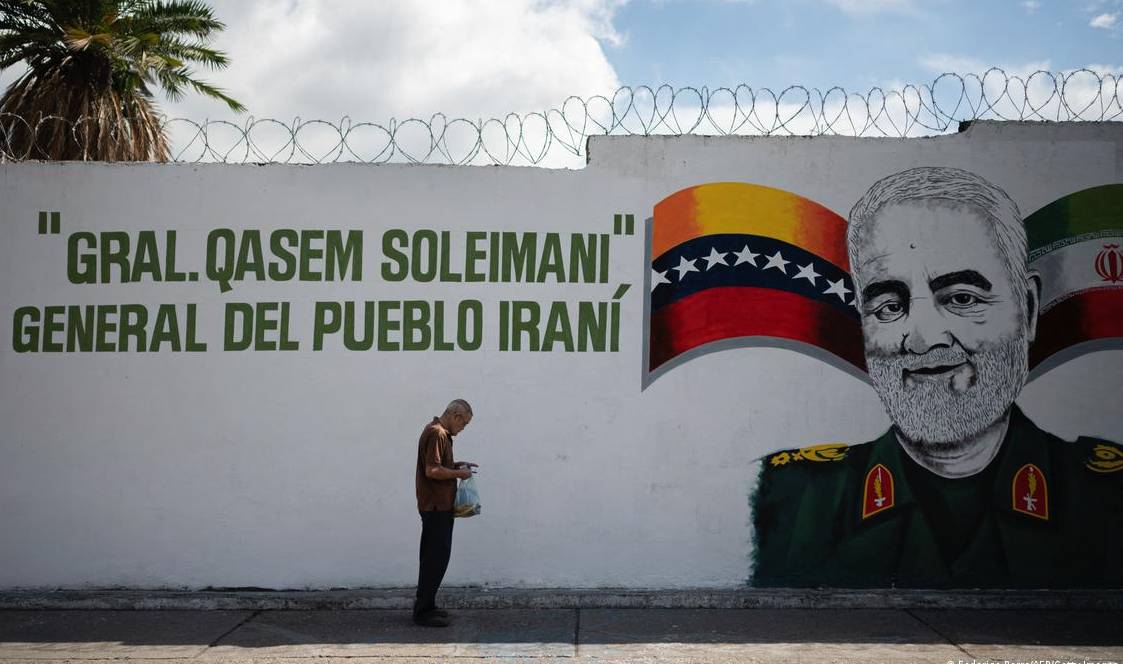
For more than twenty years, Venezuela was Iran’s main foothold in Latin America. The alliance with the Chavista regime allowed Tehran access to infrastructure, financial networks, and diplomatic cover. That balance has changed: the departure of Nicolás Maduro and the new orientation of Delcy Rodríguez’s government toward the United States introduces clear uncertainty regarding the Venezuelan government’s support for Iran’s presence.
However, the networks built over years are not dismantled by decree. Logistical, commercial, and financial connections continue to exist, although from now on they will have to face a new scenario with less political protection and greater external pressure. In this way, Venezuela ceases to be a safe haven and becomes a contested space, where different actors seek to reposition themselves.
Organized crime: where everything converges
The factor that best explains the persistence of Iran’s presence in Latin America is its convergence with organized crime, with which it has developed functional alliances. Criminal organizations provide routes, infrastructure, and the capacity to operate clandestinely, while networks linked to Iran offer international connections and financing mechanisms oriented toward money laundering.
The result is a gray zone where the criminal and the geopolitical intertwine. And it is precisely in that space where states face the greatest difficulties in acting. Moreover, this convergence reduces Iran’s dependence on allied governments. Even in scenarios of loss of political support, as in the Venezuelan case, these networks allow it to maintain its presence.
More pressure, but not less presence
The current international context is also unfavorable for the Revolutionary Guard. The war that began in February 2026 has increased pressure on its structure through targeted attacks, the weakening of its leadership, and greater diplomatic isolation. However, this pressure has a paradoxical effect: far from reducing its presence in Latin America, it increases the value of its external networks. The region is not a priority front, but it does offer financing, mobility, and lower visibility.
Added to this is an emerging dimension: cyberspace. Recent incidents suggest that the IRGC has expanded its operations beyond the physical domain, facilitating Iranian projection in digital arenas.
In this context, the key to understanding the Revolutionary Guard’s presence in Latin America lies in recognizing that it does not depend on a single factor. The IRGC relies on a combination of state actors, illicit networks, and decentralized structures. That is why, when one of these pillars changes—as is now happening in Venezuela—the network does not collapse, but rather transforms.
This is the real challenge for Latin American states. They are not facing a rigid structure, but a flexible web capable of adapting and operating at the margins. The question is not only how much power Iran has in the region, but what capacity states have to respond to threats that do not follow traditional logics. In today’s world, networks move faster than states. And the Revolutionary Guard has learned to operate in that space.
*Text originally published in Diálogo Político
Autor

Political analyst, PhD in social sciences from the University of Valladolid and professor at the International University of La Rioja.