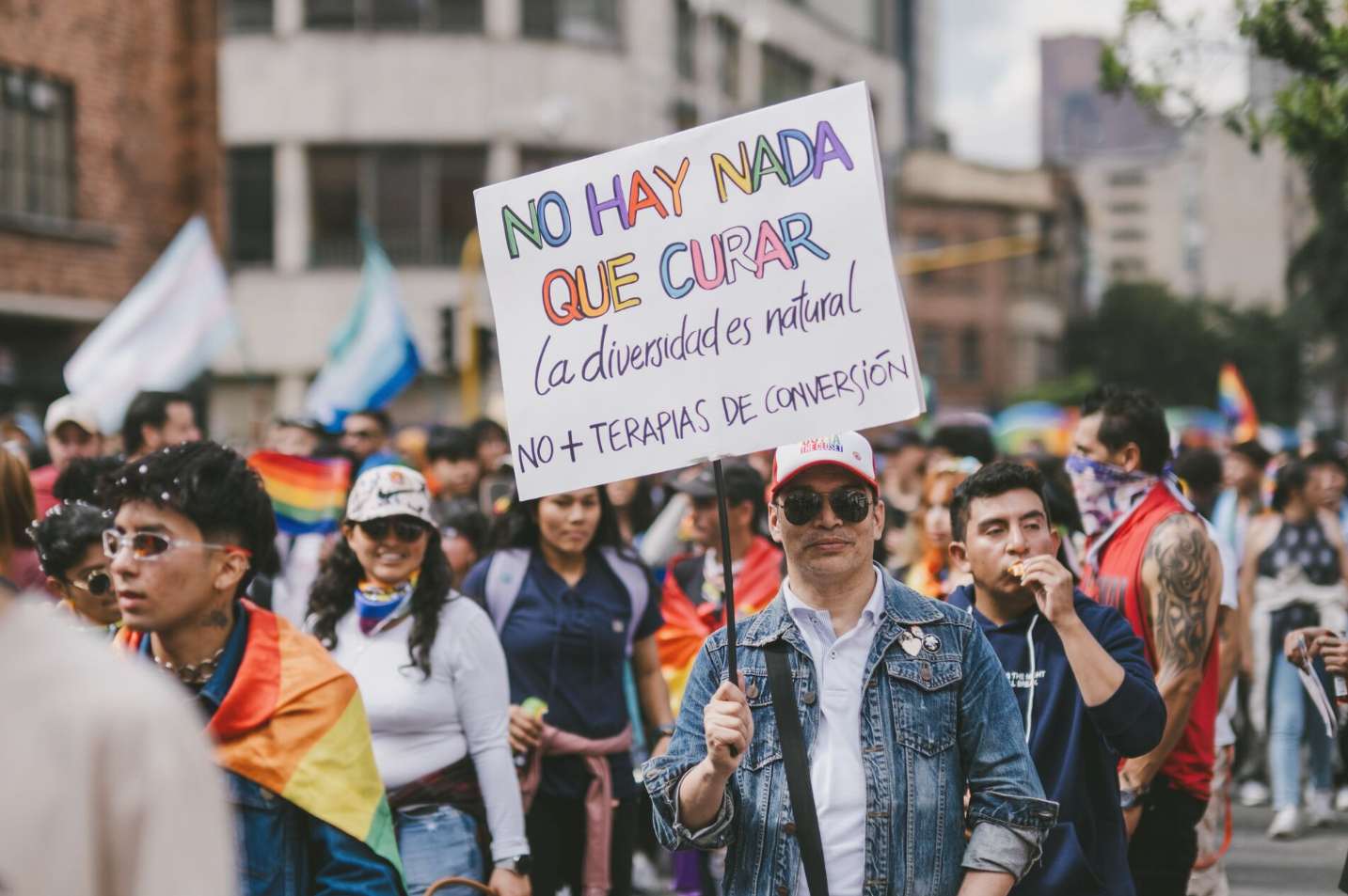
Conversion therapies, known as SOGIECE (Sexual Orientation and Gender Identity and Expression Change Efforts), are neither practices of the past nor marginal phenomena: they are the most regressive banner of a global offensive against LGBTIQ+ rights, a facet of the relentless advance of worldwide ultraconservatism. This reaction draws on the construct of “gender ideology” as a mobilizing force.
Colombia represents a paradigmatic example. It is a country that, within Latin America, moved early through key stages in the struggle for LGBTIQ+ rights but recently has stalled on banning SOGIECE, practices that the UN classifies as torture. The Colombian setback, far from being a contingency, is a symptom of a reluctance operating on a global scale.

The false conversion therapies
Supporters of SOGIECE claim that a person’s sexual orientation or gender identity (SOGI) can—and above all should—be changed. However, these practices, in addition to calling into question the very nature of homosexuality, are not therapies but rather highly discriminatory, cruel, inhuman, and degrading procedures. The UN, the Pan American Health Organization (PAHO), and the World Psychiatric Association consider them human rights violations, classifying them as ill-treatment, including the category of torture. Both the UN and the Council of Europe call for their prohibition.
Their “techniques” bear this out: among these “treatments,” which lack any medical or scientific basis, are humiliation, isolation and confinement, forced medication, beatings, rape, electric shocks, drugs, and coercive religious practices, among other methods. Their psychological and physical effects are long-lasting and entail serious health risks.
As early as 1973, the American Psychiatric Association (APA) removed homosexuality from the Diagnostic and Statistical Manual of Mental Disorders (DSM-II), concluding that it was not an illness, as it does not entail psychological impairment or social maladjustment. In 1990, the WHO likewise removed homosexuality from its International Classification of Diseases (ICD).
However, shortly after the APA’s ruling, in 1976, a backlash emerged led by the U.S. ultraconservative Christian group Exodus, linked to the “ex-gay” movement, which held that sexual orientation was not innate and could be reversed through Jesus Christ. In 2013, its president, Alan Chambers, acknowledged the futility of such claims: he dissolved the organization and apologized. Even so, Exodus’s influence had already taken root in Latin America.
SOGIECE today
Today, SOGIECE practices are carried out in more than sixty countries, especially in Africa, Latin America, the Caribbean, and Asia. Other states, by contrast, have banned them or prosecuted them criminally: Malta, Canada, and France have classified them as crimes; Brazil and Ecuador have expelled them from the health sector, while Chile has discarded them as a mental health issue. In Spain, which could serve as a regional benchmark, legislation provides for a broad prohibition of conversion therapies, accompanied by a sanctions regime regarding their promotion and application, thereby strengthening the protection of LGBTI rights. The Spanish Congress is currently debating the criminal prosecution of SOGIECE.
“Gender ideology” as a central construct
The aforementioned ultraconservatism requires cultural and methodological cover, and the construct of “gender ideology” provides an incentive for SOGIECE to operate with impunity while simultaneously generating systematic resistance to any legislative attempt to curb them.
This construct lacks a scientific basis, functioning instead as a discursive and mobilizing tool. It emerged in Europe and is structured as a reaction to LGBTIQ+ gains, which, according to this narrative, are framed as supposed “threats” to the traditional family while also denying biology. The pattern of action against LGBTIQ+ people includes limiting the recognition of gender identity, restricting the transfer of trans women to women’s prisons, and eliminating or suspending gender transition-related medical treatments.
Its rallying points are articulated around conservative groups and media outlets and the Catholic Church, including Pope Francis (who has called “gender ideology” “the greatest danger of our time”). In the Americas, it has been strongly adopted by leaders such as Trump, Milei, Bukele, Bolsonaro and his sons, Kast, Asfura, and Rodrigo Chaves, as well as by other groups in Mexico and across the region.
What is happening in Colombia?
The criminal prosecution of SOGIECE in Colombia began to take shape in 2021. In 2022, various social and LGBTIQ+ organizations submitted more than forty thousand signatures to Congress as part of a citizen legislative initiative, which took the form of a bill informally known as “nothing to cure.” It pursued a dual objective: banning the offering, practice, advertising, or public funding of events that promote SOGIECE, and enabling their criminal prosecution. However, it does not define them as a standalone offense, but rather as aggravating circumstances (of a general nature) in the crimes of “torture” and “discriminatory acts” when committed with the intent of changing sexual orientation or gender identity.
The initiative was shelved. Nevertheless, in November 2022 it was reintroduced as “Bill No. 272,” and in 2023 it advanced in the House of Representatives, although it stalled again in 2024 in the Senate due to the deployment of dilatory strategies by senators to deliberately delay the bill’s progress, effectively torpedoing its return to the House for approval and subsequent presidential sanction before the legislative session closed.
Resistance from sectors of society to the bill in Colombia has materialized in opposition arguments centered on the defense of the family, freedom of religion, and medical autonomy. However, trans activist Danne Aro Belmont, executive director of the GAAT Foundation (Group for Action and Support for Trans People), considers that the current moment is favorable due to the pro-majority in Congress, although the right and far-right improved their positions in the March 2026 legislative elections.
An analysis of the Colombian case—one of the latest setbacks for LGBTIQ+ rights in the region—may be understood as a local chapter of the global struggle between the cresting wave of a rising far right and those seeking to reverse it. The obstacles standing in the way of enacting legislation against SOGIECE are not only political; rather, they reflect a cultural and social fabric that sustains their persistence.
The Colombian lesson shows that drafting anti-SOGIECE laws inevitably requires prior cultural and political awareness-raising efforts.
Autor

Historian and PhD in Legal and Social Sciences specializing in the Balkans from the University of Malaga. Master's degree in History from the University of Granada.