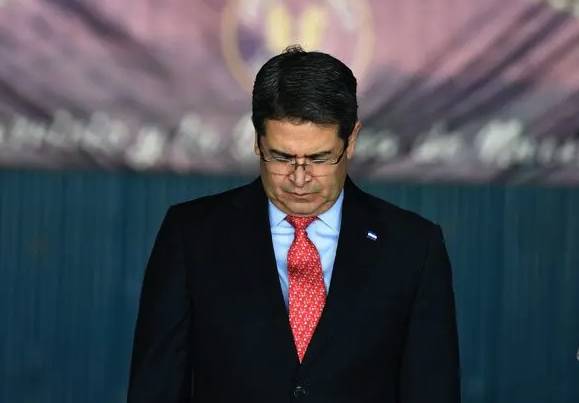
An investigation by journalists affiliated with Canal Red has made public several recordings in which prominent Honduran politicians—among them former president Juan Orlando Hernández (JOH) and current leader Nasry Asfura—can be heard discussing a scheme orchestrated by leaders of the international far right to destabilize progressive governments in Latin America. The objective of the plot revealed by the “Hondurasgate” scandal was to create a media outlet to spread fake news about the administrations of Sheinbaum and Petro.
JOH, pardoned by Trump despite facing drug trafficking charges in the United States, allegedly played the key role in financing Asfura’s victory in the latest Honduran elections, with Trump’s backing. Furthermore, JOH is said to have pushed for the assassination of Marlon Ochoa, adviser to the National Electoral Council and member of the progressive LIBRE party, because of his denunciations of fraud during the presidential elections, particularly in relation to explicit interference coming from Washington.

Although Hondurasgate has a highly domestic dimension within Honduran politics, its regional and international implications should not be underestimated. The recordings reveal that JOH was allegedly organizing a disinformation campaign with financial support from Argentine president Javier Milei, aimed at destabilizing the political climate in Brazil, Colombia, and Mexico, countries governed by progressive forces. Milei’s government would allegedly support the aforementioned media outlet together with the government of Benjamin Netanyahu and the United States.
Chanel Red released 37 recordings extracted from conversations held through WhatsApp, Signal, and Telegram between some of the most relevant political figures in Honduras and actors linked to the international far right. The audios, previously subjected to forensic authentication processes using the Phonexia Voice Inspector program, reveal alleged money transfers from Honduran public institutions—particularly the Secretariat of Infrastructure and Public Works—to finance political and media operations coordinated from the United States.
In one of the most sensitive recordings, JOH asks Asfura to send 150,000 dollars to establish a digital platform linked to the circle surrounding the U.S. president. In other conversations, JOH speaks about financial support coming from Israel and directly mentions that the pardon granted by Trump had allegedly been facilitated through lobbying efforts financed by Israeli actors.
Beyond the media campaigns, the conversations point to broader geopolitical projects. These include the expansion of special economic zones, the installation of a new military base in Roatán, the construction of a penitentiary center inspired by El Salvador’s CECOT model, and infrastructure projects awarded to U.S. companies. The recordings also show strong concern about limiting China’s presence in Honduras and consolidating a strategic alignment with Washington and Tel Aviv.
Regardless of the findings of Hondurasgate, there is an evident current practice of tripartite alignment between the Latin American right, the United States, and Israel. The objective of these actors appears to be contributing to U.S. efforts to shift the region toward the right. From the perspective of the United States, the prevalence of right-wing governments serves the goal of pushing China away from the region. From Israel’s perspective, the alliance with Christian Zionist groups—evident in its closeness to politicians such as Jair Bolsonaro—may secure diplomatic backing amid the ongoing international criticism over both the genocide in Gaza and the wars in Iran and Lebanon.
Hondurasgate confirms that automatic alignment and the dependency associated with this practice remain a structural problem in Latin American foreign policy. The gravity of the phenomenon lies in the fact that such alignment does not appear to respond to Latin American strategic interests, but rather to external agendas linked to preserving the globally declining hegemony of the United States and sustaining Israel diplomatically in an international context increasingly adverse to both actors.
The instrumentalization of media campaigns, disinformation networks, and transnational political alliances demonstrates that Latin America’s ideological dispute can no longer be understood exclusively through a national lens. On the contrary, it is embedded within a multipolar scenario in which external actors actively seek to influence the region’s political orientation, provoking responses from the left, as seen in Barcelona.
Strategic subordination to Washington and Tel Aviv reproduces historical patterns of political dependency that limit Latin America’s capacity to build a truly autonomous and sovereign foreign policy. Ultimately, the case forces a reconsideration of the debate over regional autonomy in the 21st century. In a context of multipolarity—accepted by much of the Global South—Latin America faces the challenge of deciding whether to continue acting as a space of subordinate alignment or to move toward a more autonomous, plural, and coherent international position aligned with its own historical and geopolitical interests.
Autor

PhD candidate at UNU-CRIS and Ghent University. Master's degree in Latin American Studies from Georgetown University and a Master's degree in Diplomacy and International Relations from the Diplomatic School of Spain.