History is full of wars whose official explanations tell only part of the story. The leaders of imperial powers have always resorted to virtuous and respectable reasons to justify what, ultimately, is nothing more than greed, satisfied by spilling the blood of those who are militarily weaker. Spain’s conquest of the Americas was not primarily about bringing God to indigenous peoples, as was claimed; above all, it was about gold, silver, land and slaves. The same was true of the Crusades; it was not simply Christianity versus Islam. European imperial ambition was also at play. In fact, the Fourth Crusade (1202–1204) attacked and sacked Constantinople, a Christian stronghold.
Kipling, the English writer, poetically summed up another of the presumptuous ex post arguments commonly made by colonizers: conquest was a sacrifice, undertaken for the good of the conquered:
“Take up the White Man’s burden, send forth the best ye breed; bind your sons to exile to serve your captives’ need; to wait in heavy harness, on fluttered folk and wild, your new-caught, sullen peoples, half devil and half child.”

In modern times, especially after the Second World War, the promotion of democracy, another morally unimpeachable concept, has been chosen to justify aggression.
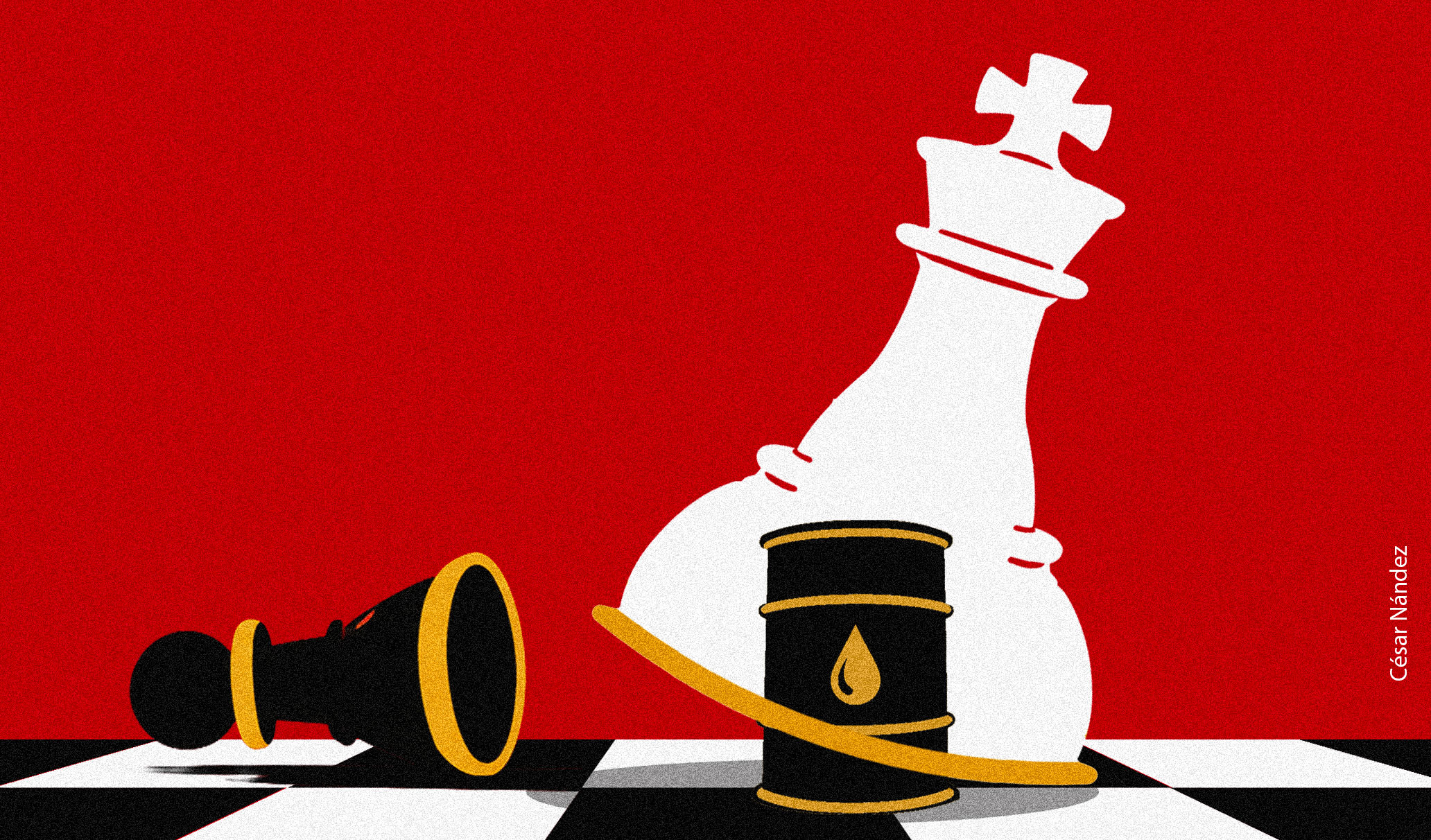
Yet, just as with the real objectives of traditional colonization, the reason for modern wars waged by countries such as the United States is not democracy, but economics, especially the economics of oil. This is particularly relevant in relation to the Middle East and Venezuela.
Perhaps there is no clearer official acknowledgment of the causal link between oil interests and aggression than President Jimmy Carter’s State of the Union address in January 1980. In explaining the challenges facing the United States, Carter emphasized “the overwhelming dependence of the Western democracies on Middle Eastern oil supplies.” Carter then made the strategic implication unmistakable. Referring to the Persian Gulf, he declared: “An attempt by any outside force to gain control of the Persian Gulf region will be regarded as an assault on the vital interests of the United States of America, and such an assault will be repelled by any means necessary, including military force.” (State of the Union Address, January 23, 1980.)
This was not the language of some obscure conspiracy theorist. It was the president of the United States (incidentally, the most consistent president in modern American history when it came to human rights and democratic values), speaking before Congress, explicitly identifying Middle Eastern oil as fundamental to the security of the West and declaring control of the Persian Gulf (and therefore the Strait of Hormuz) to be a vital American interest.
This brings us to the invasion of Iraq. Alan Greenspan, hardly a leftist but rather someone who had spent decades at the heart of the American economic establishment, eventually becoming chairman of the Federal Reserve, wrote in his 2007 book The Age of Turbulence: “I am saddened that it is politically inconvenient to acknowledge what everyone knows: the Iraq war is largely about oil.”
Given his vainglorious grandiloquence and obsession with self-adulation, Trump has been explicit about material interests. On January 3, 2026, immediately after the military operation to capture Nicolás Maduro, he was asked whether U.S. troops would maintain a presence in Venezuela. His response was direct: “We’re going to have a presence in Venezuela as far as the oil is concerned,” because “we’re going to take a tremendous amount of wealth out of the ground.”
Subsequent events make the statement even more consequential. On August 28, Trump announced what he called “THE BIGGEST OIL DEAL IN THE HISTORY OF THE WORLD!” He declared that, at his direction, Secretary of State Marco Rubio and Secretary of War Pete Hegseth had secured “majority U.S. control of more than 65 BILLION BARRELS of proven oil reserves in Venezuela” (the capital letters and exclamation marks are in the original!).
The White House subsequently described the agreement as aimed at securing American energy dominance “for the next century” and stated that the United States had obtained majority control of more than 65 billion barrels of Venezuela’s proven reserves, along with governance rights, economic ownership and guaranteed access to oil at below-market prices.
But what Trump has in transparency he lacks in originality. As early as 1950, the United States had its eyes (and its wallet) on Venezuelan oil. A secret document from the time stated that “All U.S. policies toward Venezuela are affected to a greater or lesser degree by the objective of assuring an adequate supply of petroleum for the United States” (U.S. Department of State Policy Statement on Venezuela, June 1950).
Trump may be more open about the real reasons, but his objectives are the same as those of traditional imperialism: extracting wealth from militarily weaker nations. What mattered about Venezuela was oil, not whether Maduro’s regime was democratic or dictatorial. As long as Iran favored Western companies with exploitative oil contracts, it was a friend; it did not matter that the Shah was a ruthless and corrupt dictator. When the ayatollahs came to power and nationalized the oil industry, Iran became an enemy. It does not matter that Saudi Arabia is an absolutist and theocratic monarchy, where much of the oil wealth finances the business interests and extravagant luxuries and privileges of the royal family, as long as Western powers have preferential access to its oil.
Putin’s Russia, with its invasions of Georgia, Crimea and the Donbas in Ukraine, its bombing campaigns in Syria to support dictator Assad and preserve its influence in the Middle East, and its direct interventions and those carried out through the Wagner Group in various parts of Africa, also occupies a prominent place on the podium of aggression.
Certainly, neither the United States and its NATO allies nor the European colonial powers of the past hold a monopoly on military violence. But these are the powers that lecture and moralize from the pinnacle of righteousness, looking down on the rest of the world. That is why it is so grotesque when they attempt to disguise their barbarity by claiming that it is a tool for spreading the word of God, civilizing “sullen peoples, half devil and half child,” or promoting democracy. These concepts have been used to mask their willingness to place military superiority at the service of their greed and to dress up the use of the law of the jungle in international relations in white.
So, the question is not whether invasions are driven by economic interests. Obviously, that has almost always been the case. The question is whether those interests are honestly acknowledged, how they are pursued, and whether, when war is chosen as a tool, the enormous human costs can be justified.
That is the conversation that should be had before, not after, the next military attack.
Autor

Politician and economist. Professor at IE University (Spain). He holds a Master's degree in Economics from the University of Manchester (England). Former Congressman and Minister of Planning and Economic Policy of Costa Rica.