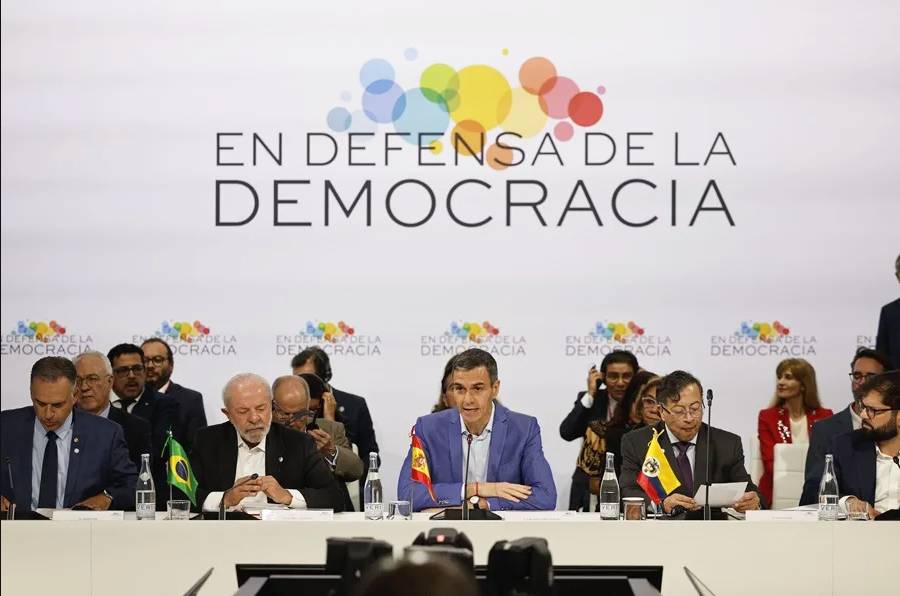
Should a democracy allow its adversaries to use elections and political rights to destroy the democratic order itself? This question lies at the core of the idea of militant democracy: in extreme situations, democracy can restrict the actions of those who attempt to eliminate it. The concept was formulated by the jurist and political scientist Karl Loewenstein, exiled from Nazi Germany, in articles published in 1937. Nearly nine decades later, Tom Theuns revisited the debate to ask whether the European Union also acts as a militant democracy in the face of democratic backsliding among its Member States. The answer is yes, but in a restricted sense.
When defending democracy requires setting limits
The distinction proposed by Theuns is important. Fines, judicial proceedings, and fund freezes penalize conduct or exert pressure on governments. On the other hand, banning a party, stripping a political actor of the right to run for office, or suspending a State’s voting rights in shared institutions directly affects political participation. For the author, this is what characterizes militant democracy.

This response is justified only under two conditions: a real threat to democratic continuity must exist, and the restriction must be necessary because less severe measures prove insufficient. In the European Union, the infringement procedures under Articles 258 to 260 of the Treaty on the Functioning of the European Union and the freezing of funds under the Rule of Law Conditionality Regulation are legal and financial instruments. Article 7 of the Treaty on European Union, which allows for the suspension of a State’s voting rights, comes closer to Theuns’s strict definition.
Hungary, Poland, and Slovakia
Viktor Orbán’s government weakened institutional checks and balances, modified electoral rules, and expanded its influence over the media and the judiciary. The European Union responded with legal actions and financial restrictions, but did not suspend Hungary’s voting rights in the Council. In April 2026, Orbán lost power at the ballot box after 16 years in office. The defeat proved that alternation in power was still possible; however, it did not erase the cumulative effects of institutional changes.
In Poland, the Law and Justice party (PiS) government also clashed with European institutions over measures that expanded political control over the judiciary. The response included judicial proceedings, fines, and the withholding of funds. PiS left government in 2023, but rebuilding institutions after years of erosion is harder than winning an election.
Slovakia, under the government of Robert Fico, serves as a more recent warning. Changes to anti-corruption agencies, criminal legislation, and public media sparked criticism from European institutions. These cases show that democratic backsliding usually progresses through gradual legal modifications. They also help explain why the European Union prefers to resort to legal and financial sanctions before suspending political rights.
Mercosur already has a democratic clause
Mercosur does not need to turn into a European Union to defend democracy. The Ushuaia Protocol, signed in 1998, establishes that the full validity of democratic institutions is a condition for integration. If a breakdown occurs, the remaining countries can suspend the affected State from the bloc’s bodies and from its participation rights. According to Theuns’s definition, this suspension constitutes a measure of militant democracy.
The mechanism was first used in 2012, when Paraguay was suspended following the expedited impeachment of President Fernando Lugo. The decision remains controversial. Researchers Túlio Sérgio Henriques Ferreira and Ana Cláudia Alves Cunha Paiva argue that the suspension was not motivated solely by the defense of democracy: it also facilitated Venezuela’s entry into the bloc, which had previously been blocked by the Paraguayan Senate.
In 2017, Mercosur suspended Venezuela, citing a breach of the democratic order. Rights and obligations linked to its status as a member state were revoked. Therefore, the South American bloc has already applied the tool that is referenced when proposing a regional response to the government of Nicolás Maduro.
Both episodes highlight different problems. The Paraguayan case raises questions about bias and the political use of the clause. Venezuela’s suspension, on the other hand, did not lead to the restoration of democracy, calling into question the effectiveness of the instrument. The existence of a clause in a treaty does not guarantee that governments will apply it consistently or that it will succeed in altering the behavior of an authoritarian regime.
Brazil and the limits of response
Brazil also experienced democratic erosion. During Jair Bolsonaro’s presidency, there were repeated attacks on the electoral system, the Federal Supreme Court, the press, and the norms of institutional coexistence. The events of January 8, 2023, and the investigations into an attempted breakdown of the constitutional order confirmed that the threat was not abstract.
At the same time, the 2022 elections resulted in an alternation of power, and Congress, the judiciary, the press, and civil society retained their resilience. This does not eliminate the severity of that period, but it distinguishes the Brazilian case from a more consolidated institutional capture.
This difference is important when classifying responses. Judicial proceedings and convictions for violence, property damage, or attempted coups sanction behavior criminalized by law; fines and reparations also do not, in themselves, constitute militant democracy in the strict sense. Disqualification from holding public office comes closer to the concept because it restricts the right to stand for election. In Jair Bolsonaro’s case, the disqualification was decided by the Electoral Court, not the Federal Supreme Court.
Political restrictions may be legitimate in the face of a severe threat, but they require individual accountability, proportionality, due process, and transparent criteria. Institutional firmness helped prevent a breakdown in Brazil; public trust in it depends on these boundaries being applied with rigor.
An integration that protects democracy
My hypothesis is that Mercosur already possesses an extreme measure, but lacks intermediate instruments and safeguards to make it reliable. The bloc could advance through independent monitoring of democratic quality, transparent criteria for recognizing a breakdown, the right of defense, and the review of decisions. It also needs to strengthen its institutions and expand the financial capacity of FOCEM to support the press, civil society, and institutional recovery.
The European experience demonstrates that permanent rules, financial resources, and legal mechanisms make it possible to exert pressure on governments before resorting to political exclusion. Mercosur’s trajectory teaches that a democratic clause, without impartial and effective application, can become a source of dispute or have little effect. The goal is not to copy the European Union, but to ensure that South American democracy has a regional defense that is predictable, legitimate, and capable of functioning even as governments change.
Autor

Political scientist, a graduate of the Centro Universitário do Distrito Federal (UDF) in Brazil, and a master’s student in the professional program in Political Science and International Relations at the Instituto Brasileiro de Ensino, Desenvolvimento e Pesquisa (IDP).