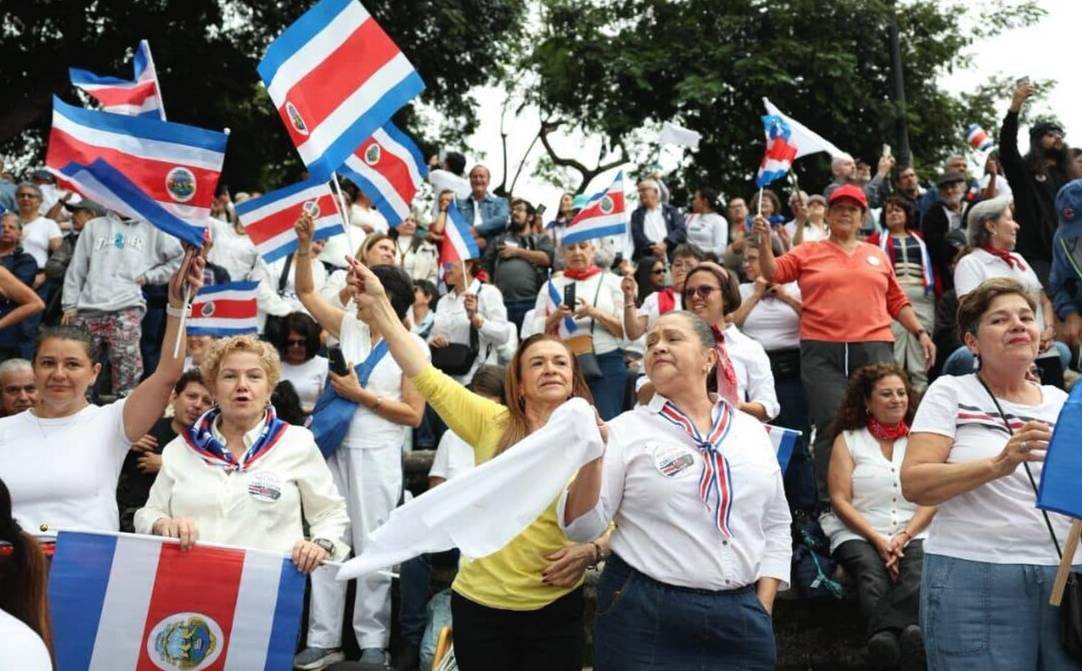
For several years now, data in Costa Rica have shown the emergence of two deeply differentiated visions of the country, both in the strategic economic sphere and in the sociocultural realm. Two events that took place in August more explicitly reflect the dimensions and characteristics of these two visions: the gathering held on August 6 in Plaza de la Democracia in defense of the democratic system and the judiciary, and, a week later, the publication of opinion polls on President Laura Fernández’s performance, one hundred days after the start of her government, with her approval rating standing above 74% among those surveyed. This is a record figure in the country’s political history, especially considering that the polls were conducted after the opposition’s sit-in.
However, this does not diminish the political significance of the sit-in. Rather, it identifies its nature. It was an active and successful demonstration by a segment of the citizenry, largely reflecting the united action of the forces opposed to the government, which nevertheless is clearly a minority compared with the views of the citizenry as a whole. Once again, this demonstrates that the ability of minorities to mobilize falls far short of representing the majority’s perception. This is a common phenomenon worldwide.

Nevertheless, this minority opposition is endowed with a sociocultural glue no less robust than that represented by President Fernández’s refoundation project. In fact, what today unites the social-Christian party’s neoliberal representative with the left-wing representation of the Broad Front and the social-democratic faction of National Liberation is, above all, the defense of the political traditions of Costa Rican democracy of the past, which was clearly successful at the continental level.
Opposed to this national outlook, a project for changing the country has emerged with arguments no less forceful. According to its narrative, the aim is to free Costa Rica from the deadlock caused by the failure to implement the structural reforms proposed by different actors since the end of the last century. And to achieve this, it has not been possible to proceed through the path of the—always overvalued— Costa Rican consensus, implemented through the elites, but rather through a break with the political tradition, faithfully represented by the defiant victory of outsider Rodrigo Chaves at the beginning of 2022.
President Chaves’s political and personal characteristics sharpened the harsher features of this rupture, which, in addition to disrespect for national political traditions, showed a determination to carry out his program against all odds, including authoritarian behavior. However, he failed to secure the constitutional and systemic rearrangements needed to remain in office and had to project the rupture through one of his most prominent collaborators, then Planning Minister Laura Fernández.
Fernández’s resounding victory in February clearly demonstrated the deep-rooted support for Chaves’s rupture project, which he reinforced by assuming the ministries of the presidency and finance in the new government. As the polls show, popular support for Chaves refers both to his proposal for structural change and to his confrontational style.
As the new president reaches her first hundred days in office, two important questions raised at the beginning of her term appear to have been resolved. The first was whether Fernández would be able to combine the continuity-oriented nature of her government with the need to establish her own profile as a leader. There is little doubt that she has achieved the desired results in this regard. The differences in communication style compared with her predecessor have not diminished the new president’s image of firmness.
However, at the deeper doctrinal level, there remains a significant unresolved shift. In her victory speech, Laura Fernández made it clear that her triumph meant Costa Rica’s entry into its Third Republic. “This is the end of the Second Republic,” she declared triumphantly. She added that it represented “a profound and irreversible change.” “Today, the Third Republic is born!” she exclaimed.
It is significant that this idea was absent from the celebration of her first hundred days in government. Does this mean that the president has abandoned her refoundation project? It is difficult to know. It could be an option in response to the opposition’s firm resistance, which would somewhat reduce her strategic ambitions. But it could also represent a tactical shift, aimed at avoiding alarm while bringing about substantive change on the more practical terrain of institutional and financial management—something that, for example, would be consistent with the fiscal pact proposed by her finance minister.
In any case, it is now possible to identify the hard core of each of the two political sensibilities. On the government side, the argument is that the goal is to put into practice the postponed strategic changes that would pull Costa Rica out of the stagnation produced by an elite pact. Their argument is that this change is being resisted by those who feel a deep nostalgia for the successful Costa Rica of the past. Breaking that resistance would require a departure from traditional ways of conducting politics, something that would necessarily be confrontational.
For the opposition, although there is no convergence on the changes that are needed, there is consensus that the forms adopted by the rupture project—and particularly those of former President Chaves—show a tendency not only toward disrespect for Costa Rica’s political traditions, but also toward the essence of an authoritarian project seeking to eliminate the system of checks and balances.
Security is the most controversial issue. A rights-protective legal framework is closely associated with an autonomous judiciary that rejects any attempt at institutional control. The rupture camp’s argument is to highlight the historical gap between arrests and convictions. According to them, the system worked when Costa Rica faced manageable levels of ordinary crime and had the lowest homicide rates in the region. But with the consolidation of organized crime and the rampant increase in the homicide rate, the population is demanding a forceful response. The controversy has ultimately taken the form of a head-on collision between the executive and judicial branches. The judiciary refuses to submit to results-based institutional planning, while the rupture project does not respect the aura of untouchability surrounding the judiciary.
At the same time, the executive branch is implementing Bukele-style contingency models, such as the construction of the High-Containment Center for Organized Crime (CACCO), which will restrict prison conditions, including communications and visits for inmates. And in response to opposition criticism over the violation of these prisoners’ human rights, the government insists that it is protecting the human rights of Costa Ricans, which are being systematically violated by organized crime.
The confrontation in this sphere has led to extreme political polarization. The judiciary has shown signs of wanting to issue mandates to the Legislative Assembly, while the presidency’s response has been to condemn what it has described as an institutional “coup d’état.”
The risks of remaining in such extreme polarization are evident, beginning with the benefits that organized crime itself derives from it. However, the fundamental positions of the two opposing projects are difficult to negotiate, something that could keep the country under extreme pressure. What cannot be foreseen, at least in the short term, is a return to the forms of consensus that characterized Costa Rica in the past.
Autor

Enrique Gomáriz Moraga has been researcher at FLACSO in Chile and other countries in the region. He was a consultant for international agencies (UNDP, IDRC, IDB). He studied Political Sociology at the Univ. of Leeds (England) wit R. Miliband.