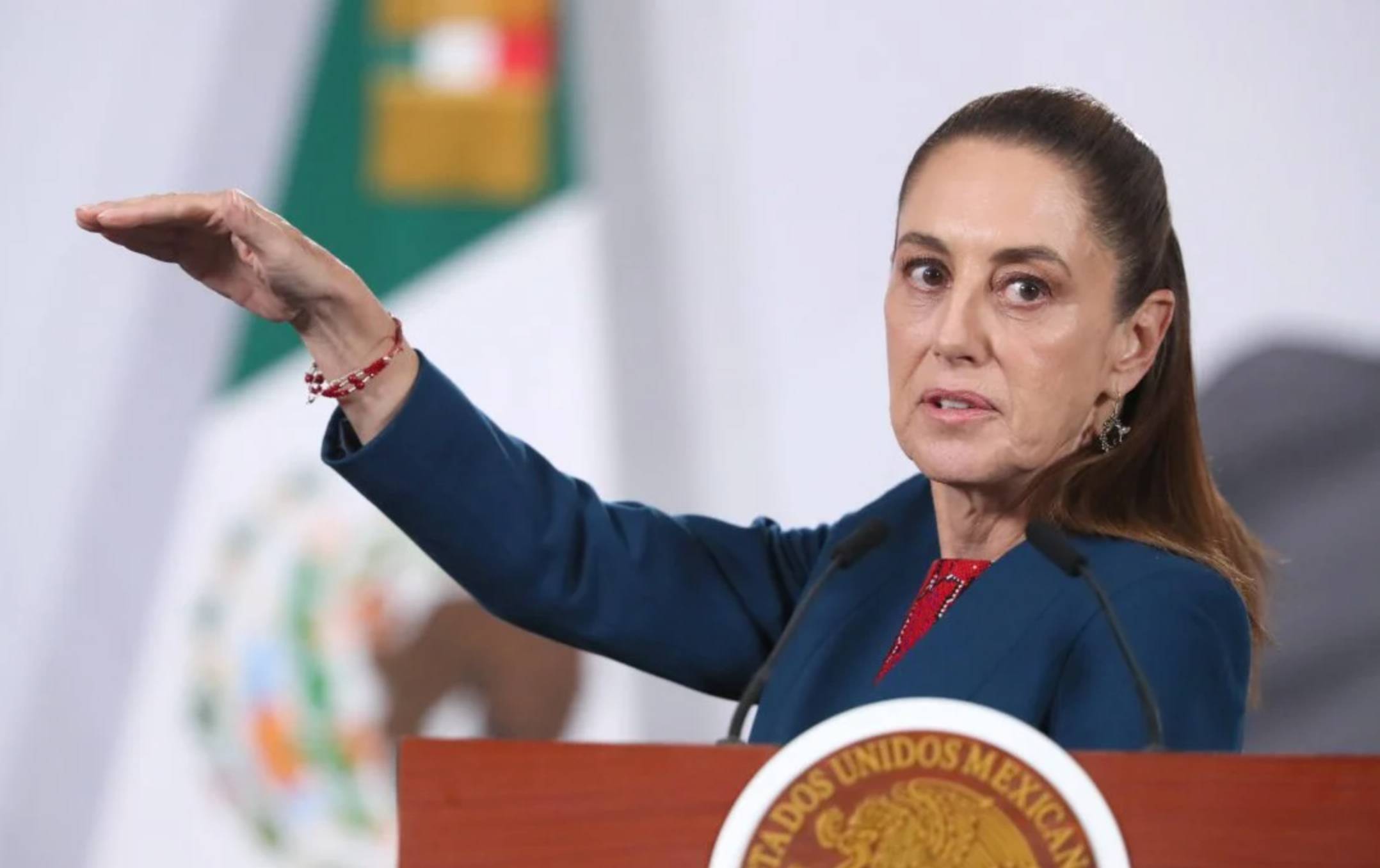
Andrés Manuel López Obrador’s victory, which brought him to the presidency of Mexico in 2018, and subsequently Claudia Sheinbaum’s victory in 2024 were welcomed by the diverse currents of the left as political victories.
However, at least in Mexico, the social-democratic current did not take long to begin distancing itself from all this, because it was a highly personalized project that replaced the institutions of the so-called “transition to democracy,” which political scientist Mauricio Merino expanded to “transition to democracy through elections.”

During the campaign, the new occupants of the National Palace had described the pacts of the transition as “corrupt and neoliberal,” so in their political vision, it was necessary to undertake a profound regime change.
It was with this approach that the process of institutional erosion began, which had nothing to do with improving democratic institutions, but rather with a gradual concentration of power that, over the years, has resulted in an increasingly autocratic system. But what was the strategy that shaped Mexico’s new political regime?
First: the Sigamos Haciendo Historia (Let’s Keep Making History) electoral coalition, dominated by the Morena party, came to power through elections, but once in office, it set about challenging democratic institutions, viewing them as instruments of neoliberalism. It did so under the populist maxim “the people voted and the people decided,” paving the way for a strategy that turned an absolute majority into a supermajority, giving it a free hand to enact reforms without constitutional or regulatory checks.
Second: the binarization of society emerged, along with the implementation of a political mechanism through which a society as complex and plural as Mexico’s was reduced to a simple, elemental opposition: “Us versus them.” And it was not merely polarization; this binary, reductive, basic relationship entailed transforming the legitimate diversity of interests, identities, and opinions into a moral divide between those who belong to the people and those who, in this worldview, are the “enemies of the people.”
Third: the strategy moved forward alongside a gradual reduction of institutional checks and balances, so that two simultaneous processes converged: first, the governing majority accumulated more political power; and second, the institutional mechanisms capable of limiting that power lost autonomy, oversight capacity, and public legitimacy.
Fourth: this was accompanied by the delegitimization of the political adversary, pejoratively referred to as “prianismo,” that is, the “neoliberal right,” the PRI and the PAN. This campaign emerged from the presidential pulpit and was neither a secondary phenomenon nor merely a propaganda strategy to gain points in the competition for votes: it was a mechanism for transforming democratic competition into a moral confrontation between the “good people” and their “enemies.”
Fifth: during López Obrador’s administration, the political foundations of an autocracy were laid, and that autocracy has advanced steadily under Sheinbaum’s government. In just two years, the most far-reaching constitutional reforms aimed at eliminating institutional checks and balances have been approved; electoral victory has progressively been transformed into a concentration of power for which there are now no institutional mechanisms capable of imposing limits.
Sixth: a system of political loyalties was designed that proved lethal to the democratic system and, in some areas, took on a narco-political dimension. Power ceased to depend solely on electoral popularity and began to be built around an architecture of protection, control, and loyalty surrounding the governing core through Congress, the Judiciary, autonomous bodies, the oversight system, and electoral authorities.
This construction of majorities and networks of loyalty spread across states and municipalities, reducing the effective space available to the opposition through rewards, candidacies, positions, resources, and political protection for those aligned with the movement. These are mechanisms designed to enforce discipline and prevent defections from the “movement” of the Fourth Transformation (4T).
Seventh: the hegemonization of elections ultimately came to occupy a central—and perhaps decisive—place in Mexico’s autocratization, because it turned an electoral victory into a progressive accumulation of power that has steadily reduced the ability of other actors to compete.
The 2026 V-Dem Report, produced by the University of Gothenburg, describes this regressive process as a case of democratic breakdown within its analysis of autocratization. The Swedish organization ranks Mexico 110th out of 179 countries on its democracy scale, a position that suggests that between 2018 and 2026 the country moved from a democracy under construction to an autocratic regime.
Eighth: intervention in information and society constitutes another component of this process. In this regard, the so-called “audience rights” are particularly significant, and this is not a secondary matter: they help legitimize the concentration of power by reducing society’s ability to obtain information, compare perspectives, organize, and respond.
Ninth: paradoxically, the justification for the concentration of power as an expression of the popular will is not usually presented to society as an act against democracy, but rather as the implementation of a will expressed at the ballot box. It sounds logical. Elections are the quintessential instrument of a democratic system, especially when the right to a free and secret vote is guaranteed. And that was where we stood in Mexico until 2018.
Ultimately, in Mexico there is an opposition and there are elections; what there is not is a level playing field in the competition, because the electoral victories of the Obrador movement have been transformed into a concentration of power, the concentration of power into institutional capture, institutional capture into hegemony, and hegemony into a regime in which democratic institutions formally survive and, as a result, cease to constrain power.
And, surprisingly, this accumulation of power seems to appeal to a segment of the progressive left.
Autor

Professor at the Universidad Autónoma de Sinaloa. D. in Political Science and Sociology from Universidad Complutense de Madrid. Member of the National System of Researchers of Mexico.