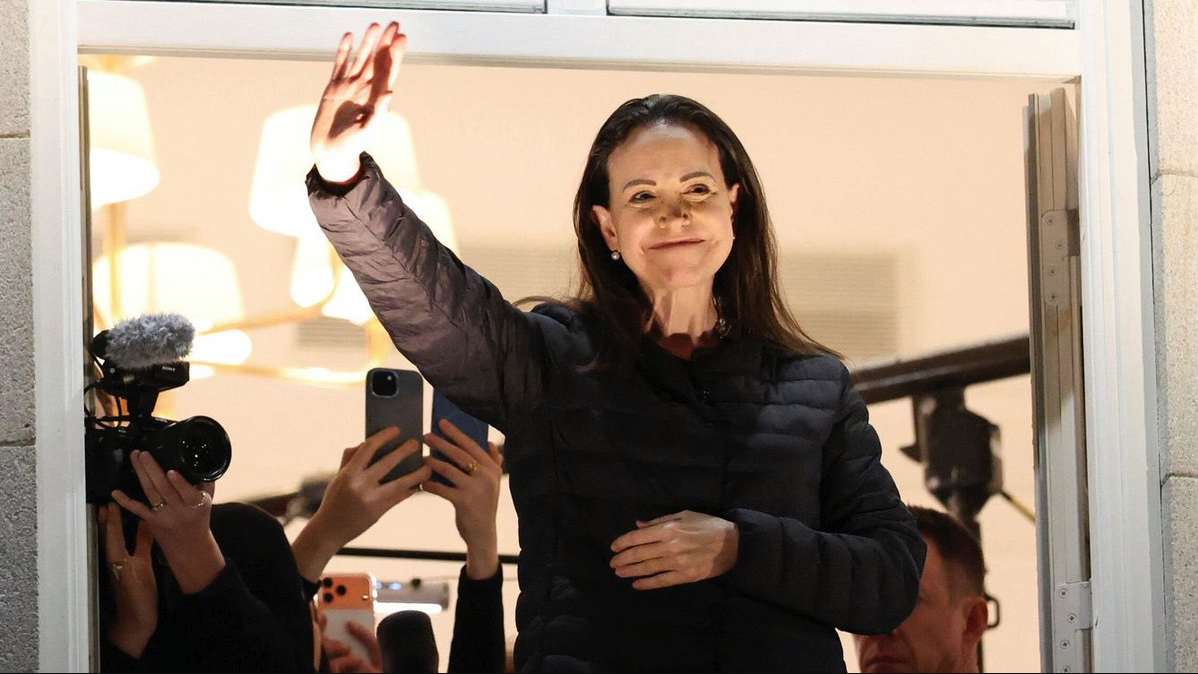
Recently, after living in hiding for sixteen months due to persecution by the Venezuelan government, María Corina Machado reappeared in Oslo—although she did not arrive in time—to receive the Nobel Peace Prize. Her merits in defending democracy in Venezuela are undeniable. The Norwegian Committee cited criteria such as the struggle for democratic rights, a “just and peaceful” transition, civic courage, and the unification of the opposition through the use of peaceful tools. However, the confrontational discourse of Machado and her international allies raises doubts about the coherence between her merits and the peaceful path that, in theory, earned her the award.
A political profile that goes beyond mere activism
Machado lacks the conciliatory traits required to bring together all the country’s different sensibilities. Venezuela’s roster of suitable opposition figures—equally seasoned in the struggle for freedoms—includes figures such as Gerardo Blyde (architect of the Barbados Agreement between the government and the opposition) or Manuel Rosales. Both have been targets of Maduro’s movement and carry in their DNA—and this aspect is decisive—the negotiating gene, an attribute Machado does not display.

And the fact is that Chavismo—no matter how much its detractors may regret it—has many supporters and still retains significant mobilizing capacity. It is therefore impossible to build a new country without its participation. Moreover, Venezuelan society is deeply polarized and perhaps the last thing it needs is a figure who divides it even further, such as Machado—especially when her political affinities are taken into account.
Courted in Europe
Machado has shifted from a conservative tendency (European liberalism/neoliberalism) to frequenting the global far right. In 2024 she drew closer to the Ibero-American far-right project Iberosphere, linked to Spain’s Vox party. And from February 2025 onward, Machado positioned herself more clearly by participating in “Europe Viva 25,” the summit of the Patriots for Europe (PfE) held in Madrid. The Patriots are a constellation of far-right European parties, very powerful in the European Parliament. At this forum, Machado and Milei were the star guests invited by Santiago Abascal (Vox). PfE includes parties such as Viktor Orbán’s Fidesz, Marine Le Pen and Jordan Bardella’s National Rally (RN), the Dutch Geert Wilders’ Party for Freedom (PVV), and Matteo Salvini’s League (Lega), among others, with Benjamin Netanyahu’s Likud as an observer.
At the convention—whose slogan, “Make Europe Great Again,” leaves little to the imagination—the cream of the continent’s far right was present, seasoned leaders in dismantling European democracies. The speakers’ narrative delved into the old litany of ultranationalist victimhood. Their bête noires are global multilateral institutions such as the UN, the WHO, or the ICC, as well as the European Union and Muslims.
Machado thanked the forum for the invitation and welcomed the “awakening of European societies” and their appreciation of freedom, hinting at a retreat of democracy in Europe. Nor was there any lack of jubilation—shared by those present—over Donald Trump’s return to the White House. As for Netanyahu, the relationship is longstanding: at the time she congratulated him on his “decisive actions” in the “war” in Gaza and has promised to move Venezuela’s embassy in Israel to Jerusalem, which would violate international law.
U.S. interventionism, or how to restore a democracy through authoritarianism
Machado firmly supports a return to the old interventionist policies of Uncle Sam in Latin America championed by Trump, whom she considers the best opportunity for “change” in Venezuela and the bearer of a courageous stance in U.S. policy toward the country.
The Venezuelan leader regards the U.S. Caribbean strategy as “absolutely correct,” including extrajudicial killings of alleged drug traffickers in the Caribbean, which contravenes the Declaration of Human Rights. At the same time, she courts Trump with access to Venezuelan oil and promises multi-billion-dollar business opportunities for the United States.
Bellicose rhetoric and calls for “international” intervention
Years earlier, in 2018, Machado invoked Article 187 of the Venezuelan Constitution to request “an international peace mission,” citing the “responsibility to protect, applied, for example, in Kosovo in 1998–1999.” She also appealed to the TIAR (Inter-American Treaty of Reciprocal Assistance), a Cold War defensive instrument, to assemble an international coalition to carry out a “Peace and Stabilization Operation” in Venezuela, with a regional allied multinational force.
After the start of Trump’s second term, Machado has made repeated references to Maduro’s imminent downfall, the near arrival of “freedom,” and her detailed plans “for the first 100 hours and the first 100 days of the transition.” She has also promised that Venezuela will “soon be the United States’ greatest ally in the region.”
Where there’s smoke, there’s fire
The signs are not few. Trump has declared Maduro a terrorist, closed Venezuelan airspace, and deployed the U.S. fleet in the Caribbean—actions that demonstrate, at the very least, military intimidation. Machado, for her part, appeals to the “actions of President Trump” and to the Venezuelan armed forces to support him. And although she avoids speaking of invasion, her adviser Pedro Urruchurtu believes that Maduro cannot be overthrown without the use of force.
After receiving the prize, Machado turned Oslo into a political lectern with scarcely veiled calls for U.S. intervention, urging “decisive” Trump “actions,” and asserting that “Venezuela is already invaded by Russian and Iranian agents, terrorist groups, and drug cartels,” and that “60% of the population works” for the latter.
The Nobel Peace Prize certainly does not fit someone who, like María Corina Machado, projects a decidedly aggressive discourse. The laureate does not exude fraternity, but rather the invasion of one country by another in the name of a supposed struggle for democracy, thereby legitimizing the agenda of the new Monroeism of the Trump administration. Her tools are thus implements of war, not of peace.
Autor

Historian and PhD in Legal and Social Sciences specializing in the Balkans from the University of Malaga. Master's degree in History from the University of Granada.