While some countries in this leading Caribbean bloc embrace U.S. power, others seek to limit its reach, leaving the rest to scramble for the middle ground.
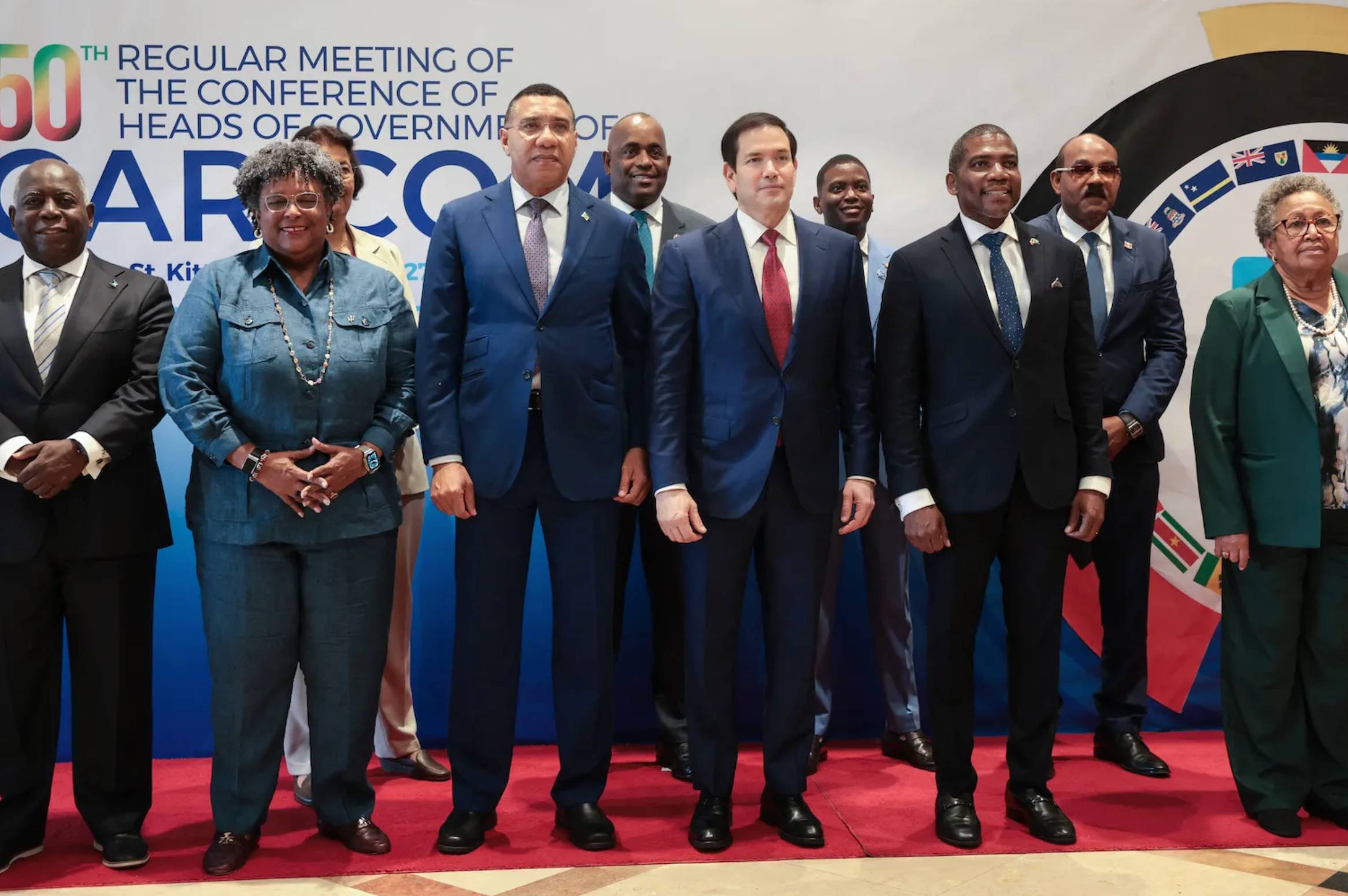
The Caribbean Community (CARICOM) bloc is increasingly divided over how to manage U.S. power: while some member states court the strategic benefits of U.S. power, others seek insulation from its asymmetric consequences, and a final group seeks to navigate a diplomatic middle course.
Founded in 1973, CARICOM brings together 15 Caribbean nations to advance regional integration, coordinate foreign policy and pool their collective strength on economic, social and security challenges.

With the unique exception of Haiti, whose independence dates to 1804, its 14 sovereign member states gained political independence between the 1960s and 1980s. Against that historical backdrop, the bloc’s founding treaty enshrines the coordination of member states’ foreign policies as a core pillar.
The widening foreign policy divide within CARICOM centres on a fundamental question: should its member states seek greater protection and leverage through multilateralism and collective action, or work pragmatically with prevailing centers of power? At stake is a broader question of how small states can exercise greater agency as the international system becomes more multipolar: by reshaping the rules and institutions that structure global power, or by working within them and leveraging relationships with the states and institutions that already shape those rules. In that calculation, the United States looms large.
Barbados’ Prime Minister Mia Mottley has emerged as a leading proponent of the former vision, while Trinidad and Tobago’s Prime Minister Kamla Persad-Bissessar increasingly personifies the latter. The respective visions exemplify two competing models of small state agency: Multilateral Transformation (championed by Mottley) and Pragmatic Power Leverage (championed by Persad-Bissessar), which I outline elsewhere.
As CARICOM member states diverge in their approaches to U.S. power, great-power competition and multilateralism, sustaining coordinated foreign policy becomes more difficult. The problem is not that member states pursue different strategies: their interests, vulnerabilities and relationships with Washington are not identical. It is whether CARICOM can manage those differences without losing its capacity to coordinate positions where collective action would strengthen its members’ bargaining power.
This divergence is not entirely new. Since independence, CARICOM member states have sought to preserve strategic autonomy through multilateralism, non-alignment and the principle of sovereign equality, even as geographic proximity and economic ties have made the United States an indispensable partner. The 1983 invasion of Grenada exposed the limits of that consensus: some Caribbean governments supported the intervention, while others condemned it as a violation of sovereignty. What distinguishes the current moment is not the existence of disagreement over Washington, but the geopolitical context in which those disagreements must be managed and the potential consequences for regional coordination.
The Trump administration has tested CARICOM’s longstanding diplomatic playbook in new ways, while its increasingly assertive approach to hemispheric affairs has placed renewed pressure on the region’s commitment to strategic autonomy and sovereign equality.
The asymmetry is longstanding. What is changing is the character of U.S. power, the strategic environment in which CARICOM must manage that asymmetry, and the consequences of failing to coordinate its responses.
Renowned International Relations theorist Stephen M. Walt’s article “The Predatory Hegemon,” published in Foreign Affairs earlier this year, offers a useful analytical lens for examining how weaker states respond to a dominant power: by bandwagoning with it, hedging between competing powers, or balancing against it. Applying that framework to the national statements delivered by 14 CARICOM member states during the General Debate of the 81st Session of the United Nations General Assembly reveals a broad pattern in how this bloc of small states is positioning itself toward the United States.
These categories are analytical, describing the dominant tendency evident in each state’s recent diplomatic positioning rather than fixed foreign policy identities.
Guyana and Trinidad and Tobago have moved most clearly toward bandwagoning, seeking greater agency by deepening their security and strategic relationships with Washington. Their security, economic development and international positioning are increasingly framed in ways that accommodate U.S. preferences.
Trinidad and Tobago, in particular, has shown an unusually explicit willingness to accommodate Washington’s preferences. Guyana offers a clear illustration of how security dependence can translate into diplomatic signalling aligned with a dominant power.
The Bahamas, Jamaica and Belize occupy a more fluid middle ground, cooperating closely with the United States where their interests converge while preserving room for manoeuvre through CARICOM and multilateral institutions.
Dominica, St. Kitts and Nevis, Saint Lucia and Suriname also display elements of hedging. These states combine practical engagement with Washington and resistance to aspects of its agenda, preserving diplomatic flexibility where their interests diverge.
Haiti is its own case, with its relationship with Washington shaped by severe constraints on strategic choice.
Barbados, Grenada, St. Vincent and the Grenadines, and Antigua and Barbuda have pursued institutional or “soft” balancing, using multilateral institutions, international law and the principle of sovereign equality to preserve autonomy from U.S. power.
CARICOM’s divergent responses to U.S. power reveal a central tension in small state diplomacy. Governments may gain room for manoeuvre individually by deepening bilateral relationships, hedging against uncertainty or relying on multilateral institutions. Yet these strategies can carry collective costs when they weaken the bloc’s capacity to coordinate positions on issues of shared concern.
CARICOM must therefore overcome its collective-action problem: not by eliminating strategic differences among its members, but by developing ways to manage those differences while preserving—and mobilising—the advantages of regional cooperation.
That imperative has acquired greater urgency amid geopolitical fragmentation, intensifying great-power competition and uncertainty about the rules and institutions governing international relations.
CARICOM’s member states differ in their interests, capabilities and external dependencies, so their responses will not always align. But these differences make coordination more important, not less.
The bloc’s challenge is to prevent competing national strategies for pursuing agency from undermining its capacity to act collectively where interests converge. Given the political sensitivities surrounding this divide and its high-profile nature, overcoming CARICOM’s collective-action problem cannot be left to the grouping’s Council for Foreign and Community Relations alone. It requires heads of government to lead the charge, providing the political direction and commitment needed to manage differences among member states and translate regional solidarity into sustained political leverage.
Autor

Outgoing Director of the Diplomatic Academy of the Caribbean, part of the Institute of International Relations at the St. Augustine Campus of The University of the West Indies (The UWI), Trinidad and Tobago. Holds a PhD in Political Science from York University, Toronto.