The South American ratifications of the Mercosur–European Union agreement allow us to observe how the logic of regionalism in the region is changing. In an international context marked by growing geoeconomic rivalries, Mercosur appears to operate less as an expression of deep political convergence and more as an institutional tool that states turn to in order to manage strategic vulnerabilities on the global stage.
For more than three decades, the agreement between both blocs advanced and retreated in step with regional political changes and the oscillations of the global order. The announcement of a principle of agreement in 2019 seemed to mark a turning point after twenty years of negotiations. However, the initial enthusiasm quickly faded in the face of environmental objections in Europe, changes of government in South America, and an increasingly unfavorable international climate for trade liberalization, among other factors.

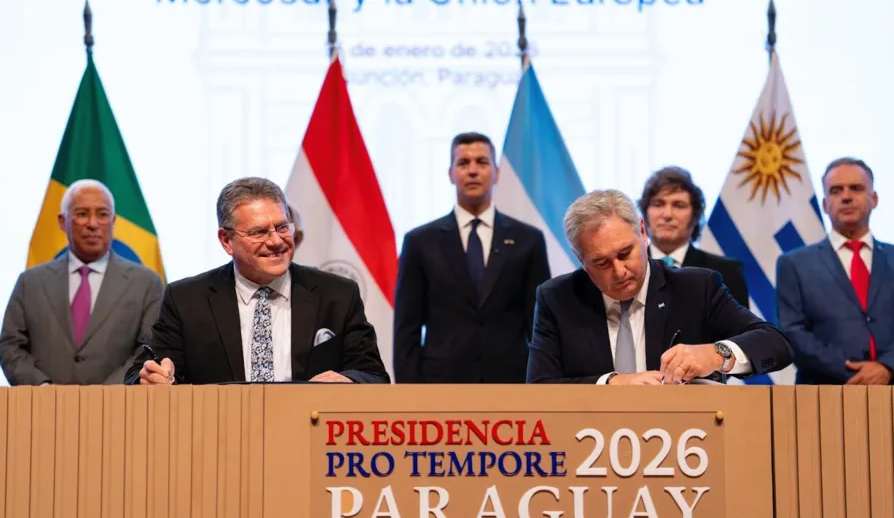
Seven years later, the scenario shifted again. Following the signing of the historic agreement in January 2026, Uruguay and Argentina approved it in February. Brazil advanced it with partial approval in the lower house, and Paraguay began its legislative process. In parallel, the European Commission announced its intention to accelerate the provisional application of the treaty, considering it a strategic priority.
Within this framework, we must ask: why now? What implications do these developments have for South American regional integration?
A threatening international environment
Between 2019 and 2026, the global environment changed profoundly. China consolidated its economic presence in South America and became the main trading partner of several countries in the region. Global value chains began to reorganize around criteria of economic security rather than efficiency. The United States and the European Union strengthened industrial reshoring policies and expanded the use of trade measures justified on national security grounds.
However, the return of Donald Trump to the presidency in the United States and the increase in tariffs on European products—along with a sharp rise in friction in transatlantic relations—pushed the European Union to diversify partners and accelerate pending agreements. In that context, advancing the agreement with Mercosur acquired additional value for Brussels as a way to secure markets and strengthen economic alliances in an increasingly uncertain trade environment. In this setting, trade agreements ceased to be mere instruments of economic openness and became true tools of geopolitical positioning.
A regional paradox
The progress of the Mercosur–European Union agreement occurs, paradoxically, at a moment of limited political coordination in South America. Regionalism is going through a phase marked by divergent national agendas, weakened institutions, and the absence of regional leadership capable of articulating a common project. Far from a renewed integrative impulse, the ratification process appears to be unfolding in a context of political fragmentation.
The positions of Mercosur presidents reflect this diversity. For Lula da Silva, the agreement is an opportunity to expand Brazil’s industrial development. For Javier Milei, it represents a strategy for Argentina’s reintegration into global trade. Yamandú Orsi interprets it as a pragmatic avenue to expand Uruguay’s external options, while Santiago Peña presents it as a platform to attract investment to Paraguay.
Rather than a shared vision regarding the direction of Mercosur, what emerges is a circumstantial convergence of national interests. Each government interprets the agreement through different domestic priorities, yet all find in it a useful instrument to improve their international room for maneuver.
In this sense, the point of convergence lies not so much in a common idea of regional integration as in the perception that acting through Mercosur allows countries to at least partially cushion the vulnerabilities each faces individually in an international system increasingly laden with threats.
The new use of regionalism
Here lies the most significant transformation. Regional integration ceases to operate as a political project with intrinsic meaning and instead functions as an institutional device available for differentiated national objectives.
Mercosur no longer acts as a source of shared preferences. It functions as a diplomatic and legal infrastructure that enables collective negotiation in a world of blocs, trade tensions, and strategic competition.
In this context, Mercosur acquires a function that goes beyond the traditional logic of integration. Its value lies less in deepening regional convergence than in offering a platform from which South American countries can negotiate, protect interests, and reduce exposure costs in the face of a more demanding international environment.
Regionalism under pressure
The progress of the agreement shows that coordination of regional actions can persist even when political cohesion is limited. The ratification process in South America offers a glimpse into the extent to which institutions can survive ideological cycles and continue to provide frameworks for collective action even when political consensus is weak.
This has important implications. These types of developments suggest that the future of South American regionalism may depend less on large shared political projects than on its practical utility in the face of an increasingly threatening international environment.
In a global order marked by geoeconomic rivalries, technological competition, and trade fragmentation, countries in the region face well-known structural vulnerabilities: economies heavily dependent on primary exports, exposure to financial shocks, and limited capacity to influence the definition of global rules. In that context, Mercosur retains a relevance that does not necessarily stem from political cohesion among its members, but from the institutional scale it offers for operating in a more competitive international system.
The ratifications of the Mercosur–European Union agreement reflect precisely this logic. They do not announce a relaunch of South American regionalism, but they do show that regional institutions remain a resource available when the external environment becomes more demanding.
Autor

Doctoral candidate in International Relations and CONICET, doctoral fellow at the Faculty of Political Science and International Relations of the National University of Rosario, Argentina. Focuses on South American regionalism and international financial governance.