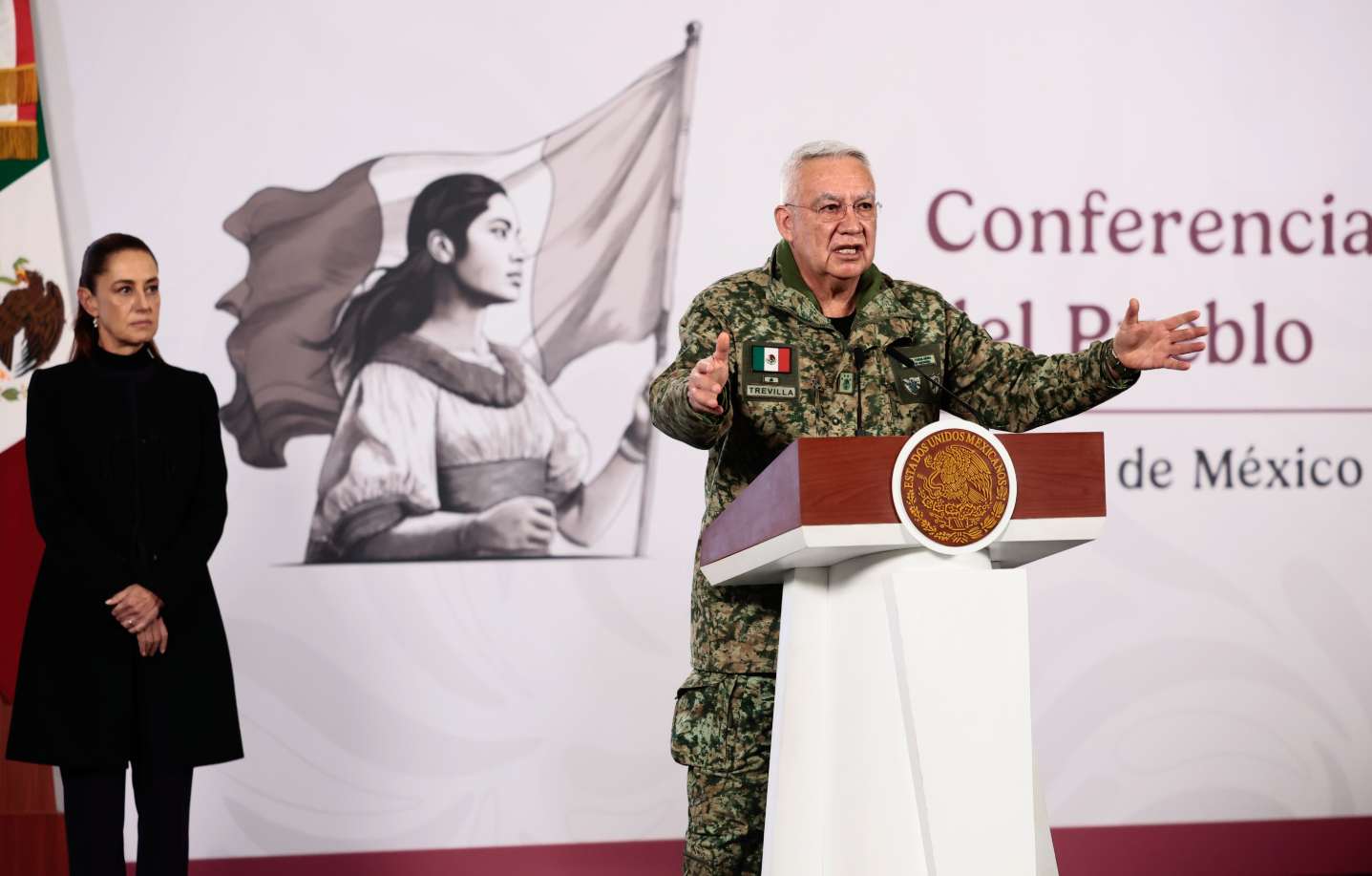
In the days following the killing of Nemesio Oseguera Cervantes, “El Mencho,” public debate focused almost automatically on the immediate consequences of the operation. Attention centered on two fronts: on the one hand, the internal reconfiguration of the Jalisco New Generation Cartel (CJNG), and on the other, the impact of this blow on the relationship between the Mexican government and the United States. However, beyond the immediate context, the underlying question is another: can this tactical victory become an opportunity for the concentration of power in the Mexican Executive under the argument of national security?
The immediate public support for the operation in Tapalpa, Jalisco, is a relevant data point. According to a survey by GobernArte S.C., 82.4% of respondents “fully approved” of the military intervention. This legitimacy is understandable in a country exhausted by violence. But it is also the political capital that enables the deepening of exceptional measures. When citizens perceive concrete results such as the fall of the “most wanted criminal,” the margin expands for the Executive to strengthen the coercive apparatus of the state without facing significant resistance.

Comparative experience shows that the centralization of power rarely appears as an abrupt rupture. It is built gradually, under a narrative of necessity. Greater military presence in public security tasks, increased budgetary discretion for the Armed Forces, expanded intelligence powers, and direct coordination with external actors without robust parliamentary oversight. All of this can be justified as indispensable to confront a threat that, far from disappearing, could intensify.
In this sense, Oseguera’s fall does not close the cycle of violence; it likely reconfigures it. Long Latin American experience teaches that when a cartel leader falls, different regional leaders face a dilemma: wait for the emergence of a new command that preserves unity, or break away to compete for territories and criminal markets. This process of fragmentation is usually more violent than the stage of hegemony.
A recent precedent confirms this. The fracture of the Sinaloa Cartel, following the kidnapping and transfer to the United States of Ismael “El Mayo” Zambada, resulted in two factions, “Los Mayos” and “Los Chapitos,” which since September 2024 have been disputing control of the organization. The split not only fragmented the leadership but also dragged in regional actors and multiplied confrontations. Nothing suggests that the Jalisco New Generation Cartel (CJNG) is exempt from a similar process.
If the fragmentation of the CJNG leads to an intensification of violence in at least 20 states where red flags were raised after the fall of its leader, the argument for reinforcing militarization will gain strength. Road blockades by criminal groups, attacks against public institutions and private companies, and a growing toll of soldiers, National Guard members, and police killed in combat fuel the perception of an internal war. In such a climate, the demand for order tends to prevail over the defense of checks and balances.
To this picture is added the international dimension. The operation that culminated in Oseguera’s killing revealed close collaboration with the United States. The framework described by various analysts is clear: U.S. intelligence services conduct investigation and location tasks for “narco-terrorist targets,” process the information, and deliver it to the Mexican national security system, which executes the operations. Although U.S. agents do not appear publicly, strategic monitoring is close.
This cooperation marked a breaking point with the “hugs, not bullets” policy of the previous administration, associated with a containment strategy that, according to its critics, paralyzed the capture of major drug lords. The new approach bets on direct strikes and bilateral coordination. However, the strengthening of hemispheric security may have a collateral effect: consolidating a highly centralized model in which strategic decisions are concentrated in the Executive and the Armed Forces, with limited public debate.
The legitimacy of collaboration with Washington—especially if it produces visible results—reduces the incentives to discuss its limits. What oversight mechanisms exist? What role does Congress play in defining the strategy? How is it ensured that the expansion of military powers does not permanently displace civilian institutions? These questions tend to be sidelined when the priority is neutralizing immediate threats.
The risk is not cooperation itself, but its institutionalization without checks and balances. In a context where several institutions of the democratic transition have been weakened or captured, the expansion of military power can become structural. Even if there were partisan alternation, the inertia of a strengthened security apparatus with broad social backing could persist. Paraphrasing Fouché: governments pass, the military remains.
From a democratic standpoint, the most likely scenario is not the cancellation of elections, but the transformation of the political ecosystem. Elections may continue, but in an environment where key decisions—such as budget, intelligence, or internal security—are increasingly in military hands. The concentration of power does not always take the form of an institutional breakdown; sometimes it manifests as a silent reconfiguration of priorities and balances.
Faced with this scenario, the democratic camp faces a double challenge. On the one hand, recognizing the urgency of combating both old and new criminal organizations. On the other, preventing that urgency from becoming a permanent justification for the unlimited expansion of Executive power. The revitalization of public debate around institutional reforms and checks and balances is a sign that civic reserves still exist, but their effectiveness will depend on their ability to articulate a proposal that is not perceived as indifferent to insecurity.
Ultimately, the killing of “El Mencho” can be read as an operational success and, at the same time, as the starting point of a redefinition of the balance of power in Mexico. If violence intensifies due to the fragmentation of the CJNG and bilateral cooperation deepens with broad social legitimacy, the Executive will have both the incentives and the room to concentrate more powers. Latin American history warns that emergencies tend to expand state power beyond the circumstances that gave rise to them. Preventing the exception from becoming the norm is, today, the central task of Mexican democracy.
Autor

Professor at the Universidad Autónoma de Sinaloa. D. in Political Science and Sociology from Universidad Complutense de Madrid. Member of the National System of Researchers of Mexico.