
In 2025, Brazilian media repeatedly broadcast images of Brazilian migrants deported from the United States arriving on charter flights. Based on figures published by the Federal Police and other federal agencies, the press described the deportations as a “historic record.” Since then, contradictions in the official deportation data have become increasingly apparent. Yet public debate has progressed little beyond the visual impact of the arrivals and the figures released by the federal government.
Brazil is not an isolated case. Several Latin American countries have received deportees from the United States on charter flights. As such, it serves as a warning to consider how other governments in the region have also produced and disseminated these records.

Against this backdrop, and in light of the aggressive deportation campaign promoted by Donald Trump’s current administration, we ask why these “official figures” display such significant discrepancies. We also ask whether these inconsistencies contribute to consolidating a regional far-right coalition marked by xenophobia. It remains to be seen whether the so-called progressive governments of countries such as Brazil, Colombia, and Mexico truly represent a counterweight to this scenario.
Post-truth?
Since October 2019, Confins Airport, in the state of Minas Gerais, has received ICE (Immigration and Customs Enforcement) charter flights carrying Brazilians deported from the United States. At the beginning of 2025, one such aircraft made an emergency landing in Manaus, Amazonas, where some of the migrants were seen handcuffed and shackled, walking along the plane’s wings. The images sparked widespread national outrage and prompted the Brazilian government to take a more active role in receiving this population. From that point on, the source responsible for releasing deportation figures also changed.
Until the Manaus incident, Confins Airport’s communications and press office had provided these data. Afterward, the airport stopped publishing the information, arguing that media coverage of deportees was damaging its image. Since then, the Federal Police, the Ministry of Human Rights (MDHC), and the Ministry of Foreign Affairs (Itamaraty) have begun supplying the figures. What was unexpected, however, were the contradictions that emerged in these data—contradictions that would be legitimized by sensationalist and distorted media narratives.
Reports published in early 2026 by Grupo Globo, ICL, and UOL emphasized that 2025 had set a record for the deportation of Brazilians from the United States. According to the Federal Police, a record 3,294 Brazilians were deported in 2025. CNN Brasil reported that 2,262 Brazilians had been deported that same year.
Was 2025 really the year with the highest number of deportations on record? According to figures we obtained directly from the Federal Police through Brazil’s Access to Information Law (LAI), the answer is no.
In fact, these figures differ from those that mainstream media outlets claim to have received from the Federal Police. In 2022, there were 4,516 deportations—a figure significantly higher than that of 2025 and 3,093 more than the total the Federal Police reportedly provided to Globo.
Yet the discrepancies among the figures and the Brazilian federal institutions involved do not end there. The Ministry of Foreign Affairs (Itamaraty) also presents different numbers. According to Veja, 2,785 deportees from the United States were reported in 2025, compared to 1,640 the previous year.
Unlike the Federal Police and Itamaraty, our database is fully transparent. It began in 2019 based on information provided by Confins Airport and, since February 2025, has incorporated data from the Ministry of Human Rights in partnership with the International Organization for Migration (IOM), which assumed this role that year. Below, we present a chart that brings together the conflicting sets of official figures and compares them with those of the Deportation Observatory:
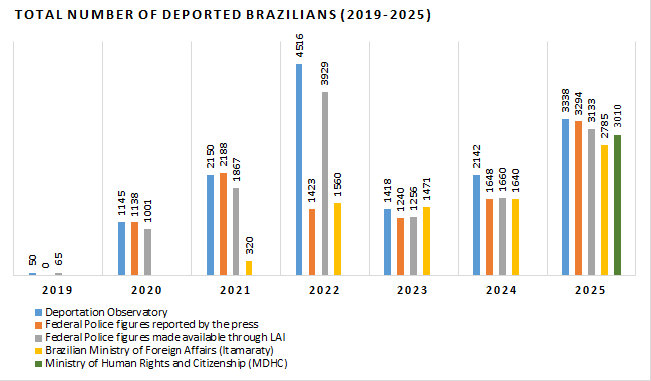
As of May 20, 2026, 16,132 Brazilians had been deported through Confins Airport. In October 2019, for example, Federal Police data obtained through the Access to Information Law recorded 65 deportees—not zero, as some reports suggested. Although the 2022 figure is lower than the one we received from the airport, it still exceeds the alleged 2025 “record” widely reported by the Brazilian press. What impact do these figures have on the narratives we construct about the Trump and Biden administrations’ approaches to migration management? What are the implications in an era of scientific denialism and post-truth politics? What commitment does the Brazilian state have to accurately documenting this population?
In interviews with UOL and TV Globo’s Jornal Hoje in January, we pointed out the contradictions in the official figures. We also highlighted that the Federal Police had disregarded the 2019 data and had emphasized an alleged deportation record in 2025 in the information provided to the media. As demonstrated here through official figures, 2022 was actually the year with the highest number of deportations. Both media outlets chose to ignore these inconsistencies and instead reproduced the data supplied by the Federal Police.
What have we learned from COVID-19?
We are not just numbers. Six years after deportations began, the Brazilian state still does not provide a consolidated official public figure. The Ministry of Human Rights, the Federal Police, and Itamaraty all present different and contradictory data. Only the Ministry of Human Rights explicitly identifies its sources, relying on information from the IOM. Even so, its records contain significant gaps and fail to include, for example, a Gol Airlines flight that landed on October 28, 2025, carrying 128 deported Brazilians. The Federal Police and Itamaraty do not even explain how their figures are compiled.
National media outlets, in turn, reproduce the data from these three institutions without examining the contradictions among them. Sensationalist headlines and articles lacking proper analytical rigor are published on a large scale. What does it mean to erase the record of 50 deported people in 2019, or 3,093 in 2022? What have we learned from the COVID-19 pandemic and from the government that so scandalously manipulated victim statistics? How many more lives can be ignored?
The issue becomes even more serious when we consider that Confins Airport is not the only destination for Brazilians deported from the United States. There are also Brazilians expelled through so-called “self-deportation” programs, as well as those who, upon entering Mexican territory, are forced to return because of the “Remain in Mexico” policy.
To what extent do these inaccurate figures on deported Brazilians reflect the true scale of Brazilian deportations since Donald Trump’s first term in office?
In this regard, the work of the Deportation Observatory has critically examined official records, gaps, and omissions related to the deportation of Brazilians from the United States, even though we are not an “official” government source. By exposing these contradictions, we seek to strengthen investigative journalism in dialogue with the public engagement of the social sciences.
Autor

Professor at the State University of Montes Claros - UNIMONTES (Brazil). PhD in Sociology from Goldsmiths University of London. Specializes in international migration of Brazilians and border regimes.

Anthropologist and visiting professor in the Postgraduate Program in History at the State University of Montes Claros - Unimontes (Brazil) and Coordinator of the Observatory of Deportations, funded by CNPq.