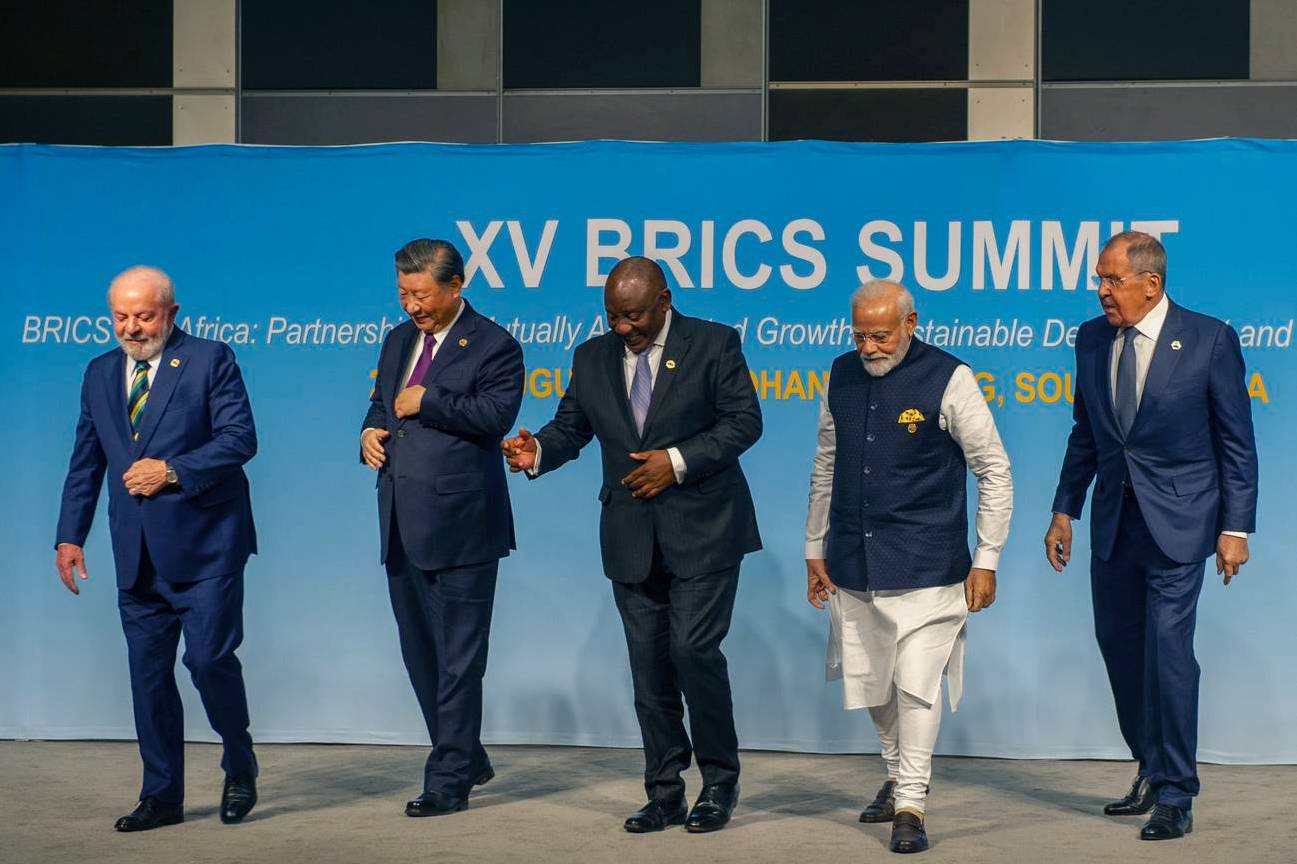
The Global South has never been talked about so much. China claims membership despite being the world’s second-largest economy; India aspires to become one of its voices; Brazil has incorporated it into its international discourse; and the BRICS are making that identity an increasingly important part of their narrative. Yet no one can say precisely where it begins and where it ends.
Are we facing a new international actor, or a category that catalyzes real transformations in global power? Expert Juan Agulló, coordinator of CLACSO’s Advanced Diploma in Geopolitics, argues for reclaiming the concept: “the West,” too, has no stable borders, and that does not prevent us from using it as a geopolitical category. The Global South, he argues, is a “definitively evolving” category, with a genealogy that runs through the Non-Aligned Movement, the G77, and debates over the center and the periphery. Its imprecision, therefore, does not make the concept useless.

The fact that the Global South can function as an analytical category does not make it a monolithic political actor. The countries encompassed by the term have different political regimes, extraordinarily unequal levels of development, and economic and strategic interests that often clash with one another. Yet several of its leading members are competing to represent that identity.
The concept of the Global South long predates China’s rise, but Beijing has an obvious interest in consolidating it as a political identity and defines itself as part of it. India, for its part, has organized successive summits under the name Voice of Global South, while Lula’s Brazil has also incorporated that identity into its international projection as a middle power, representing the Global South from the West.
The paradox is clear: those seeking to represent the Global South are also competing with one another for markets, investment, technology, and influence. Beyond the category’s difficulties, there are material transformations that help explain why it has acquired such prominence.
The return of materiality
During the decades of globalization, a certain illusion took hold that distance, borders, and the location of resources had lost their relative importance. Recent hot wars, sanctions, the competition between the United States and China, and the vulnerability of supply chains have forced us to look at the map again: Suez, Malacca, Panama, the Red Sea, and the Black Sea are once again part of the conversation. Globalization did not eliminate geography; rather, it built an enormous infrastructure that depends on it.
Raw materials have also returned to companies’ spreadsheets and to public-sector planning. Oil and gas remain strategic, but electrification and digitalization have increased the importance of lithium, copper, nickel, cobalt, graphite, and rare earths.
A considerable share of critical mineral reserves and production is concentrated in developing countries. There is, however, a qualitative difference between possessing those resources and controlling the value chains. China holds dominant positions and operates at scale in the refining and processing of numerous strategic minerals, and it is precisely there that the resource is transformed into industrial and technological capacity.
According to Mónica Bruckmann, co-coordinator of CLACSO’s Advanced Diploma in Geopolitics, “abstract subjective elements are also changing: cartography is an expression of power as well. The maps that for centuries placed the North Atlantic at the center are beginning to coexist with representations in which the Indian and Pacific oceans occupy a central position.”
While Agulló introduces an important qualification regarding geography, recovering its importance does not mean returning to the determinism of old geopolitics: “The materiality of the twenty-first century is also made up of deep-water ports, roads, power grids, the internet, and global value chains.” Territory matters, but so does what makes it possible to connect, exploit, process, and transform it into economic capacity.
Some territories are even beginning to acquire value not only because of what they produce today, but because of what they preserve for a more uncertain future: water, biodiversity, food-production capacity, minerals, or energy. A kind of geopolitical “Noah’s Ark.”
The Latin American paradox
Latin America possesses an extraordinary endowment of resources needed for the energy transition and the digital economy, yet it generally remains stuck at the earliest stages of many production chains. Having something the world demands does not necessarily mean being part of the decision-making circle that sets the rules of the international game. Bruckmann frames this as a paradox: “China represents a great opportunity that we are letting pass us by because, to a large extent, we continue to think in terms of the primary-export model, which was the logic imposed from the beginning of the colonial period and from which we still have not freed ourselves.”
The question, then, is not only who possesses lithium, copper, or rare earths, but also who has the capacity to transform them and capture greater value. “It is essential to have strategic plans and concrete policies to implement those plans,” Bruckmann argues, citing the case of Indonesia, which restricted exports of unprocessed nickel ore as part of a downstreaming strategy aimed at promoting refining and manufacturing in order to capture greater value locally. The policy triggered a trade dispute with the European Union and was challenged before the World Trade Organization, but it demonstrates something fundamental: possessing a resource and using it as an instrument of industrial policy are two different things.
More options, greater autonomy?
The rise of China (and the dynamism of India) has introduced another transformation. For many countries that for decades depended on a limited number of markets, technology suppliers, and sources of financing, the map of alternatives has expanded. Traditional ties with the United States and Europe are now joined by China and other Asian actors, new financing mechanisms, and different avenues for cooperation. The result is a system with more interlocutors and potentially greater room for choice.
Agulló sees the BRICS as a particularly interesting manifestation of this new configuration, which he sums up provocatively: “the BRICS are not the Soviet Union,” since their members have different and sometimes conflicting interests. India and China compete; energy producers and consumers pursue different objectives, and their relationships with the United States are not equivalent either. Yet these divergences do not prevent selective agreements: India cooperates with China within the BRICS while, at the same time, participating in the Quad alongside the United States, Japan, and Australia.
Perhaps this represents an important transformation from the logic of the Cold War. Autonomy would no longer necessarily have to mean aligning with no one. It may consist of selectively aligning with different actors according to specific interests.
But even multi-alignment has limits: as a decision approaches the core strategic interests of a major power, the room for autonomy can narrow rapidly. The recent controversy between the United States and CALF, the largest electricity distributor in Argentina’s Patagonia, offers a small illustration. The cooperative reported U.S. pressure over the possibility of contracting Huawei technology for technological infrastructure in a region particularly sensitive because of its proximity to Vaca Muerta. Washington considers the Chinese company a threat to its national security.
The rivalries between China and the United States draw red lines that, for now, come at a high cost to cross. The episode calls for caution: having more suppliers, investors, and partners increases the available options, but it does not necessarily eliminate hierarchies.
Autor

BA in Political Science from the University of Buenos Aires (UBA), specialization in International Relations, diploma from the INCAP School of Government. Analyst at the Institute for International Security and Strategic Affairs (ISIAE/CARI).