The government’s approval ratings foreshadowed Lula’s defeat, and the first round seemed to confirm it. What turned the election around was not a marketing formula but the fear of losing, in a race where rejection weighed as much as approval.
On the eve of the runoff, the polls gave Luiz Inácio Lula da Silva about 49% of the valid vote. The ballot box gave him 51.8%, three weeks after he had finished 2.2 million votes behind Flávio Bolsonaro. A well-known rule of electoral marketing says you should announce that your candidate is ahead, because that supposedly attracts votes. This election showed that this is not always so: here, the engine of victory was defeat.
What approval explained
Political scientist Alberto Carlos Almeida proposed in his book A cabeça do eleitor (The Voter’s Mind) a rule as simple as it is effective. When the share of people rating the government excellent or good exceeds 45% or 50%, the incumbent side is the favorite, and below 40% the advantage lies with the opposition. In 2026 the rule pointed to the opposition, with a government that Datafolha put at 35% approval in mid-October. The qualitative research we carried out at IPSE Global with LabDes/UNIRIO between November 2025 and September 2026 showed this from the inside. Voters did not know how to defend continuity or why the government deserved to stay, except by opposing bolsonarismo, and this was reflected in approval.

Those same conversations, and the polls that put rejection of Lula at 46% and of Flávio at 44%, pointed to another decisive variable. Almeida’s model is correct and sufficient in elections with moderate rejection, but when both candidates exceed 40%, the vote against the opponent becomes as predictive as the government’s rating, or more. Scholars Alan Abramowitz and Steven Webster described this as negative partisanship in the United States, and David Samuels and Cesar Zucco showed it in Brazil in their study of antipetismo.
Circumstances before technique
Many analysts describe the comeback as if there were a technological formula capable of producing it. What made it possible were the circumstances and the role each actor played in them. Heading into the first round, the government had spent almost four years without communicating what it had done, which left its activists with no arguments to defend it. The first-round campaign was triumphalist, built on attacks on Flávio and on the agendas of the Supreme Federal Court and the Vorcaro case, which ended up wearing down the government itself.
The main opposition candidate embodied radical change in a system that does not satisfy people, as the qualitative research also showed. And lulismo’s talk of winning in the first round left its activists passive and complacent, with a decentralized and disorganized campaign across the country.
The first-round result changed the roles. Rejection of Flávio and the arguments accumulated against him gave activists a reason to mobilize. The presidential campaign was centralized and began to communicate material deliveries, which in the qualitative research appeared as what mattered most to voters. Lula made new deliveries in the middle of the campaign, on ground where his opponent could not compete, and moved the contest from the field of corruption, where his name was still associated with Lava Jato, to that of achievements, where Flávio had no way of winning.
Moreover, not just any leader could have headed this movement with the same historical legitimacy that Lula has, with all his capacity to move his followers.
A common enemy and a leap into the void
The cold shower was that the opponent had received more than half of the votes. Initial dismay was followed by fear. Many saw a Flávio Bolsonaro government in scenarios ranging from a dictatorship or a dictablanda, a soft dictatorship, to twenty years of the far right in power without alternation.
Scholars Daniel Kahneman and Amos Tversky showed that losses weigh more than equivalent gains, and here the benefit of continuity was uncertain while the likely damage of defeat seemed unbearable. Anxiety, which according to American political scientists George Marcus, Russell Neuman and Michael MacKuen, authors of the theory of affective intelligence, breaks habits and forces people to pay attention, had a precise object: a common enemy presented as an enemy of the country and an ally of a foreign enemy, whose victory would be a point of no return, a leap into the dark.
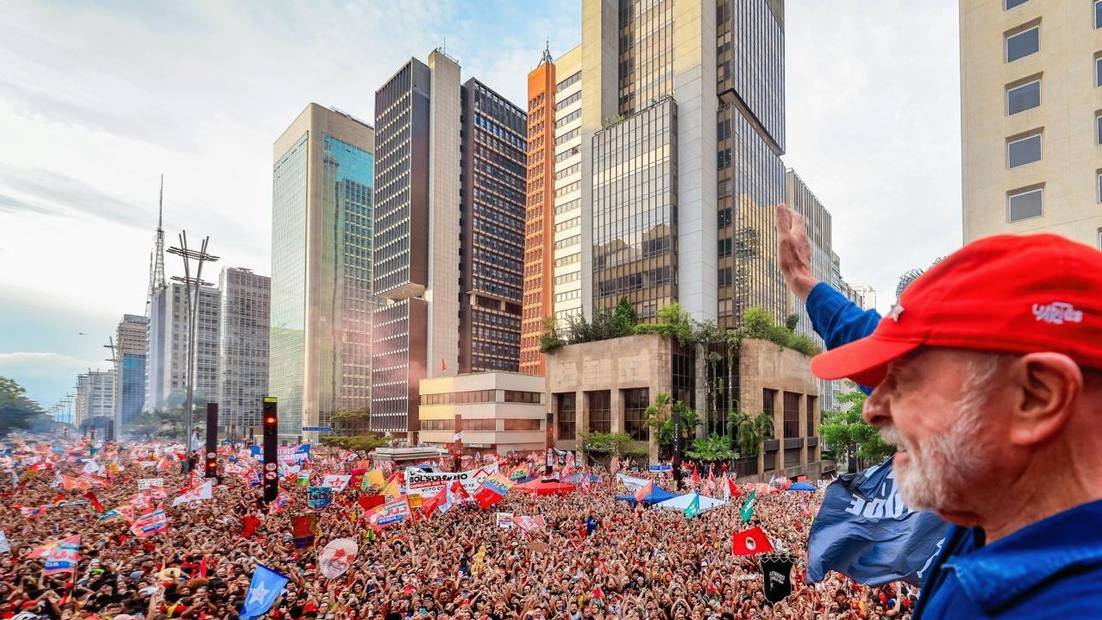
At the same time, the gap was small. Winning over some of those who had abstained would make victory possible, and that light at the end of the tunnel turned fear into energy. Activists held on to that margin and fought to the end in what was probably the largest mobilization in the country’s history. The vote is secret, but it is possible to estimate how voters moved by comparing first-round and runoff results polling station by polling station, a technique known as ecological inference. According to IPSE Global’s calculation, of the roughly 11 million votes Lula added, 4.6 million came from other candidates, 3.8 million from people who had not voted and 3.1 million from blank or spoiled ballots.
Where technique did count
Technique mattered in the conducting. On the very night of the first round, congressman André Janones created the WhatsApp channel Exército do Lula (Lula’s Army) and acted as its conductor. The tone was playful, cartoonish and fun, with gamification, concrete and cheap missions, and the metaphor of war as a frame, with ranks of generals and soldiers, clear roles and imagery that was easy to activate. Between October 18 and 25 it issued 130 missions. The system of targets was decisive. Targets that seemed hard were met at astonishing speed and gave people hope. And the next ones, even more ambitious, were reached just as easily and fed the enthusiasm.
The channel never sought to win over undecided voters or abstainers. Its game was to spread and intensify the work of the activists themselves in the real world, in the street, in the family and at work. The aim was to create a wave and carry others along until it reached those who were not planning to vote for Lula.
What the models have to learn
At IPSE Global we measured this movement in public social media posts, where Lula’s camp went from 41% to 65% of interactions and rejection of Flávio from 30% to 56%, and we fed it into a simulation with more than seven million agents. With the polls alone, the model gave Lula a 27% chance of winning, in line with the country’s main models, which put it between 16% and 30%. Including political communication and mobilization in the predictive model raised Lula’s probability of victory to 47%, the closest to the result among the predictive models published before the runoff vote. According to our post-election calculation, adjusting the model to give political communication more weight in the formula would have made it possible to anticipate the winner with a 61% probability.
Autor

Executive Director of the IPSE Intelligence research institute. Researcher in public opinion, discursive framing in the media and computer sciences.