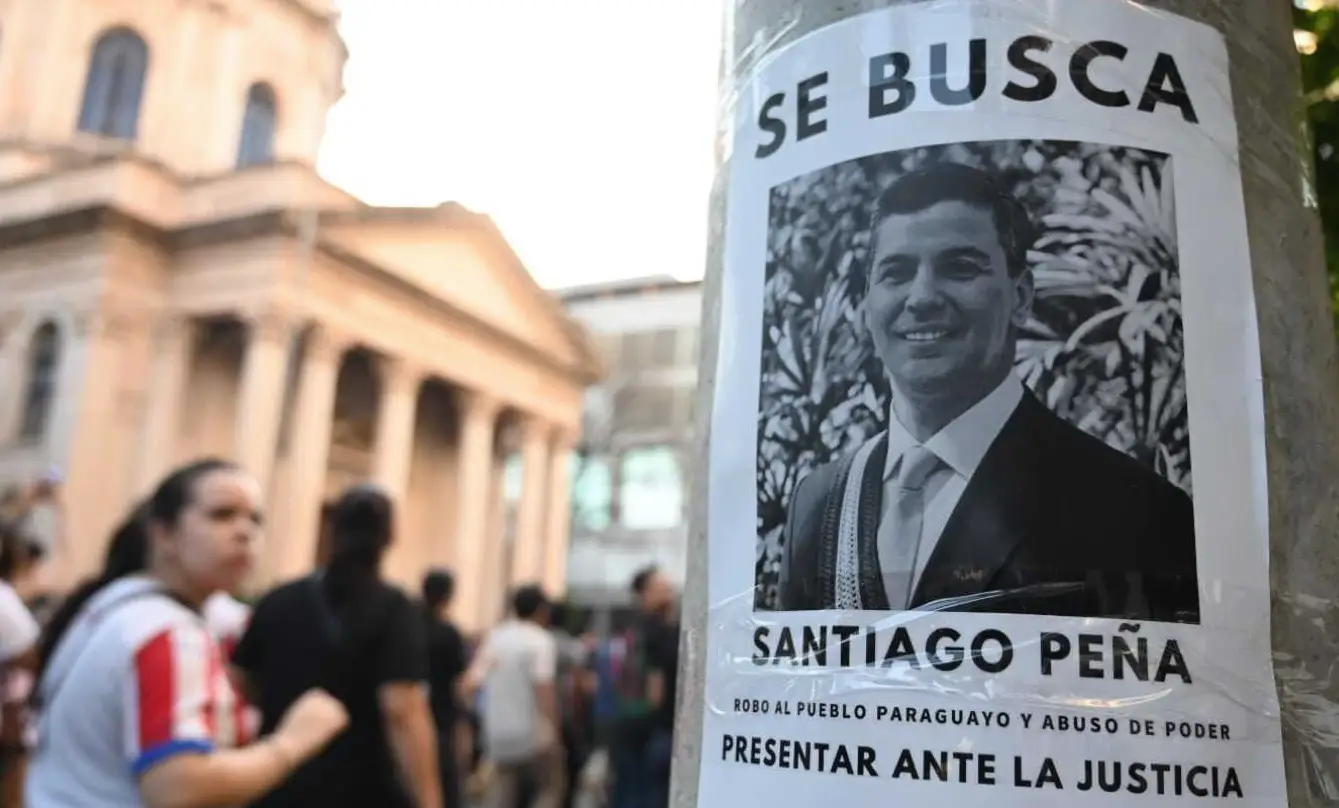
Santiago Peña’s resignation as president of Paraguay adds another name to Latin America’s infamous list of failed presidents: leaders who have been unable to complete their constitutionally mandated terms without a democratic breakdown occurring in their countries.
The crisis was triggered by the collapse of Ueno Bank, announced on November 3. The savings of approximately three million customers were frozen, an enormous figure considering that Paraguay’s total population is 6.1 million. On top of that, Ueno Bank managed US$355 million belonging to the Social Security Institute (IPS), as well as the pension payments of more than 30,000 retirees.
The now-former president had investments in Ueno Bank and faced questions over a conflict of interest in 2024, prompting him to sell his stake during the first half of 2025. The bank’s collapse and the resulting corralito—the freezing of bank deposits and restrictions on withdrawals—sparked protests outside Ueno Bank branches and the National Congress.
The situation quickly escalated into a political crisis because of the connection between Peña and Ueno Bank. Opposition lawmakers and members of the “Colorado Añetete” dissident faction of the Colorado Party—the ruling party—announced that they would initiate impeachment proceedings to remove him from office. As protests continued, on the morning of Thursday, November 5, Horacio Cartes—a former president of Paraguay and, significantly, leader of the ruling “Honor Colorado” faction—announced on social media that he would support the impeachment effort.
The current crisis has several distinctive features. First, it represents another case in which a Paraguayan president’s premature departure has been caused or hastened by conflicts within the governing party or parties. This happened in 1999, when Raúl Cubas resigned amid impeachment proceedings against him and following an intense conflict with his vice president, Luis María Argaña, also a member of the Colorado Party, who was subsequently assassinated. Something similar occurred in 2012, during the “express” impeachment of Fernando Lugo, which was supported by lawmakers from the Authentic Radical Liberal Party, the strongest party in the governing coalition led by the former bishop. In 2019, lawmakers from the Colorado Party itself initiated impeachment proceedings against Mario Abdo Benítez, also a Colorado, but the process was ultimately called off when it appeared increasingly likely that Abdo Benítez would be removed from office.
Second, Peña’s departure ranks among the fastest in the region’s history. Presidents generally resist leaving office and exhaust every available option to remain in power. Dilma Rousseff, for example, faced numerous impeachment petitions. The request was formally accepted in late 2015, subsequently approved by the Chamber of Deputies in April 2016, and finally resulted in her removal by the Senate in August. In Ecuador, Abdalá Bucaram was in power from August 1996 to February 1997. Even during such a short presidency, a series of events—mainly corruption scandals and mass protests—had to unfold before Congress removed him from office, declaring him “mentally unfit” to govern. Only Fernando Lugo comes close to matching the speed of Peña’s departure: his impeachment trial lasted less than 48 hours in June 2012.
The weak institutionalization of Paraguayan political parties, despite their remarkable longevity, is one reason the country’s presidents have repeatedly faced crises. When parties are weakly institutionalized, they have less capacity and willingness to manage—and, especially, to absorb—shocks that threaten government stability. This was the case, for example, with Alberto Fujimori in 2000, during the “vladivideos” scandal. Having governed Peru for ten years in the face of a weakened opposition, Fujimori had no institutional support or backing to help him weather the scandal, which precipitated his resignation from Japan by fax.
Something similar has happened in Paraguay. First with Lugo, who was swiftly removed in the aftermath of the Curuguaty massacre on June 15, 2012, for which he was held politically responsible—more as a pretext than anything else. His defeat in Congress was overwhelming. Now, Santiago Peña managed to hold on for barely two days after the collapse of Ueno Bank became public.
In this way, Peña joins the long list of failed presidents. The previous president to fall was José Jerí in Peru, in early 2026. Peña now becomes number 27 on the list.
The crisis is unlikely to end anytime soon. Protests over people’s savings will not simply stop because Peña has resigned. Meanwhile, Horacio Cartes, as leader of Honor Colorado, Colorado Añetete, and the opposition remain locked in a tug-of-war over possible impeachment proceedings against Peña. It remains to be seen, therefore, whether the former president will be able to avoid an even more difficult situation involving the courts. That will depend on whether his resignation is formally accepted, allowing him to become a senator and acquire the corresponding parliamentary immunity.
Autor

Ph.D. in Political Science from Loyola University Chicago, United States. Researcher at the Faculty of Economics and Government of the Universidad San Sebastián. Partner and Director of Policy at StreamData, and Alternate Director of the Millennium Nucleus on Political Crises in Latin America – CRISPOL.