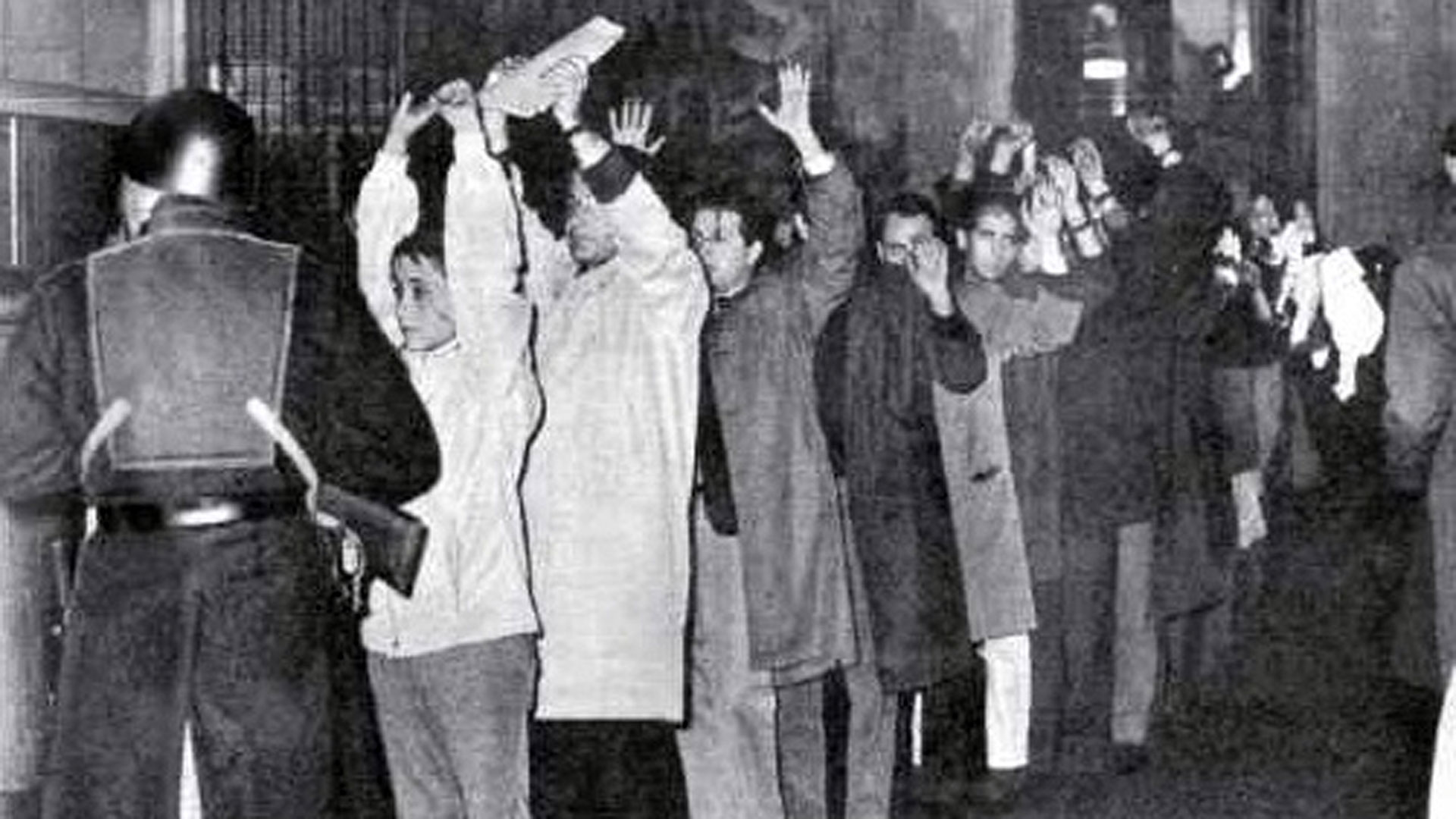
It was cold that afternoon. The typical July cold in Buenos Aires. The classrooms, nonetheless, had that human warmth that offered a special kind of shelter. And something was boiling over in the university halls. Autonomy was being debated, sovereignty was being debated, as were the purposes of public education and science. Suddenly, blows and screams erupted inside the buildings, and the faculties were besieged by the Federal Police, armed with batons that would inflict wounds destined to last forever, particularly in a field about which little has been said.
The context in Argentina and the region
The de facto government of Juan Carlos Onganía, installed following the coup d’état that, one month earlier, had overthrown the democratically elected president Arturo Umberto Illia, had dismantled the university structure by dissolving governing bodies and replacing university authorities with government-appointed intervenors. This dictatorship, self-styled as the “Argentine Revolution,” was established in accordance with the National Security Doctrine that the United States imposed on Latin America during the Cold War as part of its political-military strategy. The intervention in the universities pursued, among other objectives, the attempt to eliminate the supposed “internal enemy,” represented by students and faculty researchers who were rethinking their role and that of the institutions. Universities were undergoing a period of modernization and raising questions about what kind of science should be pursued in the interests of knowledge sovereignty. This represented a risk to U.S. interests. It was also an undesirable example for the region, since Argentine university movements, beginning with the 1918 University Reform, had influenced other countries in the Southern Cone.

The consolidation of the global environmental agenda and the silencing of science in Latin America
Argentina was immersed in this ferment of debates over what kind of education and science should be prioritized for sovereign development, and the Night of the Long Batons would have a devastating effect. The repression unleashed on July 29, concentrated primarily in the Faculties of Exact Sciences, Architecture, Philosophy, and Engineering, triggered a wave of resignations by university authorities and faculty members, which in many cases would lead to stories of exile. This diaspora resulted in a reconfiguration not only of laboratories and research institutes, but also of regional scientific collaboration networks.
At the time, ecology was an emerging science around the world and was undergoing profound changes. Until then, it had focused primarily on the study and description of species and populations, and was beginning to shift toward the study of global changes and the pollution, erosion, and degradation of ecosystems. This new research model became consolidated through funding from U.S. agencies, in what came to be known as the era of “Big Ecology,” which included the International Biological Program (IBP) and several projects funded by the United States Atomic Energy Commission in strategically located areas. It was also influenced by growing citizen mobilizations against environmental degradation, such as the first Earth Day, backed by President Richard Nixon in the United States, and, in 1972, the United Nations Conference on the Human Environment, held in Stockholm. The environmental issue, intertwined with pacifist demands and calls for planetary awareness, thus became firmly established in the late 1960s and early 1970s.
However, while in the Global North this growing concern for the environment strengthened ecology as a scientific field, in Latin America the military dictatorships set the process in the opposite direction. Repression at universities interrupted the development of ecological science, which until then had followed a trajectory converging with the evolution of the discipline worldwide. Ecology here was inconvenient for the interests of the National Security Doctrine promoted by the United States. The conditions for producing knowledge were systematically dismantled, opening gaps that would prove difficult to close and revealing the strategic dimension of this process.
It is impossible to separate the persecution of scientific thought from the economic model that those regimes sought to consolidate. For the extractivist economy promoted and sustained at the time, a science capable of measuring environmental degradation, demonstrating the impacts of natural resource exploitation, and potentially challenging that development model was deeply inconvenient. Latin America thus became consolidated as a double sacrifice zone. On the one hand, our territories and natural resources were surrendered to extraction for the development of the Global North; on the other, ideas were forced into exile, silence, and interruption. As wealth was extracted, a wound was also carved into the capacity to produce knowledge—a wound that continues to bleed to this day.
A logic of censorship and persecution renewed
Today, 60 years after the events of the Night of the Long Batons, Latin America finds itself at a similar crossroads, where education and science are once again being subjected to persecution and dismantling. Over the past decades, ecological sciences in Latin American countries have been examining the effects of neo-extractivism on socio-ecosystems. Descriptions of the negative effects of open-pit mining, large-scale agricultural production, and the energy transition in the Global North on countries of the Global South are central findings of (socio)ecological research.
Addressing these issues is an unavoidable component of local scientific agendas, in line with research agendas and the work of scientific and governmental bodies at the global level. Initiatives such as the Intergovernmental Panel on Climate Change (IPCC) and the Intergovernmental Science-Policy Platform on Biodiversity and Ecosystem Services (IPBES) now face a reality of discrediting, defunding, and hollowing out by the United States, once their promoter.
Some regional governments share this climate-change denialism, and even reject the limits that science places on the sustainable use of natural resources or the commons. The word sustainability was, in fact, included in the National Intelligence Plan (PIN) of the Argentine intelligence services in May 2025. Its directives target and place under surveillance scientific advocates who call for biodiversity conservation and the protection of the oceans, organizations and researchers involved in sustainability studies, and others who might pose an obstacle to the exploitation of mineral or oil resources.
Today, various state science and technology agencies face restrictions on using terms such as climate change. These developments are clearly concerning and represent contemporary ways of restricting science’s ability to address problems that are uncomfortable for the dominant model to confront. Such guidelines may be the result of new policies coordinated among the governments of Latin America’s new right-wing movements and the intensification of the U.S. government’s imperialist actions in the region, including the New Condor Plan and the Shield of the Americas. They may also be new bleeding wounds in our scientific systems, like those inflicted 60 years ago, whose scars remain in the form of collective memory.
Autor

Biólogo. Investigador y Profesor en el Instituto Multidisciplinario de Biología Vegetal (CONICET) y la Universidad Nacional de Córdoba, Argentina. Estudia efectos del uso del suelo sobre los servicios ecosistémicos, e interrelaciones a distintas escalas entre biodiversidad, alimentos, agua, salud y cambio climático.

Investigadora del Programa POSDOC-DGAPA de la Universidad Nacional Autónoma de México (UNAM), México.