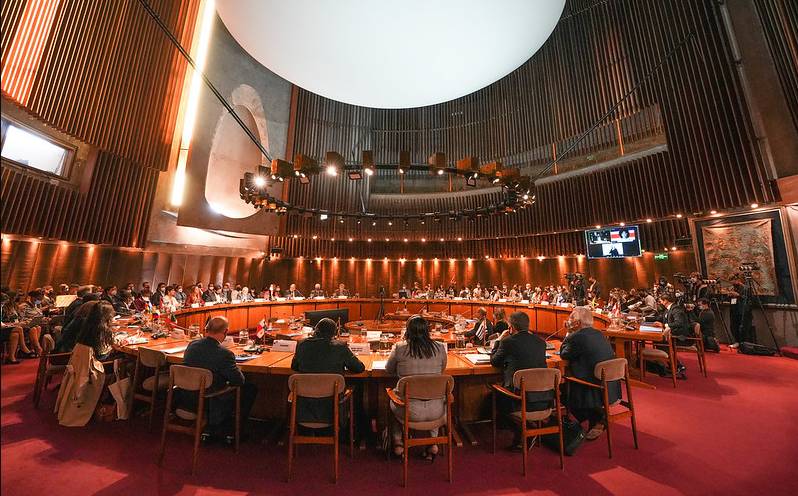
The vertigo of day-to-day events often obscures significant developments that are overlooked despite their commitment to rigorously analyzing a complex and heterogeneous situation. Moreover, there are economic institutions, such as the United Nations Economic Commission for Latin America and the Caribbean (ECLAC), whose fundamental role since its founding in 1948 has continued to be battered by the paroxysm of neoliberalism, taking a toll on its work over the past quarter century.
Along these lines is the recent document Ruptures and Opportunities: Proposals for Latin America and the Caribbean to Thrive in the New Geopolitical Era, produced by the ECLAC Commission on Geopolitics, Globalization and Development for Latin America and the Caribbean. It is a meticulous report that breaks down fundamental aspects of the region’s reality and its relations with the world.

Strengthening governance and institutions to promote development and bolster the region’s international standing is an issue deeply rooted in the ECLAC tradition, and the insistence on bringing it back to the forefront is commendable. Its main thesis is that the region’s strategic assets can only translate into development and international projection if effective governance exists. Without institutions capable of coordinating public, private, and social actors, these resources risk becoming sources of vulnerability or external dependence rather than engines of growth.
By positing that state capacity is no longer merely a contextual condition but a constitutive dimension of the development process itself, the report seeks to close the chapter on the period of neoliberal hegemony at the worst possible moment for doing so in decades in the region. This boldness is the report’s main asset.
The diagnosis begins with a “political economy of discontent”: over the past decade, the region has experienced a prolonged cycle of protests, electoral volatility, and systematic punishment of incumbent governments. The data show that opposition victories rose from around 44% during the commodities boom to 73% after 2014, pointing to a structural shift in political competition rather than simply a matter of alternation in power. These developments have manifested themselves as polarization, fragmentation, discontent, disengagement, volatility, the emergence of leaders without party affiliations, and widespread distrust of institutions and elites. All of this erodes the ability of democratic systems to sustain agreements, with a profound impact on their effectiveness in solving problems. This is the scenario I have already referred to as “fatigued democracy”.
The report also examines how the political institutions that structure relations between the Executive and Legislative branches within a presidential framework, increasingly disfigured party systems, courts, and social mobilization determine whether policies achieve continuity or are reversed with each electoral cycle. When the Executive branch lacks checks and balances, discretion is encouraged; when authority is excessively fragmented, paralysis prevails. Examples of the former, without leaving the democratic countries of Central America, can be found in El Salvador and Costa Rica, while Guatemala is an example of the latter, with Honduras and Panama occupying an intermediate position.
Institutionalized parties, legislatures with technical capacity, and a credible judiciary reduce volatility, as is the case in Uruguay and, to a large extent, Chile, while their weakness encourages short-termism and distrust, as occurs in Colombia, Argentina, Peru, and Ecuador. Political leadership plays an ambivalent role: it can expand the scope for reforms by building broad agreements, but when it replaces cooperation with the concentration of power, it favors short-term results at the cost of institutional erosion. The clearest example is Nayib Bukele.
Added to this is a growing fiscal constraint: regional public debt reached approximately 51.4% of GDP in 2024, and interest payments have come to exceed public investment, displacing resources that could otherwise be allocated to infrastructure or social inclusion. The region maintains a comparatively low tax burden and a narrow tax base. Once again, there is a call for the implementation of a profound and necessary tax system that places a greater burden on the highest incomes and reduces tax evasion. The awareness that broadening this base often faces strong political resistance linked to distributive conflicts and low levels of public trust in state institutions is a brake on change. At the same time, it provides a powerful argument for demagogues who warn potential voters that the money collected only serves to line the pockets of incompetent bureaucrats.
Based on this diagnosis, the report proposes four courses of action that should shape political and social deliberation.
The first seeks to strengthen state capacity through coherent governance. This entails empowering centers of government to set priorities and coordinate ministries; making strategic planning the organizing principle for budgets and accountability; professionalizing the public administration to retain talent and sustain reforms beyond changes in government; and institutionalizing strategic foresight so that states can anticipate transformations rather than merely react to crises.
The second course aims to restore institutional trust and legitimacy. Only 35% of the region’s population trusts its national governments, a figure linked to what the report describes as “performance fatigue”: promises that fail to translate into tangible results. The recommendations include improving the quality and equity of basic public services; strengthening integrity systems and independent oversight (lobbying regulation, asset declarations, oversight bodies protected from political interference); and expanding mechanisms for citizen participation with visible feedback.
The third seeks to build minimum consensus within the scenario described, which is characterized by enormous inequality. Here, the report advocates credible redistributive policies centered on universal public goods that reduce economic insecurity and the perception that politics is a zero-sum game. At the regional level, it proposes sustaining cooperation through functional and technical mechanisms, rather than ones based on ideological affinity, capable of withstanding changes in government.
The final course addresses the expansion of organized crime. The region, where this scourge tops the list of citizens’ concerns, accounts for nearly one-third of the world’s homicides despite being home to only 8% of the global population. Violence and the territorial control exercised by criminal groups replace state functions in areas of weak institutional presence. In contrast to the success of the “Bukele model,” which is highly tailored to a particular context, the recommendations include restoring state authority through an integrated presence combining different elements such as security, services, and economic opportunities; expanding economic and social alternatives for young people at risk of recruitment; dismantling illicit economies; and creating depoliticized coalitions to address the phenomenon’s transnational dimension.
Finally, the report frames governance as a space of political contestation rather than a merely technical problem, where tensions between rising expectations, limited capacities, and polarization explain why many reforms fail or are reversed even when they are technically sound. The real challenge for the region is not to achieve an ideal model of governance, but to expand the scope of what is politically viable, so that institutional commitments can be sustained over time despite the uncertainty of the new geopolitical order.
While the remarkable intellectual effort undertaken is indispensable for providing a roadmap for public action, the obstacles to its implementation are enormous. The current political moment is the least favorable for implementing an agenda of this kind. The “shield of the Americas” is opting for different courses of action, based on militarization, criminalization, and techno-feudal vassalage.
Autor

Director of CIEPS - International Center for Political and Social Studies, AIP-Panama. Honorary Emeritus Professor at the University of Salamanca and UPB (Medellín). Latest books: "El oficio de politico" (Tecnos Madrid, 2020), "Huellas de la Democracy Fatigada" (Océano Atlántico Editores, 2024) and "Cuando la política dejó de ser lo que era" (Océano Atlántico Editores, 2025).