It is well known that at a certain moment a relative consensus was established that the end of the twentieth century occurred around 1989. In this way, apparently a new order arose under the crucible of the consolidation of ideas that had been gradually taking hold. Democracy, the complex relationship between the market and society, pluralism, a certain sketch of international order. It is possible that the intellectual proclamations that enjoyed greater or lesser depth—sometimes crafted with ingenuity, at other times with arguments based on empirically grounded evidence produced with painstaking labor and methodological rigor—were too urgent. Eager to frame events within an all-encompassing general framework, they succumbed to occurrences that unfolded within a dizzying scenario.
It was not that the vicissitudes involved events that had not occurred before; what happened was that their reach consolidated a planetary dimension with generalizable implications for an unprecedented population approaching eight billion people, structured into political units whose number approached two hundred nation-states forged over the last two centuries of humanity’s course.

However, in less than two decades, 9/11, the economic-financial crisis of 2008, and the COVID-19 pandemic established a particular triangle. Within it, nation-states moved while confronting specific problems with varying degrees of impact on their inhabitants in relation to their identity definitions and bonds of coexistence, as well as to the level of satisfaction of basic needs. The management of conflict in societies that began to change exponentially as a consequence of the digital revolution intensified the practice of politics, lacking mechanisms with which to address the vertiginous scenario that had been established.
The end of an era is the mantra that accompanies practically every year of this century, so that one does not know what to rely on when defining that moment. Stefan Zweig is perhaps one of the most cited authors when the world of yesterday is invoked—one that at a certain moment ceases to be in order to give way to a new stage. But 83 years after his death, the world one invokes and upon which one evaluates the present is very different.
Yet the new era seems not to finish emerging, despite the fact that we write about it frequently and that there are proposals for all tastes that sketch more or less apocalyptic panoramas. The signals that are within our reach, but which we ignore, are silent. Little by little they have become extraordinarily commonplace. Have you taken the trouble to look at the corresponding labels attached to your Christmas gifts to find the name of the country of origin? Do you know the average amount of time you are connected daily through your cellphone? Are you aware of the diversity of data you provide free of charge about your decisions, tastes, displeasures, hobbies, hardships, satisfactions, about your habits? Simple gestures that can give you clues about the present and about the turbulent definition of the spirit of the time in which we live, and which we now need to define when it began.
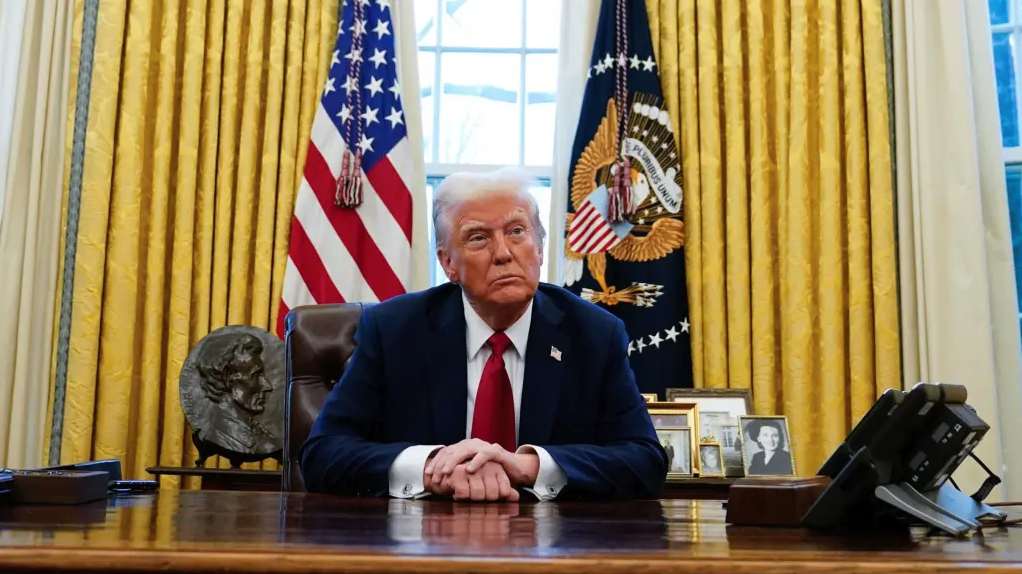
The so-called Trumpist disruption may warrant a reflection on the unrestricted decline of the legacy of the American dream in a context in which the supremacist actor himself has kicked over the board. It also leads to evaluating its projection onto European decomposition as a transatlantic alliance devised over three quarters of a century fractures. It likewise encourages analysis of the meaning of the return of the American friend in much of the continental backyard, where Nayib Bukele, Rodrigo Chaves, Daniel Noboa, Javier Milei, Santiago Peña, and now José Antonio Kast and Nasry Asfura are first-rate fellow militants, accompanying the timidity of José Raúl Mulino, Bernardo Arévalo, and Luis Abinader. They swell the roster of acolytes eager to share the table. There is nothing especially new in this, as the scheme harkens back to other bygone moments.
Brazil and Mexico have estimated populations in 2025 of 213 and 132 million inhabitants, respectively. They represent just over half of the population considered for Latin America, at 668 million. As is well known, Lula da Silva and Claudia Sheinbaum do not align themselves with the Trumpist disruption, although they suffer it. Something similar happens with Yamandú Orsi. Their political scenario is very different; certain doses of autonomy and the exercise of dignity appear, although they must also coexist with unfortunately long-standing issues in which violence and corruption are present. Nevertheless, for their citizenry the questions posed above would be equally applicable, undoubtedly yielding answers not very different from those of the rest of the neighboring countries.
Miguel Díaz-Canel, Daniel Ortega, and Nicolás Maduro are satraps who cling to power through different stratagems that inhibit any free and sovereign expression of the popular will. Their brutal, at the same time narcissistic, exercise of power is embedded in—and plays into—the hands of the most fanatical sectors inclined toward Trumpism, who see in it an erratic lifeline. Only for the millions of their fellow citizens who left their countries has the disruption of their life cycle had painful meaning.
Peru and Colombia will change their governments in the first half of 2026, with scant prospects of consolidating the end of an era, as was predicted on so many other occasions with meager results. Gustavo Petro and the successive Peruvian presidents will fall into oblivion, leaving behind confusion and disillusionment.
Everywhere there spreads a kind of militant alienation that does not seem to certify the birth of any new cycle, or at least not in the terms commonly used. Rampant inequality, the certainty of sustaining life, personal security, and minimum levels of dignity, as well as the difficulties in institutionalizing practices responsibly assumed by people, stand as the major argumentative axes of a desirable new era that remains perpetually pending its opening.
Autor

Director of CIEPS - International Center for Political and Social Studies, AIP-Panama. Honorary Emeritus Professor at the University of Salamanca and UPB (Medellín). Latest books: "El oficio de politico" (Tecnos Madrid, 2020), "Huellas de la Democracy Fatigada" (Océano Atlántico Editores, 2024) and "Cuando la política dejó de ser lo que era" (Océano Atlántico Editores, 2025).